Compare iKamper's published roof-rack load and crossbar-spacing requirements by tent family, including unresolved Skycamp 4.0 source differences.
On this page
iKamper Rooftop-Tent Rack Load and Bar Spacing Requirements
iKamper publishes model-specific minimum roof or rack load figures and crossbar spacing requirements. Those figures help you screen a proposed setup against iKamper’s instructions. They do not confirm that a particular vehicle or rack can carry the tent, and they do not grant permission to occupy a tent while it is parked. Check the exact vehicle, market, model year, roof equipment, rack, tent generation, and mounting hardware.
The values below come from the current iKamper FAQ, Skycamp 4.0 Trio Help Center guide, and Skycamp 4.0 Trio product page, checked on September 27, 2026. Where those pages disagree, the disagreement is shown rather than resolved by choosing one number. Ask iKamper which current instruction applies to your exact model and production version before buying or installing equipment based on a disputed value.
Requirements listed in iKamper’s FAQ
The current FAQ lists the following minimum roof or rack capacities for these tent families:
| Tent family | FAQ minimum | What to verify |
|---|---|---|
| Skycamp 3.0 and Skycamp 2.0 | 165 lb / 75 kg | Confirm the exact tent generation and how the applicable vehicle and rack manuals define their moving-load limits. |
| Skycamp 2X, Skycamp Mini, and X-Cover | 125 lb / 57 kg | For a Skycamp Mini, note the separate 22-inch minimum bar spread described below; other models use different fit details. |
| BDV Duo | 175 lb / 79 kg | Verify the exact BDV version and compatible rack and mounting hardware. |
| BDV Solo | 150 lb; FAQ pairs this with 55 kg | The pound and kilogram figures do not appear to be equivalent conversions. Confirm the intended requirement with iKamper rather than converting or selecting a value yourself. |
The FAQ gives a general crossbar spread range of at least 30 inches and up to 60 inches, with a 22-inch minimum exception for the Skycamp Mini. A spread figure alone does not show that the bars support the tent at the correct points, that the bar profile fits its clamps, or that the vehicle and rack are approved. See the bar measurement guide for the measurements to record.
Skycamp 4.0 pages currently disagree
The current Skycamp 4.0 Trio Help Center guide and product page do not give one consistent set of load minima or spacing values. The relevant sections also describe different checks, so do not combine them into a single approval threshold.
| Skycamp 4.0 model | Help Center guide | Product page | Reader action |
|---|---|---|---|
| Quad | FAQ: 180 lb / 81 kg | FAQ: 185 lb / 84 kg | Request written confirmation of the applicable minimum. |
| Trio | Mounting Requirements: minimum 140 lb; FAQ: 150 lb / 68 kg | FAQ: 155 lb / 71 kg | The guide’s separate mounting minimum and FAQ value differ from each other and from the product page. Confirm which requirement applies to the exact unit and setup. |
| Duo | FAQ: 135 lb / 61 kg | FAQ: 140 lb / 64 kg | Request written confirmation of the applicable minimum. |
The Trio’s spacing information also varies by section. The Help Center mounting section gives 22–60 inches; its FAQ says at least 30 inches, with 60 inches as the maximum. The product page’s technical specifications say 24–49 inches, while its FAQ gives 30–60 inches. The sources do not explain whether these ranges refer to different reference points or conditions. Measure the installed bars as each current instruction defines them, then have iKamper confirm the relevant range before relying on an edge value.
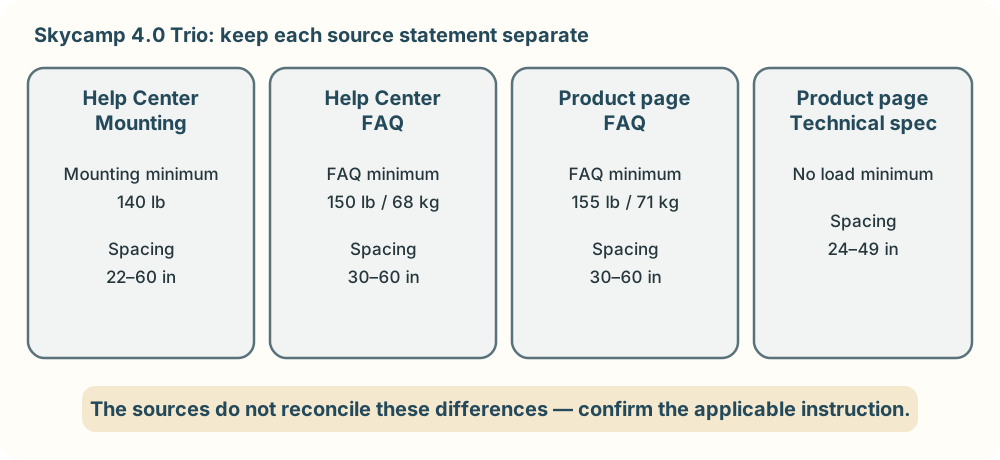
These are live-page statements, not a substitute for the manual included with your tent. Product pages and online instructions can change, and a named model may have revisions, market differences, or bracket requirements. Save the response or instruction revision that matches your equipment. If the sources remain inconsistent, treat the requirement as unresolved and do not use the most permissive number as a pass.
Keep tent requirements separate from vehicle approval
A tent maker’s minimum requirement is only one input. First find the vehicle maker’s roof-load limit for the exact model year, trim, roof option, and market. Check what that limit includes and whether rack-system mass must be subtracted. Then check the installed rack, feet, fit kit, platform, adapters, and any applicable tent requirements. Use each source’s own definitions and apply the lowest compatible limit after accounting for the complete moving load.
Do not convert a dynamic driving limit into a parked capacity by applying a multiplier. A parked or static figure must come from an applicable source that covers the vehicle and equipment, and it does not by itself establish permission to sleep in a rooftop tent. If vehicle instructions do not address occupied parked use, ask the vehicle maker and equipment makers for guidance on the exact configuration. The dynamic and static load guide explains how to keep these questions separate; the vehicle and rack eligibility guide provides a full setup check.
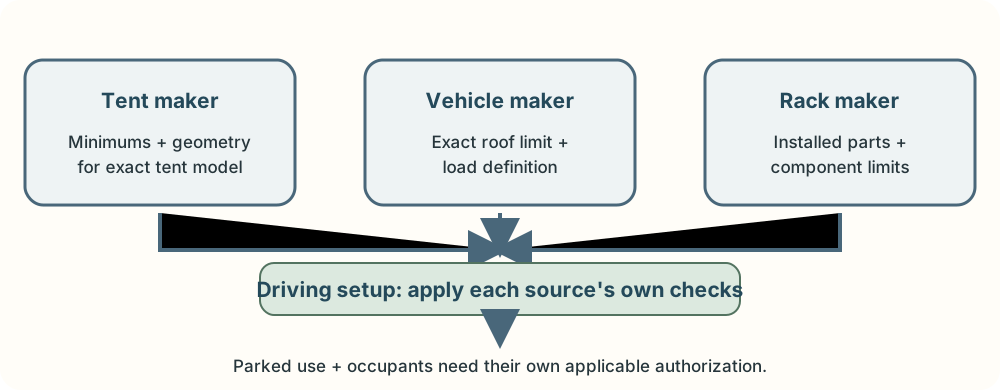
Before purchase or installation, record the tent model and revision, vehicle configuration, rack parts, bar spread in the required reference direction, bar width and height, mounting interface, and written answers to any open source conflict. Check that the tent rails are supported at the specified positions and that clamps or brackets match the bar profile. If the instructions do not agree or omit a necessary measurement, pause and get confirmation instead of treating an incomplete lookup as evidence of fit.
Sources and product references
Use these references to check the current instructions and fit information for your market and exact setup.
- iKamper Frequently Asked Questionsprimary
- Skycamp 4.0 Trio Guideprimary
- Skycamp 4.0 Trioprimary