Check the exact vehicle, roof, rack, tent, load limits, and mounting instructions before treating a rooftop-tent setup as suitable.
On this page
Can Your Vehicle and Roof Rack Carry a Rooftop Tent?
A vehicle’s rack lookup, a tent’s weight, or a large parked-load figure cannot answer the whole question on its own. You need a documented path for the exact vehicle and roof, the installed rack or platform, the tent and its mounting hardware, and the loads for both driving and camping. If one of those pieces is unknown, treat the setup as unverified until the relevant manufacturer or a qualified fitter confirms it.
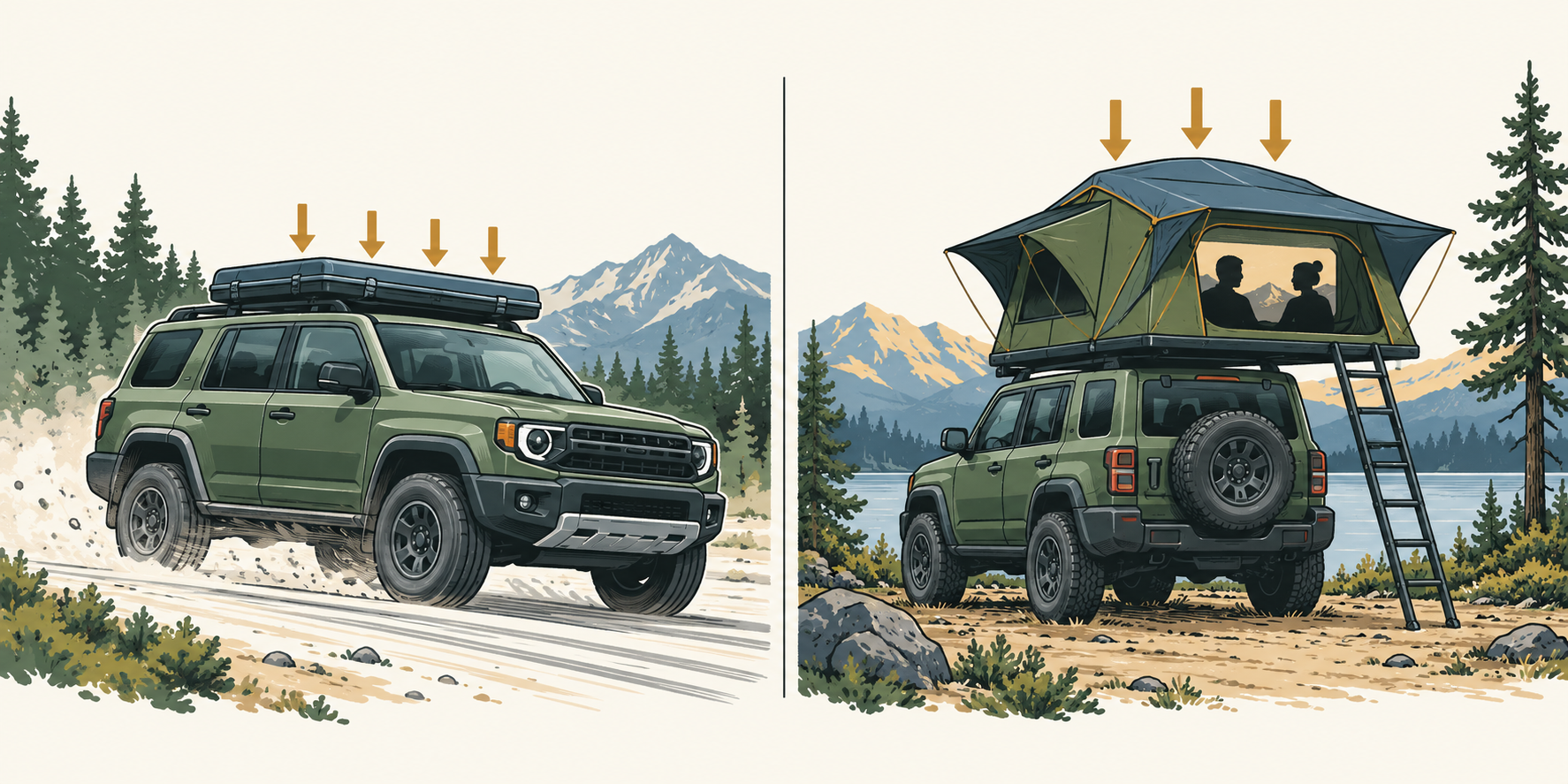
1. Identify the vehicle and roof exactly
Write down the market, model year, make, model, trim or body, roof type, and factory roof equipment. Raised rails, flush rails, fixed points, factory crossbars, tracks, and glass or panoramic roofs can change which rack systems are allowed. Check the owner’s manual for the exact vehicle and roof configuration. Do not transfer a limit from a similar model, a different year, or another market.
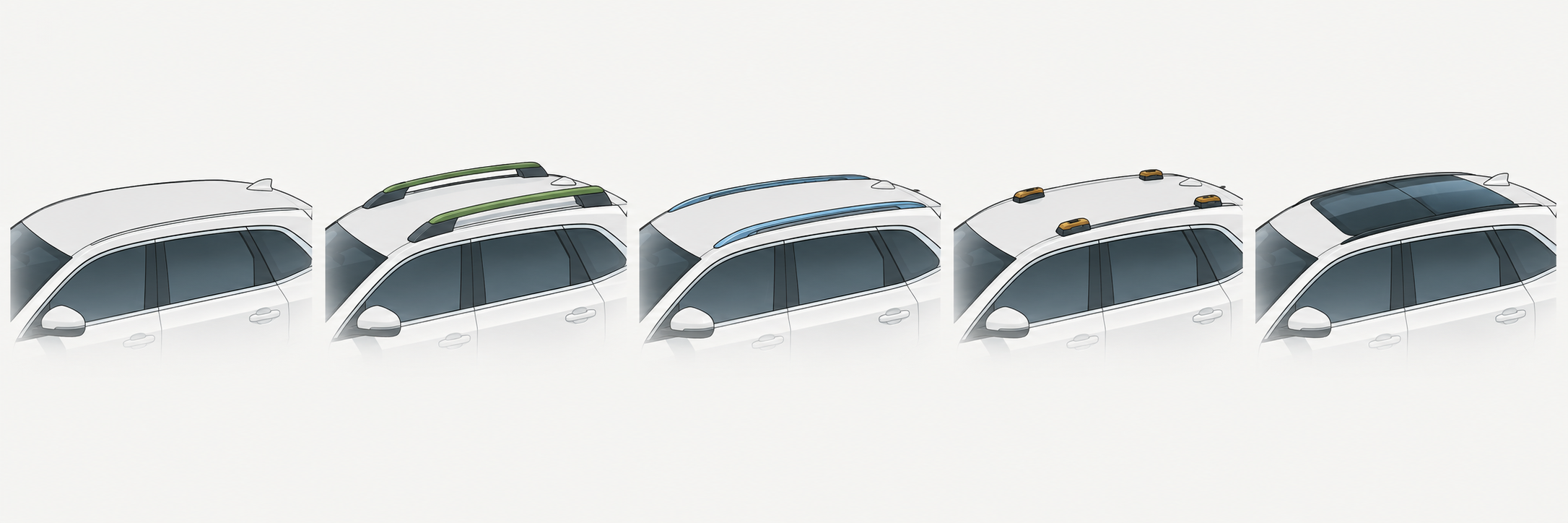
For example, Subaru’s 2026 Crosstrek accessory brochure excludes Base trim from its tent listing. That detail shows why “it is a Crosstrek” or “it has rails” is not a complete fitment identity. Compare the 2025 US Crosstrek listing and 2026 Crosstrek listings only for the model year and market they describe.
2. Confirm the whole mounting path
Match the vehicle-specific feet, fit kit, crossbars or platform, tent brackets, and tent model. Check that every maker permits its part to be used with the next part in the path. A product-family statement such as “fits most vehicles” is a starting point, not a result for a particular roof and rack.
Some fit tools deliberately show “not measured” or “no confirmed fit.” That does not mean either confirmed fit or definite no-fit. Read the status definition and the actual product instructions. Yakima’s current tent guide uses separate approvals for the bar or platform, the leg or rack, the vehicle fit type, and the vehicle roof-load rating. A compatible bar alone does not satisfy the other checks.
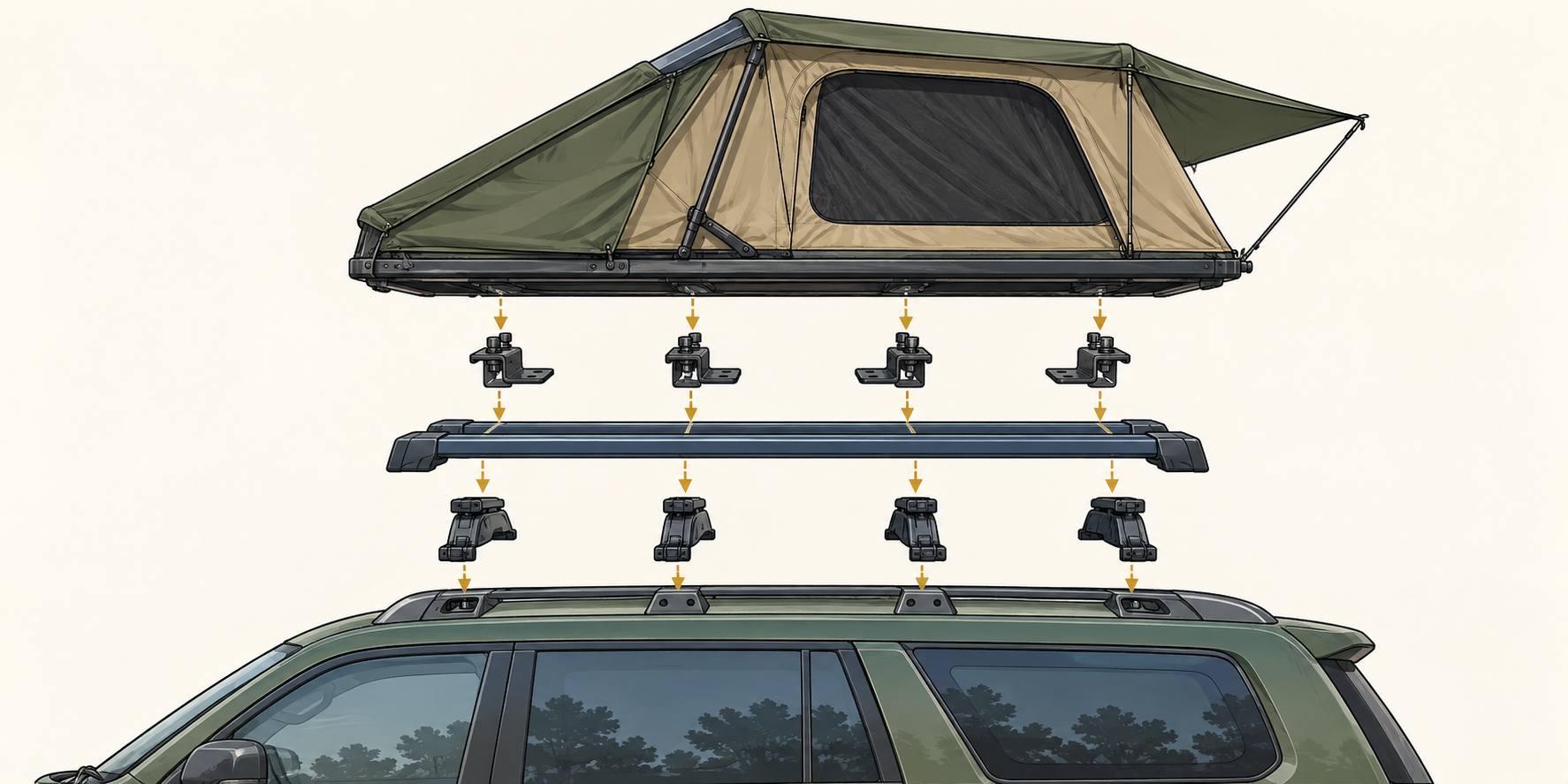
For a UK-specific example, Volvo Cars UK describes a Thule tent designed and tested for Volvo cars with roof rails and Volvo load carriers. Its guide directs owners to select approved carriers for the exact model through Volvo’s Accessories portal; the described tent mounts in the carriers’ T-tracks. The page’s “up to 300 kg” parked figure is tent guidance, not a model-specific vehicle limit or blanket permission for occupied use. Follow the exact car, carrier, and tent instructions.
Check the tent instructions for bar width and height, front-to-back and side-to-side spread, rail or channel interface, support position, overhang, and clearance for the hatch and ladder. The bar measurement guide explains those measurements.
3. Check the driving load
Driving load is the load carried while the vehicle is moving. Use the vehicle maker’s definition and calculation. Depending on the system, the moving load can include the rack, tent, brackets, other roof accessories, and cargo. Some manuals tell you to subtract rack-system weight from a maximum load to find the remaining cargo allowance. The lowest applicable rating or restriction controls; do not assume all makers define the same figure in the same way.
Do not compare only the tent’s published weight with a vehicle number and call the setup approved. A tent may fit within its own rack rating while exceeding the vehicle limit, or the rack may be below the tent maker’s requirement. Off-road limits, when provided, may be lower and apply to a different use.
4. Check parked use separately
The load while driving and the load while a tent is deployed are separate conditions. A tent’s structural rating or a rack’s static guidance does not establish the vehicle’s parked capacity or permission for occupants. Use only a parked or static limit and occupant rule that the exact vehicle maker and applicable rack and tent instructions establish.
The 2025 US Kia Seltos manual and 2025 Canadian Kia Sportage manual each give different roof-rack limits for driving and for the parked vehicle, and both include roof-tent instructions. Their numbers apply to the manuals’ described equipped-rack scopes; they do not approve a particular aftermarket rack or tent. Kia also says not to move the vehicle with occupants in a roof tent and warns against running the engine or fuel-burning devices near an occupied tent because of carbon monoxide. Read the US Seltos manual or Canadian Sportage manual for its full wording.
Thule’s guidance gives a three-times static-to-dynamic figure only as a guideline for Thule roof racks. It is not a vehicle rating or a formula to apply to another rack brand. The load-limit guide covers the distinction in more detail.
5. Follow the chosen tent’s setup instructions
Before driving, use the rack and tent makers’ checks for fasteners, closures, straps, load distribution, and reinspection. At camp, follow the tent maker’s rules for ground, ladder support, deployment, weather, and clearances. Never adapt a procedure or numeric limit from a different tent model just because the hardware looks similar.
Stop when a required fact is missing
Pause the purchase or installation if the exact vehicle roof limit is unknown, the rack or tent maker excludes the configuration, the required bar dimensions do not match, the manuals disagree, or the parked occupant condition is not stated. Ask the vehicle maker, rack maker, or tent maker a specific question that names the year, trim, roof, rack parts, tent model, and market. A qualified installer can help confirm fit and measurements, but should not replace a limit or approval that only the manufacturer can provide.
Keep the answer conditional until the complete configuration is documented. A model-specific example is not a universal rule, and an unlisted setup is not automatically safe because it appears to fit.
Sources and product references
Use these references to check the current instructions and fit information for your market and exact setup.