Measure skis, snowboard tips, bindings, carrier loading width, bar spread, and total roof load before choosing a winter carrier.
On this page
Ski and Snowboard Rack Fit: Binding Height, Board Count, and Bar Space
A carrier can meet its advertised pair count and still be a poor fit for your equipment. Before comparing models, measure the gear and the roof system separately. Pair count, usable loading width, binding clearance, crossbar spread, and permitted roof load answer different questions; one number cannot stand in for the others.
Measure the gear you will actually carry
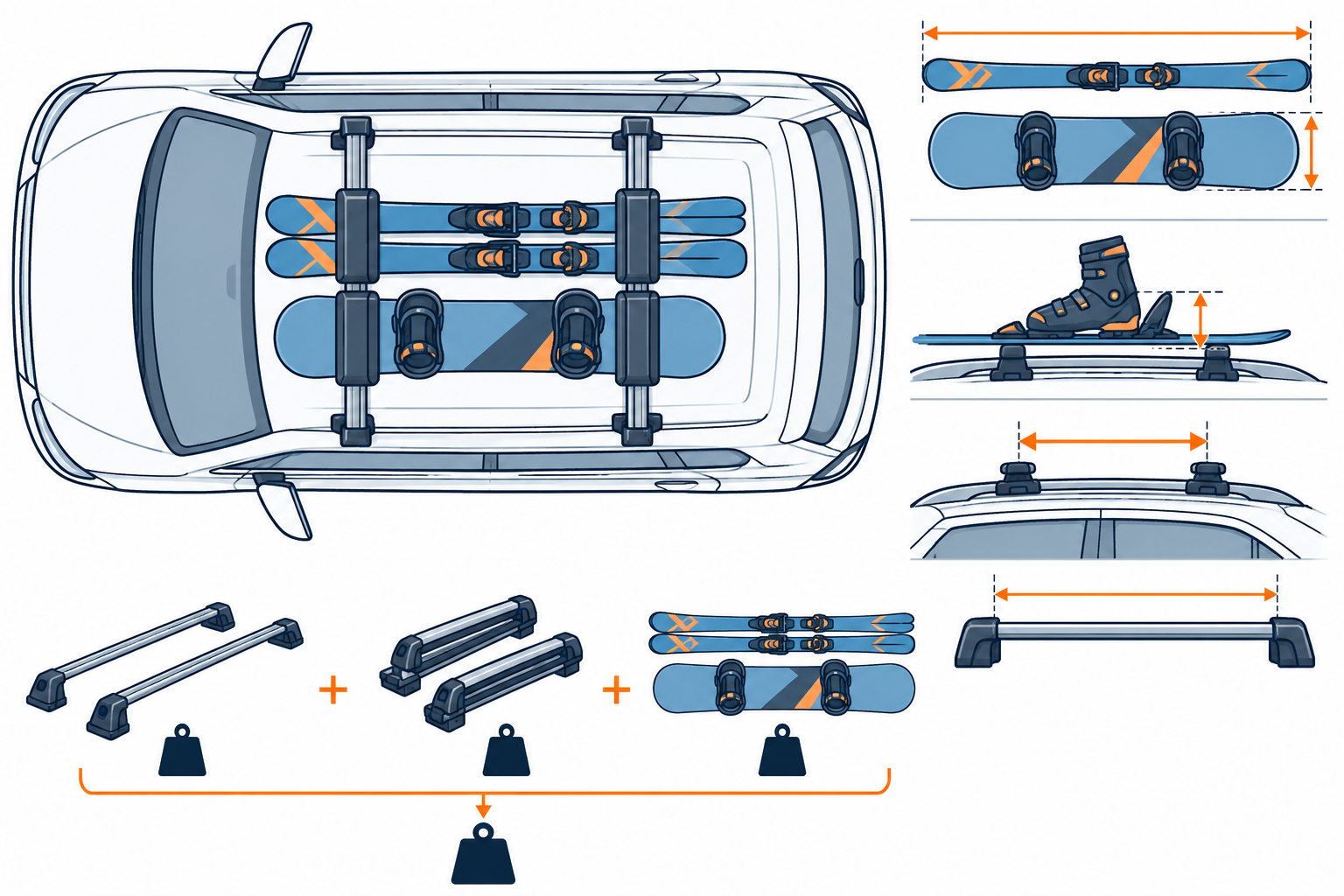
Lay out the skis or boards you intend to bring together. Record the longest length, the widest tip or tail, and the tallest binding or binding-and-boot arrangement that will be loaded. Include any unusual shape, raised heel piece, brake, or accessory that changes how the gear sits. Use the carrier manual to determine whether the bindings should face inward or outward, alternate direction, or be placed in a particular part of the jaws.
For boards, compare the widest ends rather than assuming every board has the same width. For skis, consider whether wide powder tips or brakes overlap when the equipment is stacked. A carrier may be rated for four pairs but have a loading width that does not accommodate four unusually wide pairs at once. Test the planned arrangement against the maker’s loading diagrams.
Do not assume separate ski and snowboard maximums can be combined. Rhino-Rack’s Canada snow-sports guide lists a mixed example of one ski set plus two snowboards for model 574, and two ski sets plus two snowboards for model 576. Both combinations are conditional on roof-rack bar length. These are examples for those carrier models and bar systems, not a general rule for another carrier.
Distinguish a loading-width measurement from internal length or bar width. Thule lists the US SnowPack M loading width as 19.6 inches and the SnowPack L as 29.5 inches; those product dimensions indicate space available for gear, not the crossbar length required, a maximum binding height, or vehicle compatibility. Rhino-Rack’s 576 page lists an internal length of 695 mm. That figure likewise describes the carrier, not a guaranteed number of boards in every setup.
Check binding and roof clearance
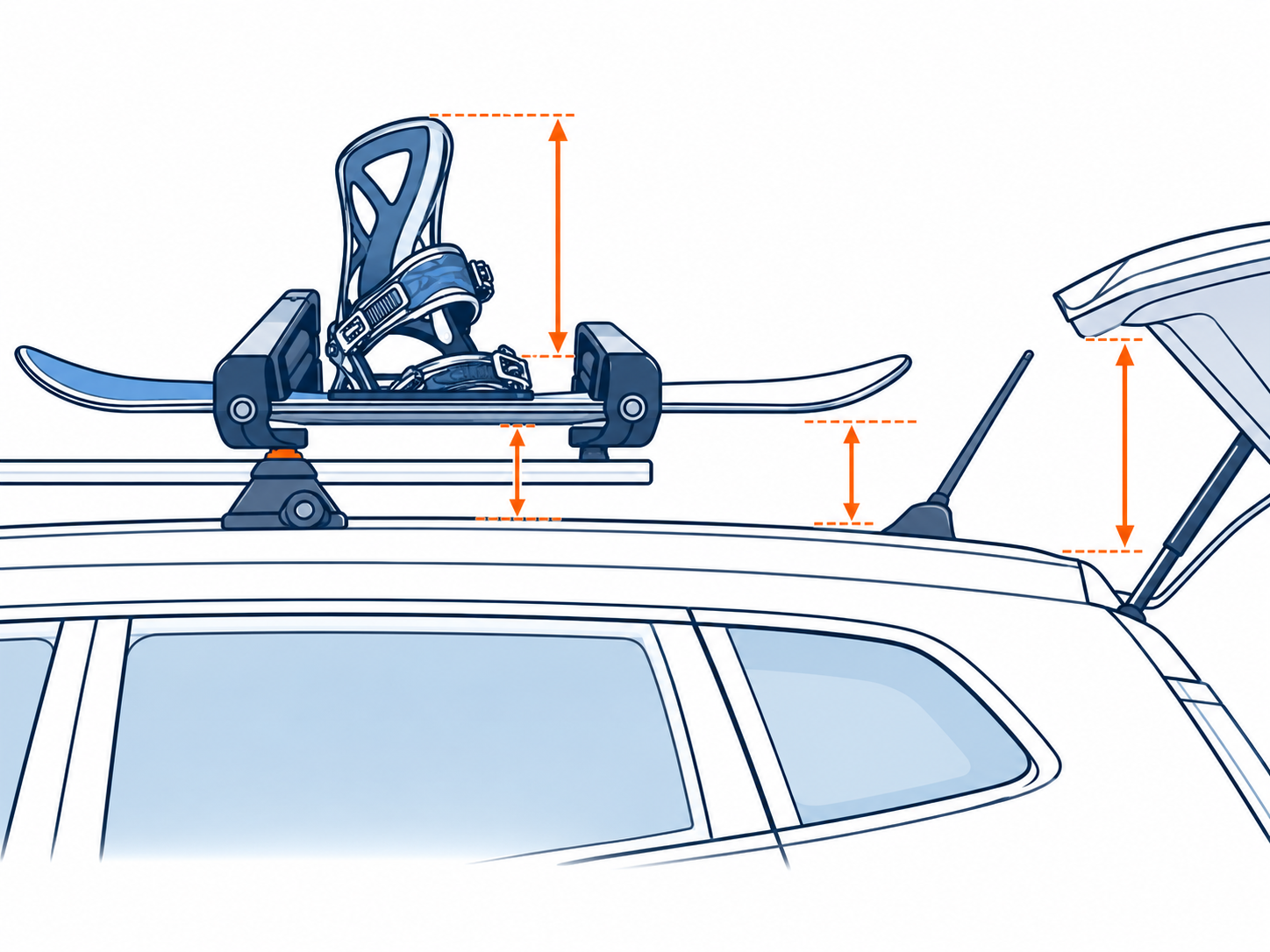
Binding height can determine whether skis sit flat and whether the carrier closes as instructed. Compare your binding arrangement with the carrier’s clearance information and diagrams. If the maker does not publish a numeric clearance, do not estimate one from a photograph. Ask the maker about the exact model and binding, or choose a product with instructions that address your setup.
Also check the gap between the loaded equipment and the roof, sunroof, antenna, hatch, and other accessories. Include the carrier’s mounting feet, clamps, and pads in the setup. Use the vehicle-specific fit information and the carrier installation sequence; a measurement taken with the carrier loose or positioned differently can be misleading. Follow any directions about opening a sunroof only when the carrier is unloaded.
Some specifications can conflict. Kuat’s GRIP product-page specifications call 4.25 inches the maximum crossbar width, while its FAQ calls the same value the minimum; the linked 2021 user guide also labels it the maximum. The conflict concerns bar width, not binding height, and neither source gives a numeric binding-clearance threshold. Do not use 4.25 inches as a binding measurement or assume which width limit applies; ask Kuat about the exact GRIP model and crossbar.
Measure the bars and attachment positions
Measure the center-to-center distance between crossbars and the usable straight length on each bar. Confirm the bar profile, clamp range, T-track dimensions, included adapters, and any required hardware. A carrier that supports T-track mounting may still need a separate adapter for your bar. Confirm whether the required part is included with the regional SKU.
Respect the manufacturer’s allowed bar spread and clamp positions. Yakima’s FatCat EVO 4 & 6, FreshTrack 4 & 6, and PowderHound 6 manuals give a 12–24-inch (30–61 cm) spread for skis or boards shorter than 67 inches (170 cm), and 12–36 inches (30–91 cm) for gear longer than that. None assigns a spread for equipment exactly 67 inches (170 cm) long. These ranges belong to the named instructions; do not assume another carrier uses the same positions. Check the manual for your exact model and market, and ask Yakima about the unassigned boundary rather than interpolating.
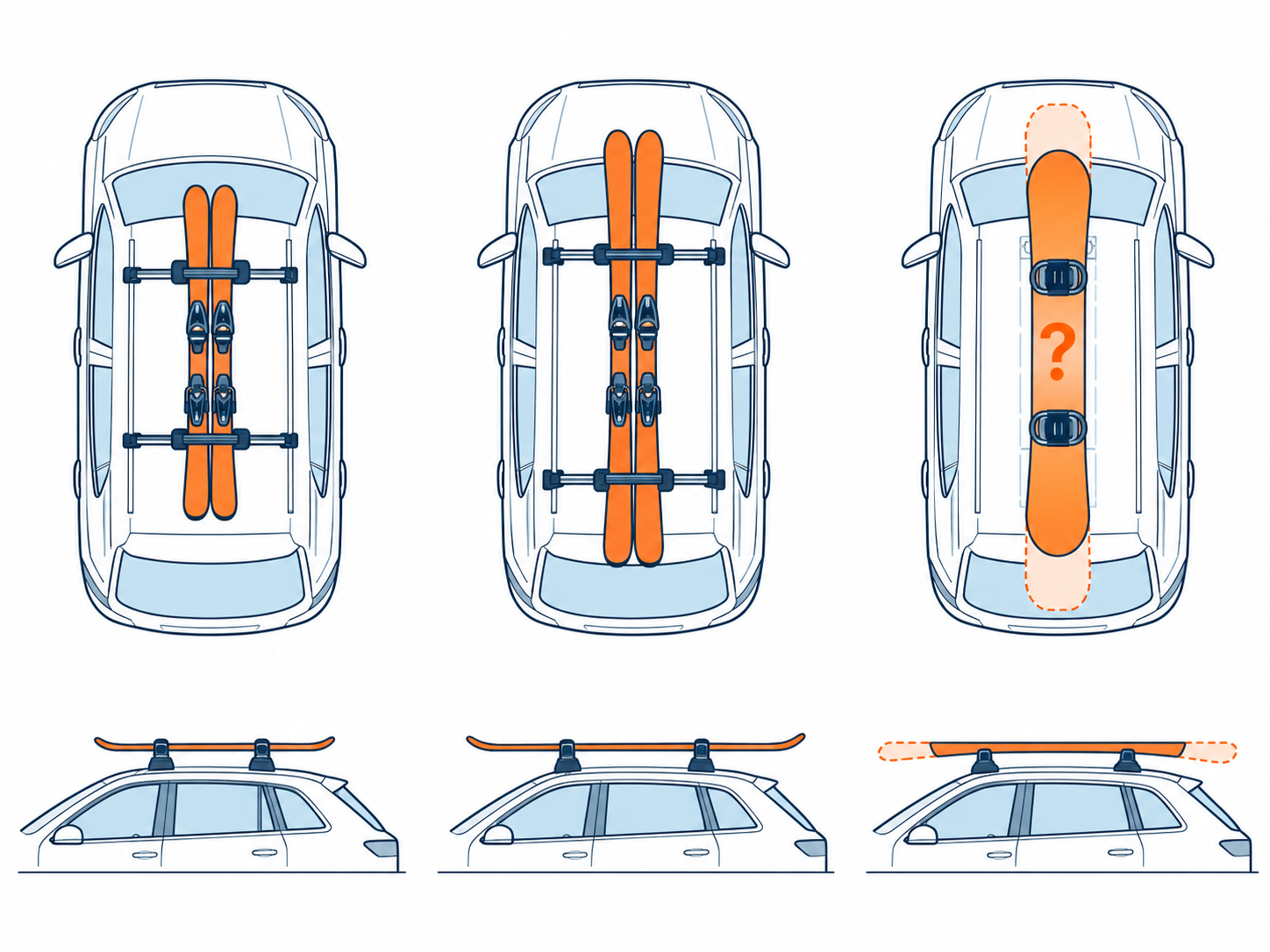
The distinction between a product listing and its installation instructions also matters. Yakima’s UK FreshTrack 6 page for SKU 8003093 lists a 12–36 cm crossbar range. Its linked FreshTrack 4 & 6 manual instead gives 30–61 cm for equipment under 170 cm and 30–91 cm for equipment over 170 cm, with no range assigned at exactly 170 cm. The sources do not explain the different lower and upper values. Use the instructions that match your exact model and market, and ask Yakima to confirm the applicable range for your setup.
The crossbars must also be approved for the vehicle and load. A product-level statement that a carrier attaches to certain bars does not confirm that those bars and feet fit your particular vehicle. Verify each link: vehicle roof, foot or tower, crossbar, adapter, and carrier.
Separate carrier capacity from roof load
Capacity describes how much gear the carrier is designed to hold in the arrangement defined by its maker. Roof load is a separate limit. Calculate the loaded mass of the crossbars and feet, carrier, and cargo together, then compare that total with the applicable vehicle, rack-system, and carrier limits. Follow the lowest relevant limit and any vehicle-specific restrictions.
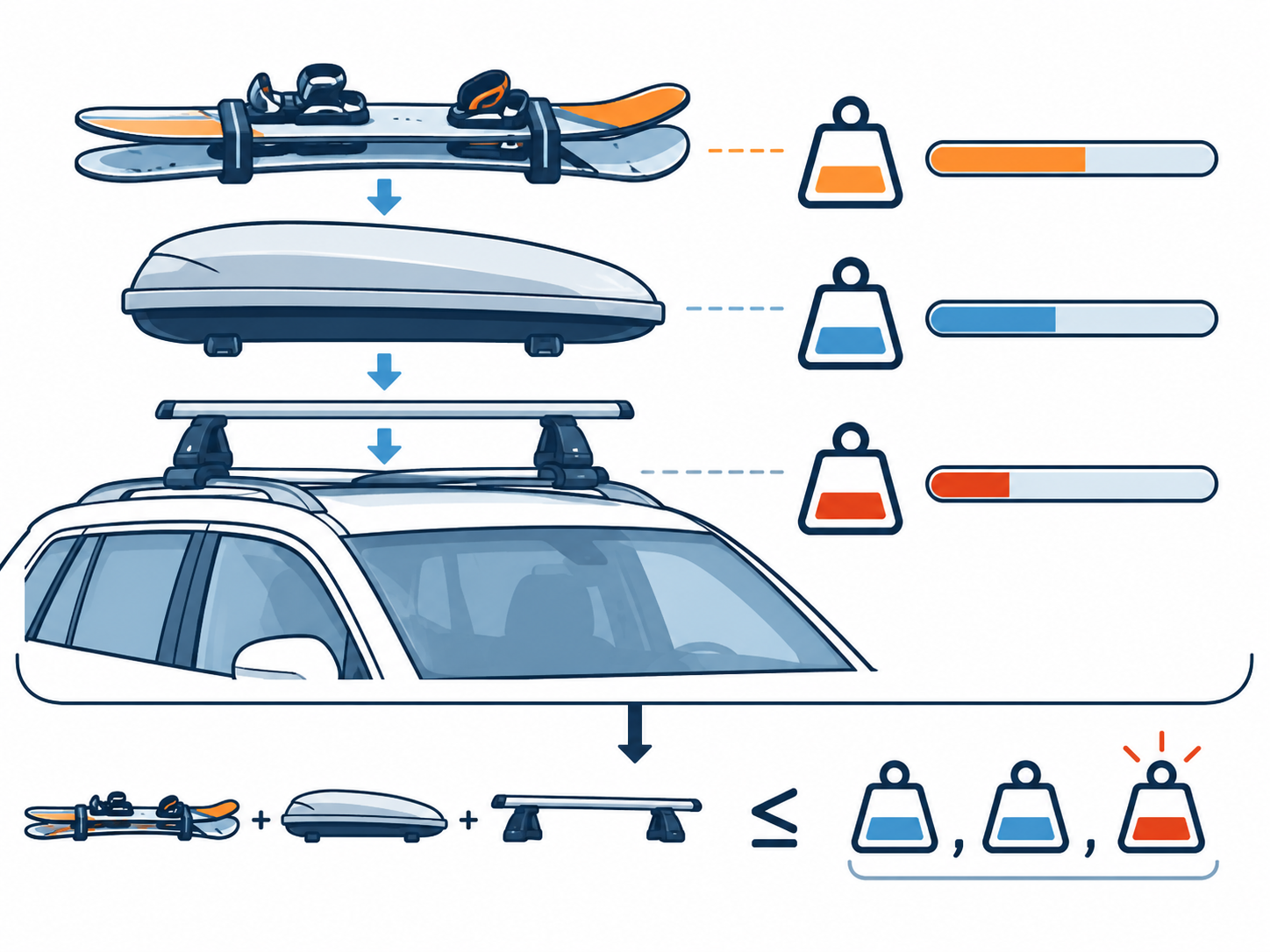
Do not copy a single roof-load number from another trim, model year, or market. Manuals can vary, and some limits refer to a dynamic load while the vehicle is moving. The car maker’s manual and rack maker’s instructions for the exact vehicle govern. If a product page gives a maximum load for the carrier, do not treat it as permission to exceed the roof-system or vehicle limit.
Use a fit checklist
Before purchase, keep a written record of:
- Carrier model, part number, and market-specific variant.
- Gear count, longest length, widest tip or tail, and tallest binding setup.
- Carrier loading width and any stated binding clearance.
- Bar profile, usable bar length, center-to-center spread, adapters, and clamp range.
- Vehicle make, model, year, roof type, and current fit result.
- Carrier, rack, and vehicle load limits and the calculated complete roof load.
If any value is missing, contradictory, or exactly at an unaddressed boundary, pause and ask the manufacturer or seller with those details. A confirmed answer for your exact setup is more useful than a general capacity label. For a model-specific example of snowboard binding placement, see the INNO INA951/INA952 guide. Then follow the vehicle-fit checklist for the exact car, rack, and carrier combination.
Sources and product references
Use these references to check the current instructions and fit information for your market and exact setup.
- Yakima FatCat EVO 4 installation instructionsprimary
- Yakima FatCat EVO 4primary
- Yakima FatCat EVO 4 & 6 installation instructions (1035852C)primary
- Yakima FreshTrack 6 (United Kingdom, SKU 8003093)primary
- Yakima FreshTrack 4 & 6 installation instructions (1035848B)primary
- Yakima PowderHound 6 installation instructions (1035847B)primary
- Thule SnowPack Mprimary
- Thule SnowPack Lprimary
- Kuat GRIP 6primary
- Kuat GRIP 4 and 6 user guideprimary
- Rhino-Rack Ski and Snowboard Carrier 576primary
- Rhino-Rack Snow Sports Buying Guide (Canada)primary
- Thule roof load and roof box guideprimary