Compare crossbar, magnetic, and vacuum-mounted ski carriers and roof boxes by capacity, attachment needs, clearance, and fit checks.
On this page
Ski and Snowboard Roof-Carrier Types and Clearance Checks
Ski and snowboard carriers fall into two useful groups: open carriers that clamp gear at the crossbars, and roof boxes that enclose it. Within those groups, loading width, access, binding clearance, and attachment details vary by model. Choose a design only after checking the gear you own and the exact roof system you will use.
Open clamp-style carriers
An open carrier holds skis or boards in padded jaws above the crossbars. It is usually compact and gives quick access to the equipment. The product’s capacity is a maximum for a particular mix of skis or boards, not a promise that every collection fitting the pair count will fit. Compare the carrier’s stated loading width with the space occupied by your widest tips and bindings, and check whether the instructions require the bindings to face a particular direction or sit between defined points.
For a concrete model example, Thule lists the US SnowPack M, model 732412, for up to four pairs of skis or two snowboards and gives a loading width of 19.6 inches. Yakima describes its FatCat EVO 4 for up to four pairs of powder skis with tips up to 136 mm, or two snowboards. Those are model-specific capacity statements. They do not confirm that either carrier fits a given vehicle, bar profile, or particular ski-and-binding combination.
Slide-out carriers
A slide-out model moves the loaded jaws outward to make loading and unloading easier. Thule’s SnowPack Extender, model 732501 in the United States, is listed for up to six pairs of skis or four snowboards and a 29.5-inch loading width. That wider loading area may suit a larger group, but the longer carrier also needs suitable mounting positions and space to extend without contacting the vehicle or nearby equipment.
Do not infer a numerical roof clearance from a product photo or a listing that does not state one. Check the installation manual’s diagrams, the extension path, bar spread, and the vehicle-specific fit instructions. Confirm that opening a hatch or moving the carrier does not bring the equipment into contact with the roof, antenna, spoiler, or another accessory.
Compact carriers and other designs
A dedicated cross-country ski carrier can be smaller than a downhill ski or snowboard clamp. The Thule SkiClick, model 729102, is described for one pair of cross-country skis and uses specified Thule bar families and mounting instructions. Its compact size does not make it a general-purpose snowboard rack. Check the product’s intended gear, mounting parts, and fit instructions before treating it as an option.
For a two-pair ski setup, Thule’s UK catalog also lists SnowPack S model 732200 with a 25 cm loading width. Its page specifies 24 × 30 mm T-tracks and lists a separate adapter for SquareBar Evo; it gives no snowboard capacity or numeric binding-clearance threshold. These UK-market details are specific to that model and do not establish a vehicle fit.
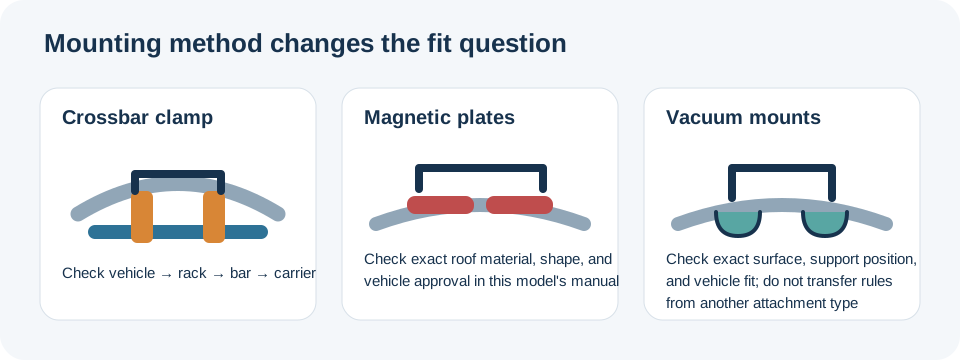
Some carriers attach without crossbars, using magnetic plates or vacuum mounts. Treat these as different attachment systems, each with its own vehicle and roof-surface requirements. For example, BORA’s instructions restrict that model to compatible vehicles and a flat steel roof. CRUZ’s magnetic-carrier instructions exclude glass, sunroof, panoramic, aluminum, stainless-steel, fiberglass, and plastic roofs, as well as certain irregular or repaired surfaces. These are separate manufacturer rules; neither approves another brand’s carrier. SeaSucker describes its Classic Ski Rack as vacuum-mounted, but that product listing does not establish a fit for a particular vehicle or roof. Check the exact model’s current instructions and the vehicle maker’s roof guidance before considering one; a magnetic or vacuum attachment that suits one roof is not a general approval for another.
Product names and regional variants matter. Rhino-Rack’s model 576 page lists capacity for six pairs of skis or four snowboards and an internal length of 695 mm. Its US page lists Pioneer Tradie 6-series, Reconn Platform, Vortex, Euro, and Heavy Duty systems. It also names selected outside bars, including Thule SquareBar, Professional/Aero, WingBar/AeroBlade, and Yakima round bars. Treat these as product-level compatibility labels; check the exact carrier, bar model, any required kit, and vehicle result. Internal length is a product measurement, not a vehicle fit result. A similarly named carrier, a regional SKU, or a previous model year may have different hardware.
Some products make broad claims such as “suits all cars.” Read those words alongside the actual vehicle selector, supplied parts, and installation manual. A broad statement does not establish that the carrier attaches to your roof system, clears your vehicle, or is approved for your load. Follow the exact product and vehicle instructions.
When a roof box makes more sense
A box encloses skis and boards and can also carry light, bulky winter gear. This can be helpful when you want weather protection or need room for gloves, helmets, or clothing alongside the equipment. Box choice depends on usable internal length, opening, roof clearance, and the box’s specific vehicle-and-bar fit. Thule’s guide uses skis up to 215 cm as an example of a length to consider; measure your own gear and compare it with the box’s internal dimensions rather than treating that example as a universal limit.
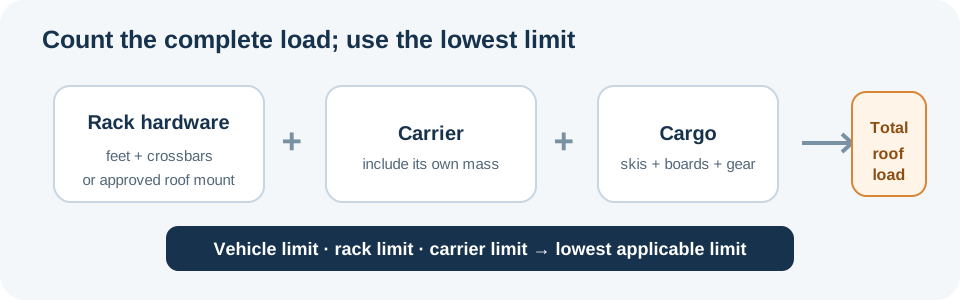
A box takes more time to load and secure, uses more vertical space, and can add aerodynamic drag. The loaded box, its mounting hardware, the crossbars, and the cargo all count toward the applicable roof-load limit. A box may solve a storage problem while adding a different fit or load constraint.
Check clearance and attachment before choosing
Make a short list of the exact carrier model and part number, your vehicle’s make, model, year, and market, your crossbar brand and profile, and any feet or adapters in the mounting chain. Use the manufacturer’s current fit lookup and installation instructions for that exact combination. If the system requires a T-track adapter, confirm whether it is included or sold separately.
Compare bar spread with the carrier instructions. Long carriers can specify placement intervals that shorter bars cannot provide. Measure the useful straight section of each bar and check the allowed clamp positions; do not place clamps beyond an instructed range to make a carrier fit. For slide-out models, include the full extension path in the clearance check. For model-specific snowboard binding placement, see the INNO INA951/INA952 loading guide. To organize gear measurements and bar-space checks across products, use the measurement guide; the vehicle-fit guide follows the complete vehicle-to-carrier chain.
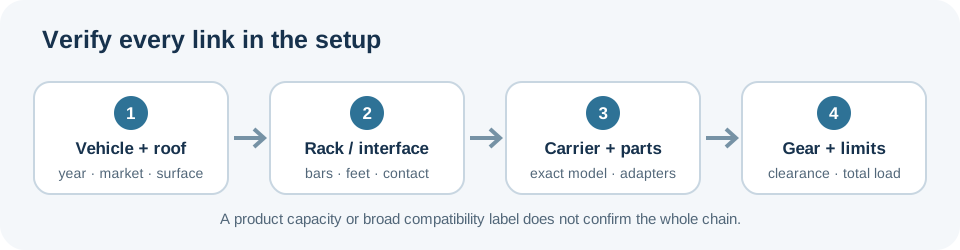
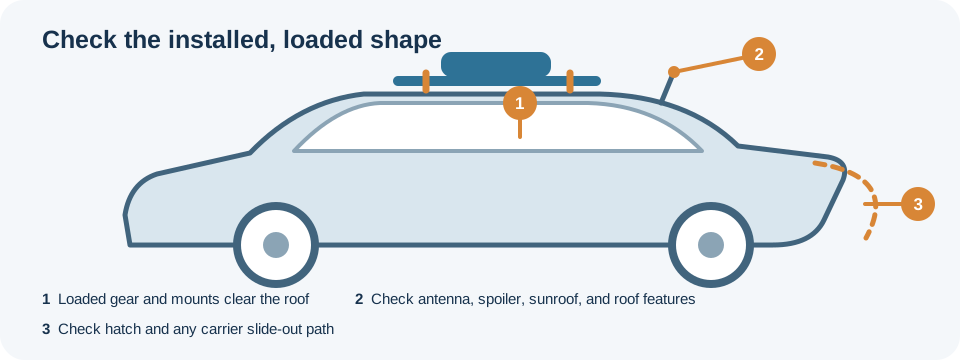
Finally, account for the total roof load and verify that the hatch, roof features, and carrier can be used together as instructed. If no current vehicle-specific fit is available, ask the manufacturer or seller to confirm the full combination before buying. A published capacity is only one part of a safe, workable setup.
Sources and product references
Use these references to check the current instructions and fit information for your market and exact setup.
- Thule ski and snowboard racksprimary
- Thule SnowPack Mprimary
- Thule SnowPack Extenderprimary
- Thule SnowPack S (United Kingdom)primary
- Thule SkiClickprimary
- Yakima FatCat EVO 4primary
- Rhino-Rack Ski and Snowboard Carrier 576primary
- Mont Blanc Ridgeprimary
- Thule roof box fit guideprimary
- BORA magnetic sliding ski carrier instructionsprimary
- CRUZ roof accessories safety and use instructionsprimary
- SeaSucker Classic Ski Rackprimary