Use current vehicle and carrier fit information to verify the full chain from vehicle roof and crossbars to adapters, carrier, and winter gear.
On this page
How to Verify a Ski or Snowboard Rack Fit for Your Vehicle
Verify a winter carrier as a complete system. A carrier can be listed as compatible with a crossbar family while the crossbars, feet, or adapter still lack a confirmed fit on your vehicle. Confirm the vehicle, roof system, carrier variant, gear, and installation instructions as one chain before you buy or drive.
Gather the exact identifiers
Write down your vehicle’s make, model, model year, market, and roof configuration. Record the roof-rack brand and exact foot or tower and crossbar models, including bar profile and dimensions. Then record the winter carrier’s full name, part number, and regional variant. If you have a sunroof, raised rails, fixed mounting points, factory bars, a spoiler, or another roof accessory, include it in your fit check.
Do not substitute a visually similar vehicle, a different model year, or a similarly named carrier. A manufacturer may change its fit list, adapter kit, part number, or installation steps between markets and model years. Use current instructions for the equipment sold where you will use it.
Verify every part of the mounting chain
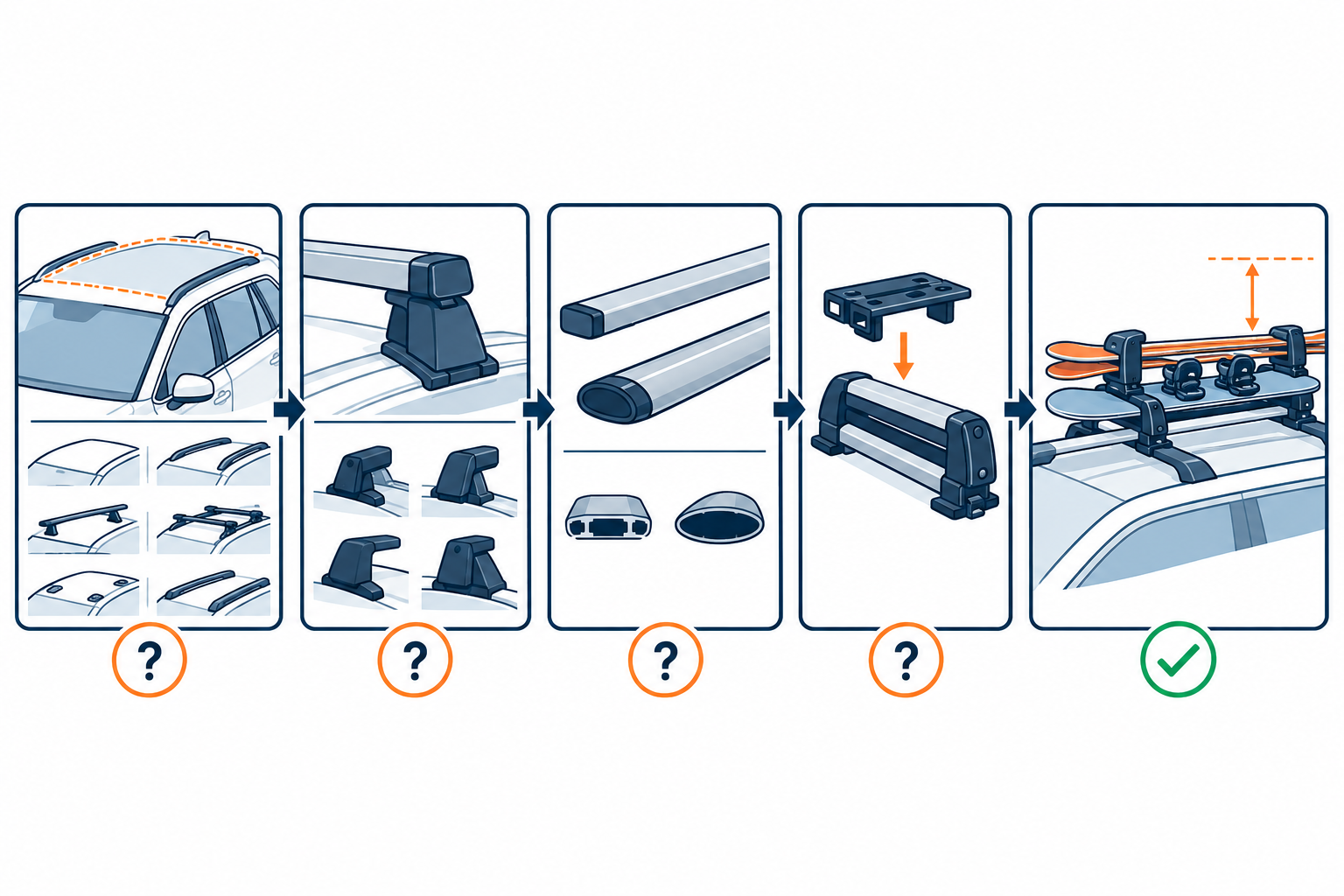
Start with the vehicle maker’s instructions for roof loads and approved attachment points. Next, use the rack maker’s selector to confirm the correct feet and crossbars for your vehicle and roof. Then check that the ski or snowboard carrier attaches to those exact bars, using the stated clamp range or required adapter. Finally, open the carrier’s installation instructions for the selected vehicle and equipment.
A carrier listing may name supported crossbar families without confirming a vehicle fit. For example, a product page that supports T-track mounting still leaves you to confirm the correct track dimensions and whether a separate adapter is required. Check the included parts for the exact regional SKU; do not assume an adapter pictured online is in the box.
Use fit tools for what they say. Thule’s category page explains that “No confirmed fits” can mean the combination is not supported or has not yet been measured. Yakima’s lookup distinguishes statuses such as no out-of-box solution, incompatible product, under evaluation, in development, and reference-only. Interpret the displayed status itself, then follow the manufacturer’s next step. An unconfirmed or unavailable result is not a positive fit and is not necessarily a negative one.

Check physical clearance and loading
A database result does not replace installation checks. Compare the allowed bar spread and clamp positions with your bars. Check that the carrier and its loaded equipment clear the roof, hatch, spoiler, antenna, sunroof, and nearby accessories, following the manual’s diagrams. For a slide-out carrier, check its full travel path. Confirm the intended ski and board count, equipment length and width, binding orientation, and any binding-clearance specification. The measurement guide helps separate gear dimensions from bar and roof limits. For one exact snowboard-placement example, see the INNO INA951/INA952 guide; its instructions apply only to those models.
Never force a clamp into a position outside the maker’s range to make the hardware reach. If the fit tool suggests a combination but the manual’s bar layout cannot be followed, contact the maker with the exact vehicle, rack, carrier, and equipment details.
Calculate the complete roof load
Add the mass of the vehicle-specific rack feet, crossbars, carrier, and cargo. Compare that total with the vehicle’s roof-load instructions, rack-system limit, and carrier limit. Apply the lowest relevant limit, plus any restrictions for a particular roof type. Do not transfer a load figure from a different trim, year, or market. Capacity for a stated number of skis is not a roof-load rating.
Treat broad claims as a prompt to verify
A product page can use broad language such as “suits all cars” while also offering a vehicle selector or model-specific installation notes. Broad marketing language does not identify the required mounting kit or confirm clearance on your car. Ask the manufacturer to identify the exact parts and instructions for your vehicle and bars. If it cannot, keep the fit unresolved rather than treating the general statement as confirmation.
Keep a fit record
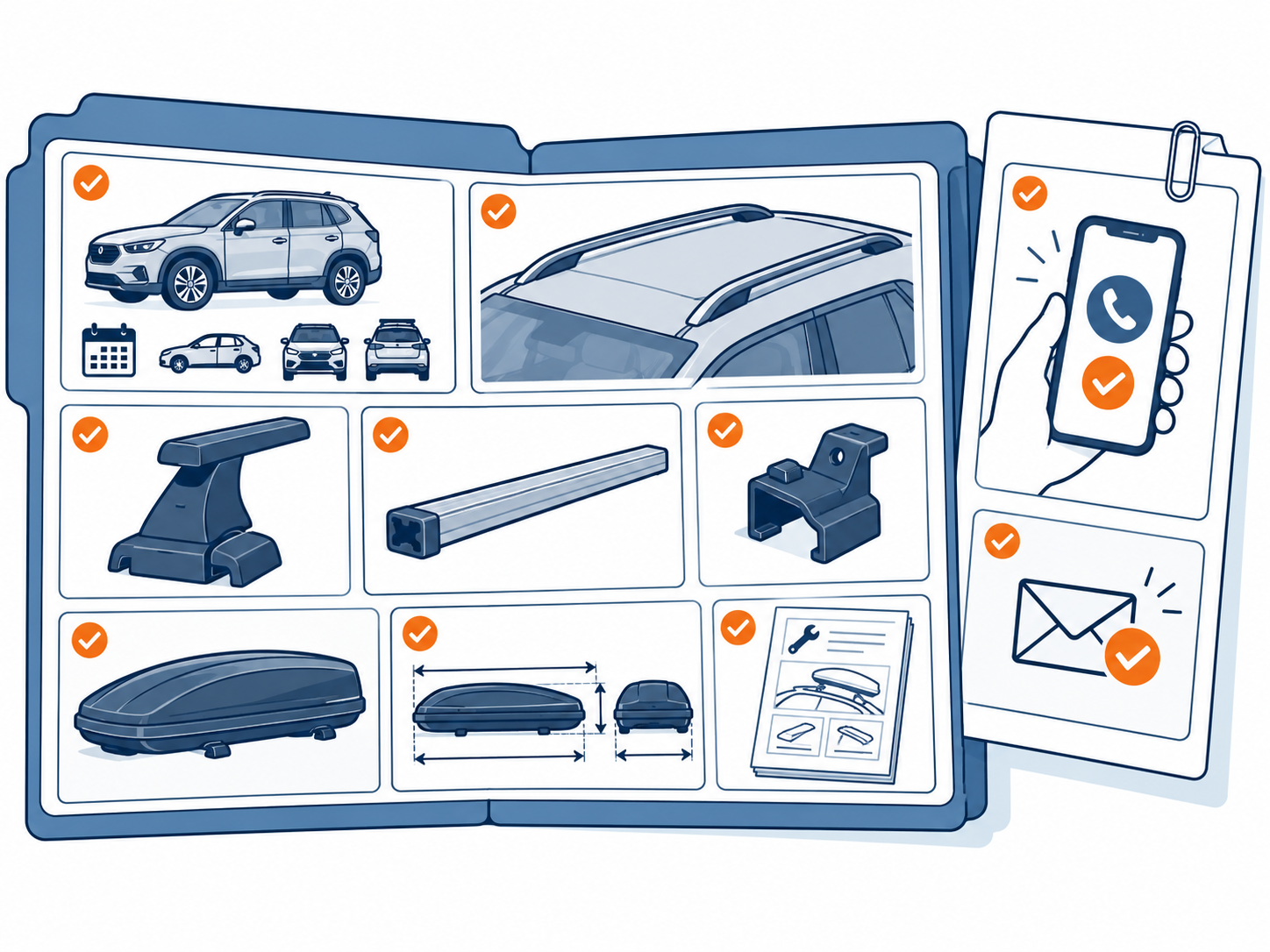
Save or print the current fit result and installation manual. Keep the exact part numbers, selected vehicle details, adapter list, allowable bar positions, clearance instructions, and load limits together. Check the hardware again before each trip and follow the maker’s torque, locking, and maintenance instructions. If you change the vehicle, crossbars, carrier, or mounting adapters, repeat the fit check; approval for the earlier combination does not carry over automatically.
Before buying, a useful confirmation request includes a photo or description of the roof, vehicle year and market, exact foot and bar models, carrier SKU, and ski or board measurements. Ask directly whether those parts are approved together and which current instructions apply. This gives the maker enough detail to answer a specific fit question rather than a generic one.
Sources and product references
Use these references to check the current instructions and fit information for your market and exact setup.
- Thule ski and snowboard racksprimary
- Thule vehicle fit guideprimary
- Yakima fit lookupprimary
- Thule SnowPack L product page and linked instructionsprimary
- Mont Blanc Ridgeprimary