Match a load stop or ladder roller to the exact bar or platform system, required adapters, work material, and vehicle load path.
On this page
Roof-Rack Work Accessories for Ladders, Materials, and Utility Loads
A work accessory must match both the carrying system and the material being carried. A roller that attaches to one platform with two adapters, or a load stop designed for one bar, is not a general approval for every vehicle, ladder, pipe, or length of lumber. Identify the installed system first, then follow the exact product instructions.
Match the interface before comparing products
Record the vehicle, market, rack or platform model, accessory part number, and any adapter part numbers. For the work load, record its length, width, mass, shape, and how it will be supported and restrained. Check that each support point and fastener position is allowed by the rack maker. If instructions do not cover the combination or load dimensions, ask the manufacturer or a qualified fitter instead of estimating from a headline product rating.
Two different work-accessory paths
| Product | Documented path | What the figure does not establish |
|---|---|---|
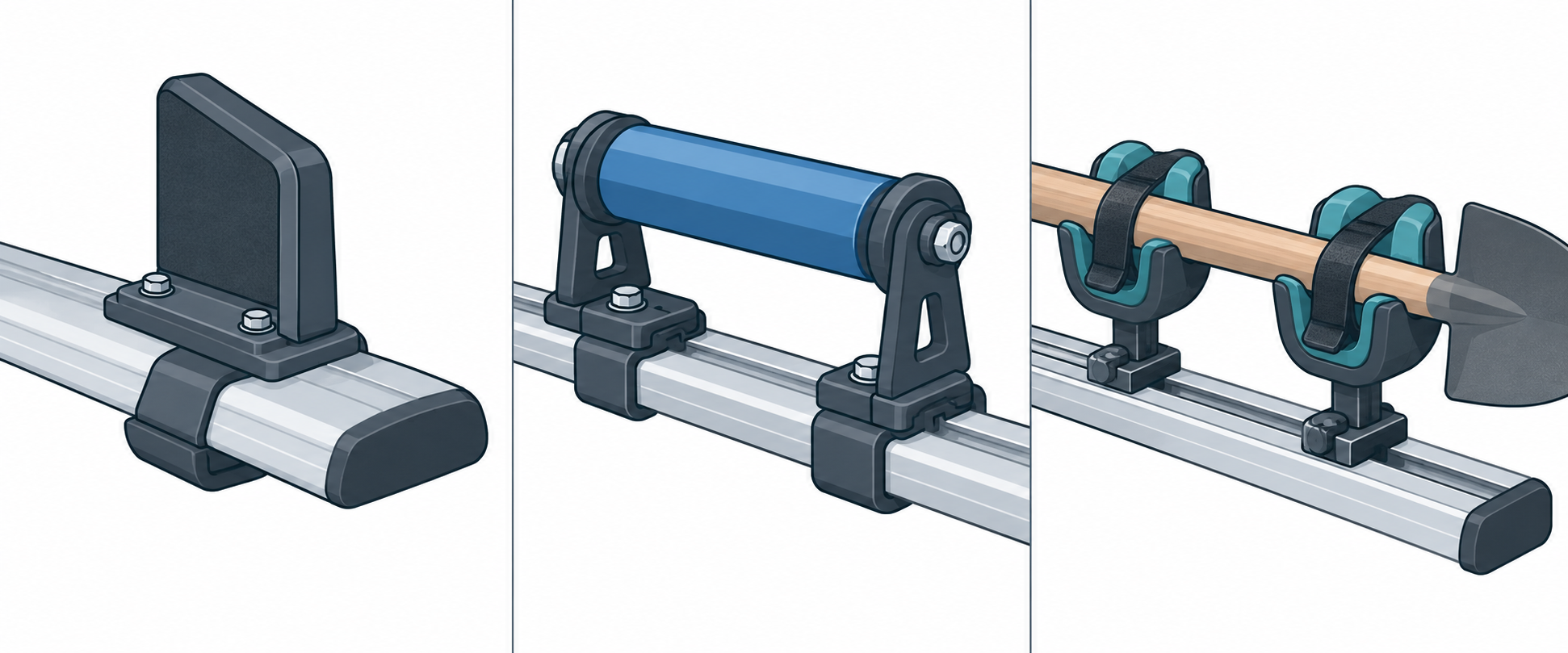
| Thule load stop 503007 | A 4 in (10 cm) vertical stop for lateral support; it weighs 2 lb and fits Thule ProBar Evo. Thule lists 523 load straps as sold separately. | The stop is not a complete restraint plan or a vehicle, bar, or load approval. Thule product details |
| Rhino-Rack LR1020, US listing | A 40 in (1020 mm) ladder roller for named CSL or Multi-Slide Ladder Rack Systems. On Pioneer Platform, Reconn-Deck, or Vortex crossbar paths, Rhino-Rack specifies both the SSIT StowIt Starter Kit and OSIT Roller Adaptor. | The stated 42 kg (93 lb) maximum is the LR1020 product limit. It is not the vehicle roof limit or approval for a particular ladder. Rhino-Rack US product details |
| Rhino-Rack LR615, European listing | A separate 615 mm roller listing for Europe; the page describes named Pioneer, Reconn-Deck, and crossbar paths with SSIT and OSIT. | Do not treat a European listing as proof of UK stock or as an interchangeable part. Confirm the regional catalog, exact system, and instructions. Rhino-Rack EU product details |
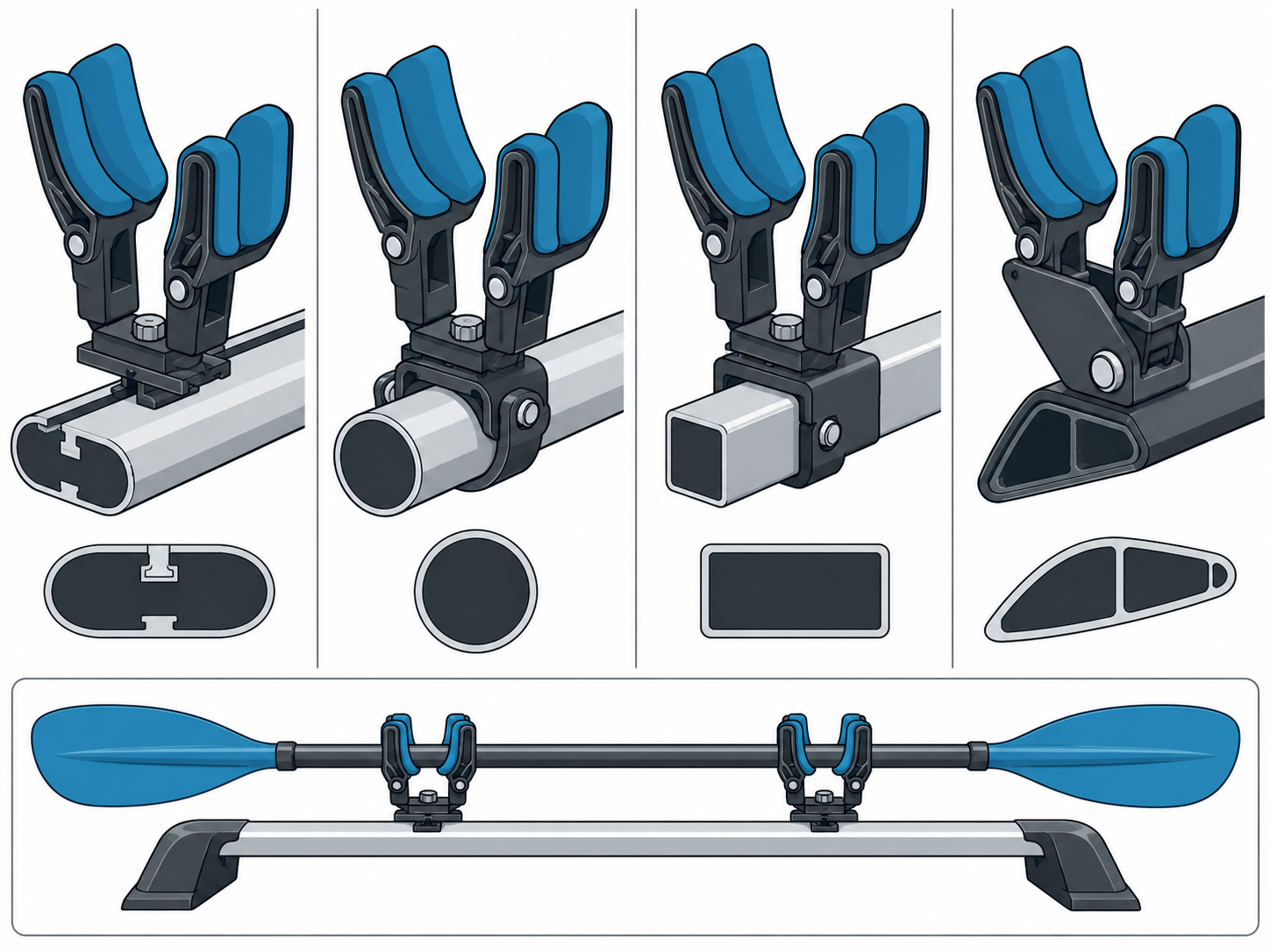
| Yakima TopGrip 8004086 | Two padded cradles hold one paddle, axe, shovel, or similar straight-handled item. Yakima lists 30–50 mm shaft diameter and a 9 lb maximum item mass, with separate branches for named bar families. | The 9 lb limit is for the item held, not the crossbars, rack, vehicle, or off-road load case. Follow the exact-bar instructions; “most other” T-slot bars are not individually identified. Yakima product details and instructions 1035913D. |
Yakima’s 1035913D instructions show separate installation branches by bar type and a 3 Nm value for the specified fastening steps. Do not transfer that torque value to other accessories or bar procedures. The TopGrip example holds one qualifying item; it is not a restraint plan for long work materials.
The two Rhino-Rack rollers show why length, system path, and region belong in the same decision. A roller’s maximum does not state the permissible mass of the vehicle roof, rack, supports, or the whole loaded system. Read every limit in its own context and use the most restrictive applicable requirement.
Account for the complete load path
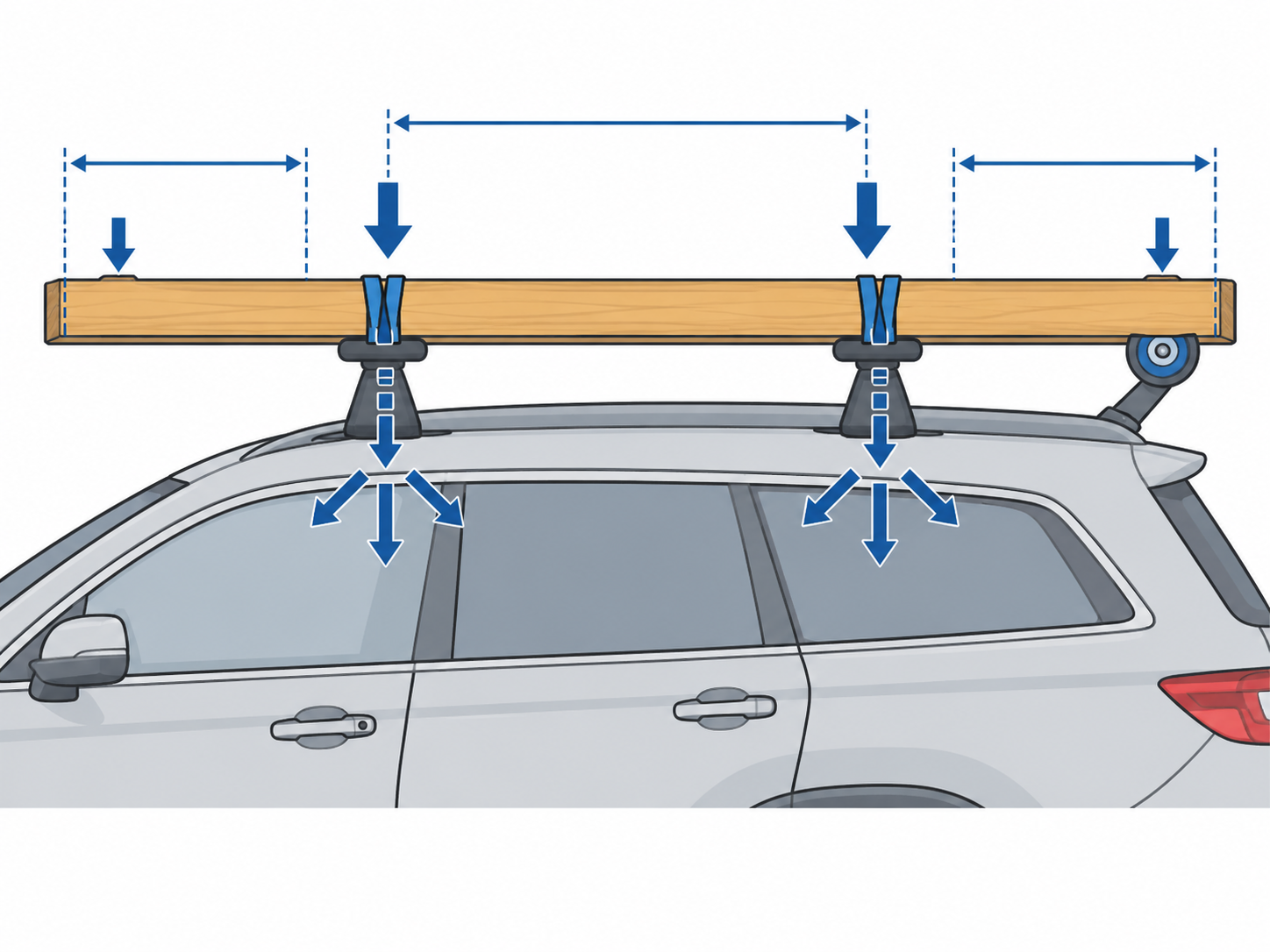
For a ladder or long material, confirm that the roller, front supports, bars or platform, and vehicle attachment points are all documented for the installed setup. Check the material’s supported span and overhang in the equipment instructions. Add the mass of the rack, adapters, roller or load stop, straps, and cargo when checking the vehicle’s roof allowance and the rack and accessory limits. The accessory rating cannot raise a lower vehicle or system limit.
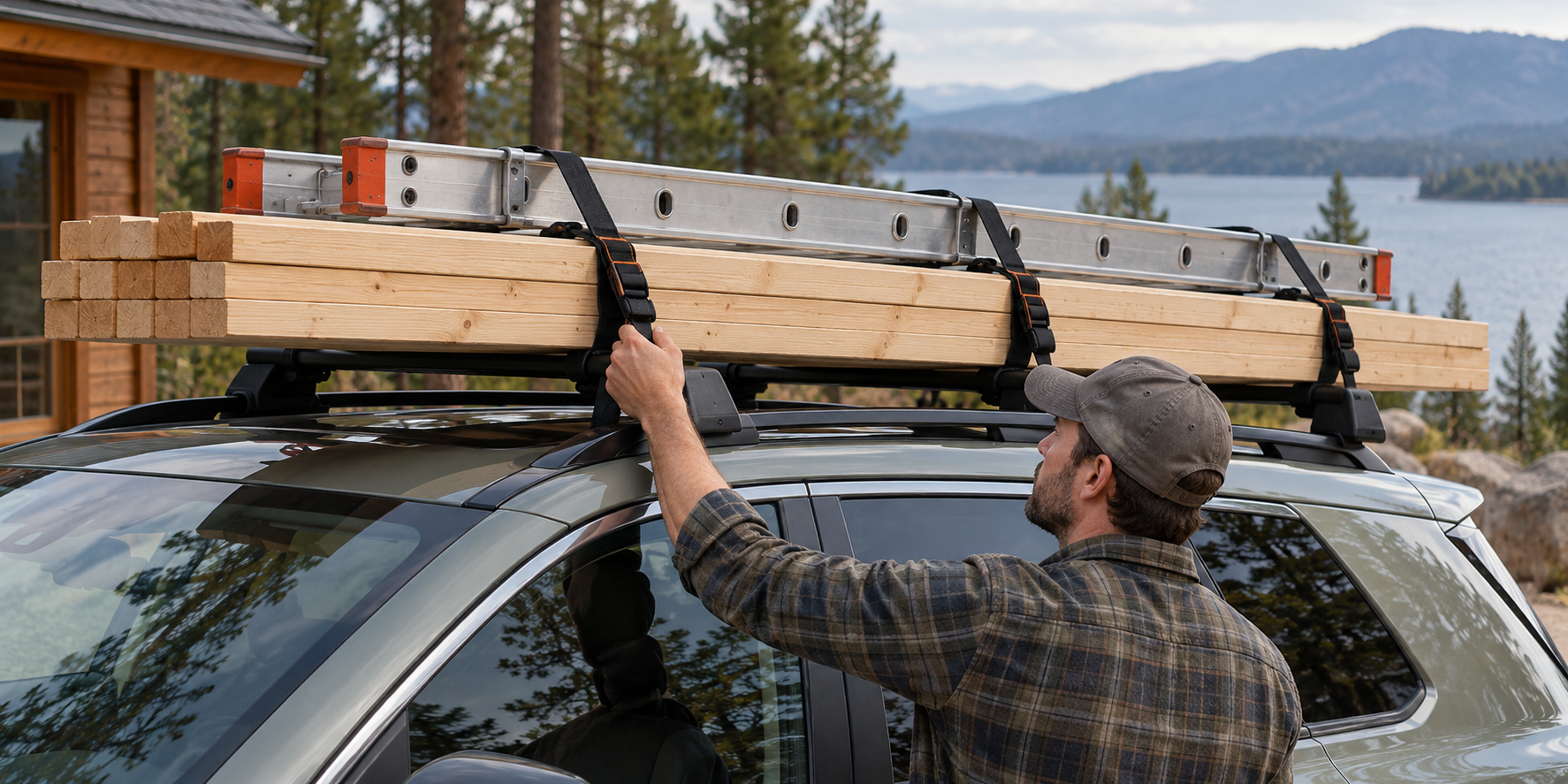
A load stop helps keep material laterally positioned, but it does not replace straps or other securement specified for that load. In the US, NHTSA advises tying cargo down with rope, netting, or straps and checking that it is secure. Follow applicable local rules in Canada or the UK and the equipment manufacturer’s instructions wherever you drive.
Before loading and driving
- Confirm the rack, work accessory, adapters, and fasteners match the exact product instructions.
- Check that the material rests on the documented supports and stays clear of doors, tailgates, lights, and other accessories.
- Count all installed equipment and cargo against the applicable vehicle, rack, and accessory limits.
- Secure the load as instructed, then check it again after loading and during the trip as required by the manufacturer and local rules.
- Recheck the full installation after a change to the bars, platform, rollers, material, or support spacing.
If a load, support position, regional part, or vehicle application is missing from the instructions, do not treat the accessory’s maximum as permission to carry it. The overland add-on guide covers Pioneer tool mounts; the load and clearance guide covers the broader operating checks.
Sources and product references
Use these references to check the current instructions and fit information for your market and exact setup.