Measure the bars on your vehicle and compare their shape, dimensions, spacing, and clearance with the exact accessory instructions.
On this page
Crossbar Geometry: Width, Height, Spread, and Mounting Interface
Two roof racks can look alike and still fail to work with the same accessory. Compatibility depends on the bars actually installed on your vehicle: their profile, width, height, spacing, attachment interface, and clearance around the vehicle. Measure the rack and compare those measurements with the current instructions for the exact carrier. A brand name or a general “fits most crossbars” statement does not replace that check.
Record the installed setup
Start with the bar maker, family, model or part number, and the vehicle-specific feet or kit. Then record the geometry the accessory asks for:
| Check | What to record | Why it matters |
|---|---|---|
| Bar profile and size | Shape plus usable width and height at the mounting area | A clamp or channel fitting may accept only a stated range |
| Mounting interface | T-track/channel, around-bar or U-bolt, clamp, or another named fitting | The accessory may need a particular fitting or adapter |
| Front-to-back spread | Distance between the installed bars, measured the way the accessory manual specifies | Carriers can require a minimum, maximum, or fixed spacing |
| Side-to-side position | Bar position and usable length across the roof | A carrier may need room for its feet, straps, or a second item |
| Clearance | Hatch open, door movement, sunroof operation, spoiler, roof edge, and total height | A carrier can mount yet obstruct the vehicle or contact a structure |
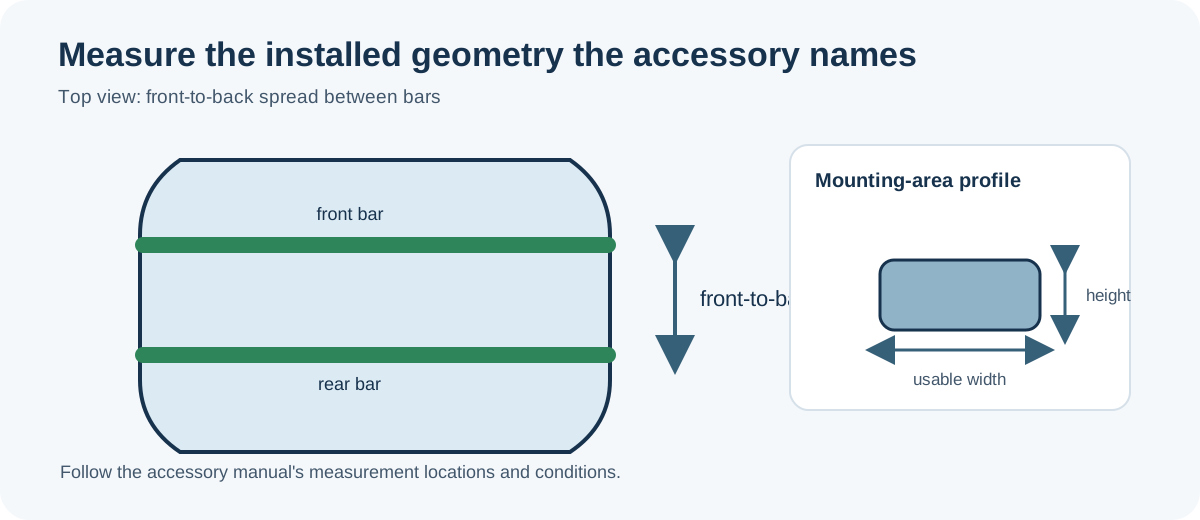
Measure the vehicle with the rack installed, not from a catalog photo. If an accessory says to measure with the hatch open, follow that condition. Keep the measurements with the vehicle and rack details so you can compare a future replacement or transfer accurately.
Match the interface, then the dimensions
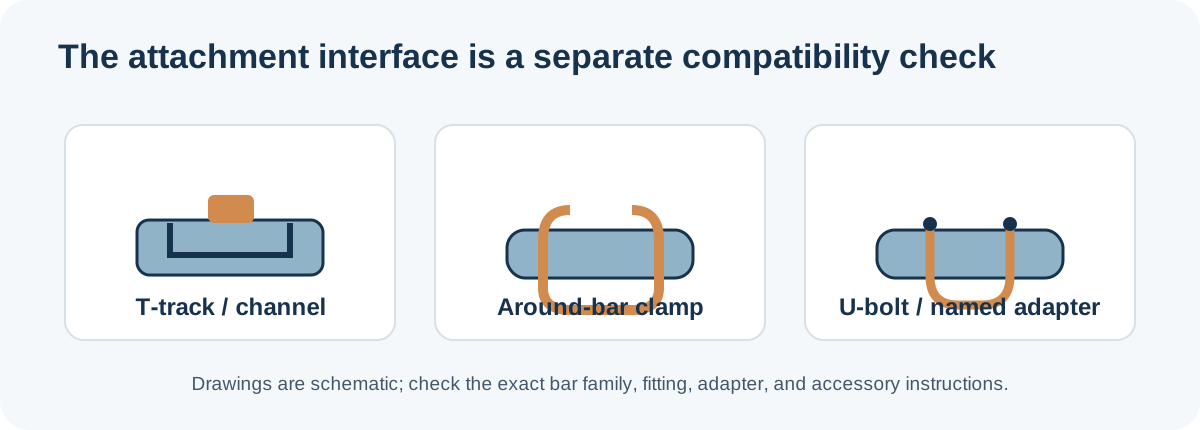
Check the exact mounting mechanism before comparing width. A Thule Hull-a-Port Aero kayak carrier, model 849000, is an example of why: its product instructions identify T-track installation on named Thule bars and around-bar installation for Thule SquareBar with a separate SquareBar adapter. That describes a carrier-to-bar relationship. It does not establish that the vehicle roof, rack feet, or complete loaded system fits.
Use the accessory maker’s minimum and maximum dimensions, spacing, and adapter list as written. “Aero,” “round,” “square,” “flush,” or “channel” may describe a broad family, while the actual product has narrower limits. Rhino-Rack’s US FAQ, for example, says many channel-equipped accessories still require a product-page check for a fitting kit, and that cross-brand exceptions may need a dealer or adapter. If an adapter is required, confirm its exact identity and whether it changes the mounting range or the supported load. Do not force a clamp onto a bar outside the stated range.
Treat spacing and load figures as product-specific
Crossbar spacing is not one universal measurement. A rooftop tent may impose a much narrower spacing requirement than a cargo box, and a platform installation can require additional parts or access to the platform slats before the platform is mounted to the vehicle. Roofnest’s guide, for example, gives different mounting directions for named platform and rack systems; those are not transferable to another tent or rack. Use the exact tent, bracket, rack, and vehicle instructions together.
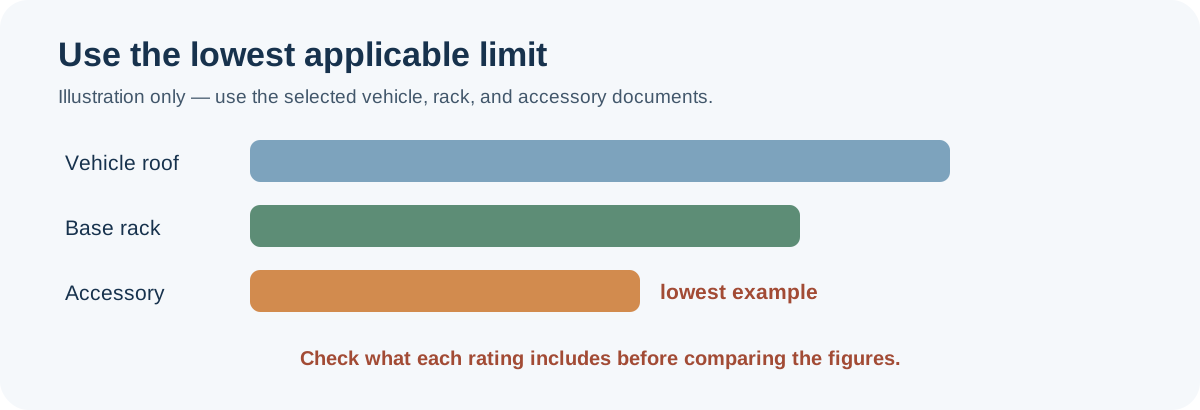
Also separate the bar or accessory’s own rating from the vehicle’s roof limit. The usable setup is governed by the lowest applicable limit. Check what each figure includes: a vehicle manual may specify total roof load, while a product page may state the rack or carrier’s capacity. Include the weight of equipment when the vehicle’s definition requires it, and do not treat a higher accessory rating as permission to exceed the vehicle or base-rack limit.
A practical fit check
- Photograph the installed bars and record every model and part number.
- Measure width, height, spacing, and clearance at the points named in the accessory manual.
- Match the mounting hardware and adapter to both the accessory and the bar family.
- Check the current fit guide for the exact vehicle and roof configuration, then compare all applicable limits.
- If a dimension, part identity, or clearance remains unknown, pause and ask the accessory maker or a qualified fitter.
For the roof attachment and parts chain, see roof types and component paths. The Crosstrek guide shows how model year and roof configuration affect the selected base. If you are moving an existing rack, use the transfer checklist and remeasure it on the new vehicle.
Sources and product references
Use these references to check the current instructions and fit information for your market and exact setup.
- FAQs & Fitting Timesprimary
- Thule Hull-a-Port Aeroprimary
- Roof Rack Guideprimary