Check each rack component against the new vehicle and current fit instructions before reusing bars, feet, kits, adapters, or accessories.
On this page
Can You Transfer an Old Roof Rack to a New Vehicle?
Sometimes a rack’s bars can be reused; sometimes the feet, vehicle-specific kit, or the whole system must change. A familiar brand, a similar roof shape, or a bar that appears wide enough does not establish compatibility. Treat a vehicle change as a new fit check for every component before putting the rack on the road.
Inventory the old system
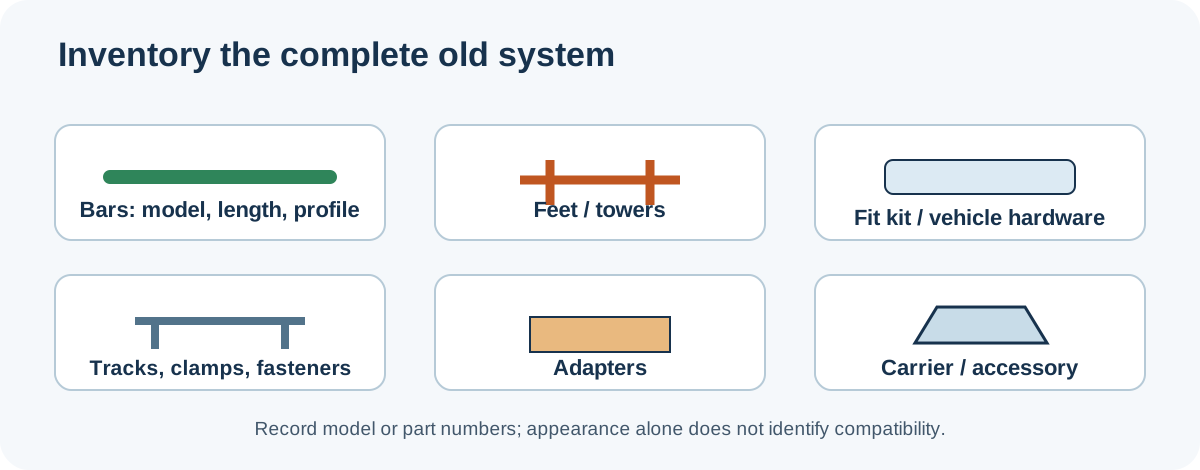
Before removing anything, photograph the installed rack and record:
- Rack brand, product family, generation, and serial number if available.
- Each bar’s model or part number, length, profile, and mounting channel.
- The feet or towers, fit kit, track hardware, clamps, adapters, and fasteners.
- The accessory models and any instructions or labels kept with them.
- The old vehicle’s year, body, trim, market, and roof interface.
Do not identify a part by appearance alone. A similar foot can use a different vehicle-specific kit, and a discontinued part may look interchangeable without being approved for the new roof.
Compare the old and new vehicle in the maker’s fit tool
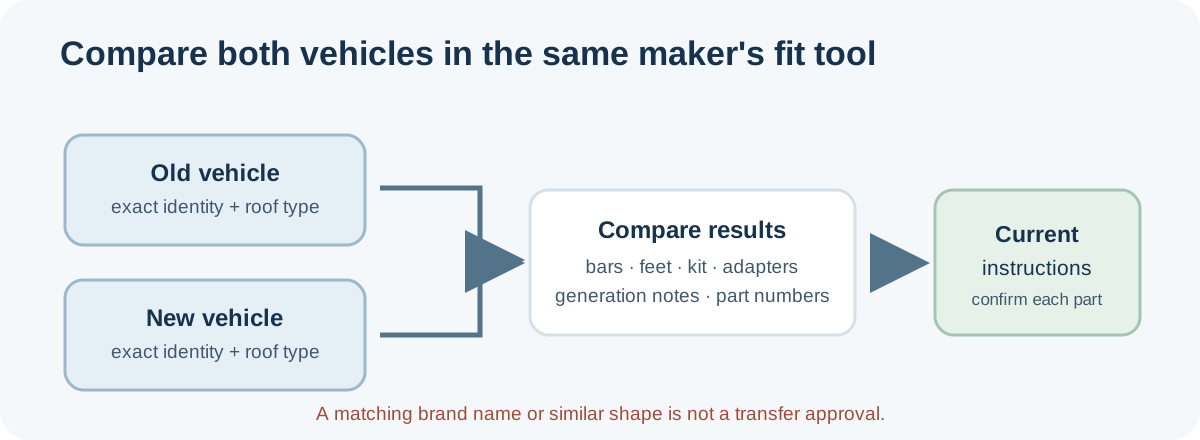
Select the old vehicle and the new vehicle separately in the rack maker’s current fit guide. Compare the returned component lists, then check the installation manual and any generation notes for each part. Thule’s US guidance, for example, describes bars, feet, and a vehicle-specific kit as system components and says raised-rail systems may not use a separate kit. Its reuse guide says bars from the previous generation may fit current-generation feet, but old feet packs cannot be combined with new kits. It also cautions that a vehicle released after 2019 may require a different path. These statements describe Thule systems; they are not rules for other brands.
Rhino-Rack likewise tells owners that an old rack may or may not fit a new car and directs them to its vehicle-fit path. That is the right default for any brand: confirm the exact bar, foot, kit, roof interface, and vehicle together. A rack manufacturer’s general accessory statement cannot override the specific result for your vehicle.
Reuse only the parts the current result confirms
Use the comparison as a component checklist:
| Component | What to confirm for the new vehicle |
|---|---|
| Bars | Exact generation and part number, usable length, shape, and accessory interface |
| Feet or towers | Correct roof type and compatibility with the bar and any kit |
| Fit kit or vehicle hardware | Exact new-vehicle application, generation, fasteners, and installation instructions |
| Adapter | Exact accessory-to-bar combination and any stated dimensions or limit |
| Carrier or cargo accessory | Fit on the bars, required spread, vehicle clearance, and current instructions |
If the manufacturer says a bar can transfer but the new feet or kit are different, replace those parts as directed. Do not mix generations or substitute hardware without an explicit compatibility result. A change from raised rails to flush rails, fixed points, tracks, or a bare roof is a different attachment path even when the bars are unchanged.
Recheck the complete loaded setup
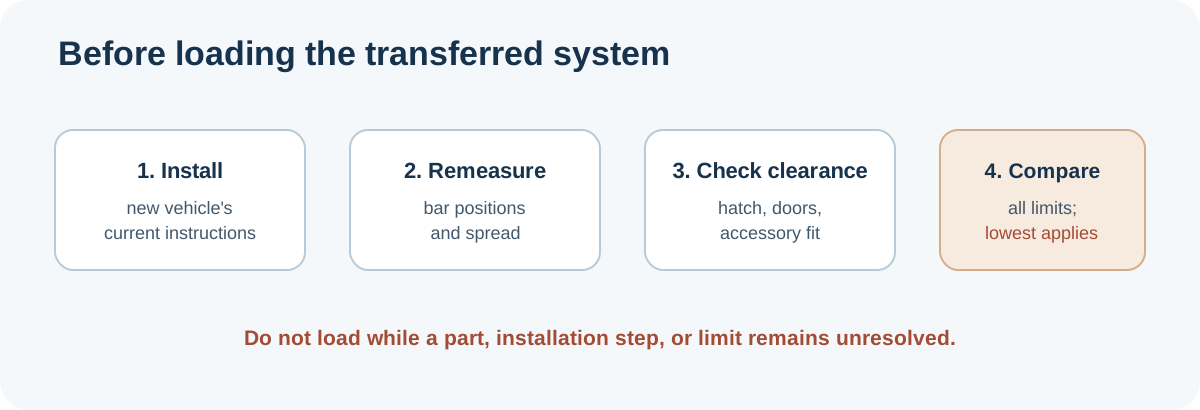
After a confirmed transfer, install the parts using the current instructions for the new vehicle. Measure the bars again and confirm accessory clearance; the new roof may change bar spacing or hatch clearance. Then check the vehicle, base-rack, and accessory limits together. Use the lowest applicable limit and account for the rack and carrier weight when required by the vehicle manual. Do not carry a load if a part number, fit result, installation step, or limit remains unresolved.
If the fit guide has no result, a part is discontinued, or the system generations do not match, send the manufacturer the rack serial number, both vehicle identities and roof types, and clear photos of the system. Thule specifically requests those details when its fit tool does not resolve a change. A qualified fitter can help identify the system, but a visual inspection should not replace manufacturer approval. For the new vehicle’s roof path, see roof types and components; for bar measurements, use the geometry checklist.
Sources and product references
Use these references to check the current instructions and fit information for your market and exact setup.