Compare aero, square, and round crossbars with channel-based platforms by interface, usable space, accessories, installation, and your intended load.
On this page
Aero, Square, Round, or Platform: Choosing a Base Rack System
The right base rack is the system that fits your vehicle and accepts the accessory you plan to carry. Aero, square, and round bars describe different crossbar shapes; a platform provides a broader mounting surface and often uses channels or a grid of attachment points. None is automatically the quietest, strongest, or most versatile choice across every vehicle and product line.
Begin with roof fit and the job
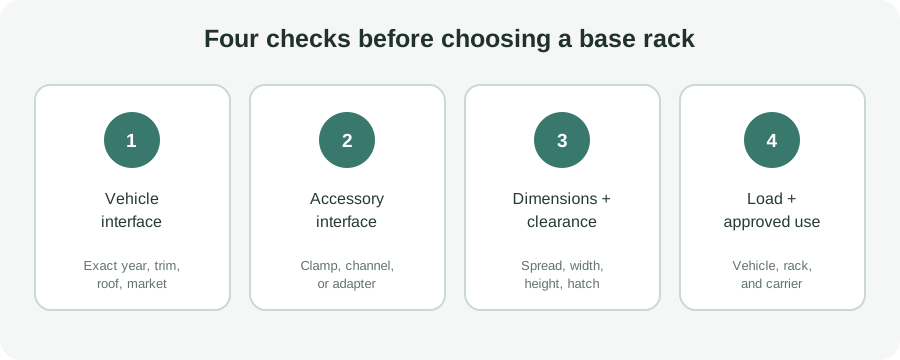
Identify the exact vehicle year, trim, roof type, and market. Use the rack maker’s current vehicle lookup and the vehicle manual to establish a supported mounting path. A bare bar type is not a complete rack: the system may also need feet or towers, a vehicle-specific fit kit, clamps, or approved adapters. Record those parts before weighing shape or features.
Next, list what you will carry and how often. A box, ski carrier, bicycle mount, kayak cradle, work load, and rooftop tent can impose different interface, spacing, access, and load requirements. If more than one accessory matters, verify each accessory against the exact base system. A bar that accepts one clamp width does not necessarily accept another, and a platform channel can still require a matching bolt or adapter.
How the common forms differ
| Form | What it offers | Questions to verify |
|---|---|---|
| Aero crossbars | A shaped bar profile; many models include a top channel for compatible T-track hardware | Which specific accessories fit the channel or clamp around the bar? What are the bar dimensions and approved vehicle fit? |
| Square crossbars | A simple rectangular bar profile used by some rack families | Does the accessory clamp fit the bar width and height? Are any adapters required? |
| Round crossbars | A round tube profile used by some rack families | Is the accessory clamp designed for this diameter, and does the maker approve the combination? |
| Platform | A larger surface with product-specific channels or mounting positions | What are the platform dimensions, mounting path, accessory hardware, height, and load limits? |
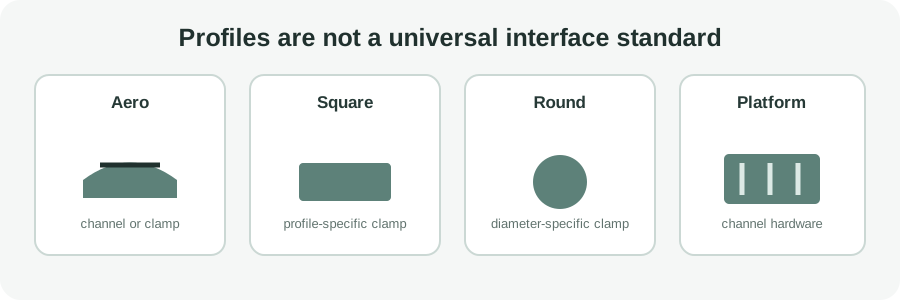
The names do not standardize every measurement or interface. Yakima’s product range, for example, includes distinct JetStream, CoreBar, and RoundBar forms; the exact tower and accessory pairing still matters. For crossbar length, use the brand’s vehicle-specific lookup. A published minimum length or a longer bar that appears to fit is not approval for a particular car, tower, accessory, or overhang.
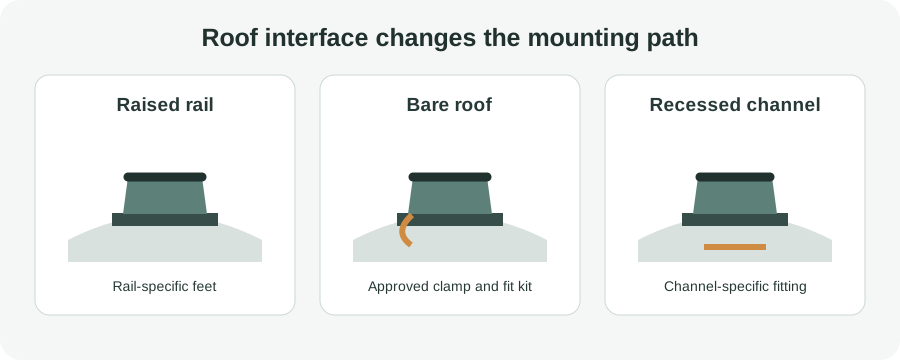
Vehicle brochures can show why roof type and trim belong in the comparison. Toyota’s 2024 US Highlander brochure describes roof-rail bars for XLE, XSE, Limited, and Platinum, but an inside-roof fitting path for L and LE. It gives no load figure in that entry, so the owner’s manual still controls. This is a trim-specific example, not a substitute for selecting the exact vehicle and part.
Product-specific measurements can help screen an interface but do not prove a vehicle fit. For example, Thule lists its Caprock crossbar kit 611300 for bars up to 95 mm wide and between 17 mm and 46 mm tall. Those dimensions apply to that named kit’s crossbar interface; they do not rate the vehicle roof, establish compatibility with every platform, or authorize a load. Check both parts’ current instructions and the exact vehicle result.
For a chosen system, compare the full chain from vehicle attachment to accessory. A Thule WingBar Evo 135 (model 711400) is listed as a two-bar pack with T-track; its feet and vehicle-specific fitting kit are separate, and some carriers need an adapter. The product page’s 100 kg bar maximum is not the installed vehicle limit. Confirm the package, feet, kit, and accessory against the exact current fit result.
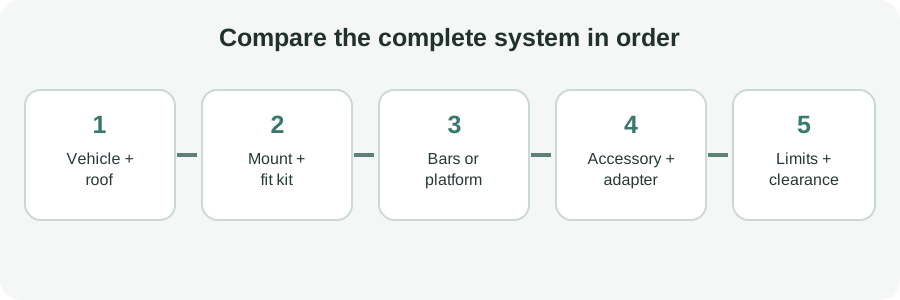
Compare usable space, clearance, and installation
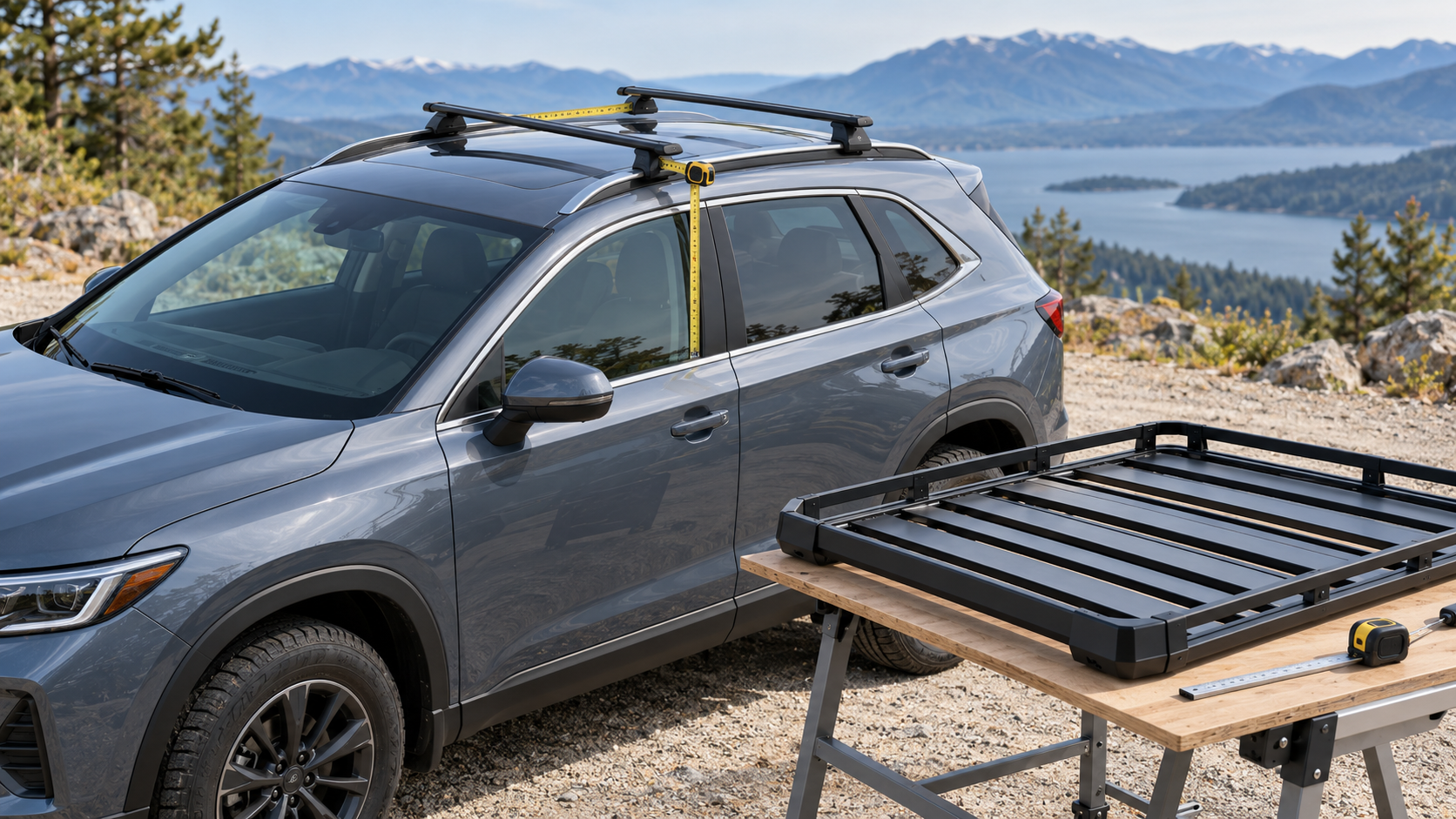
Measure the actual setup described by the manufacturer. Check the distance between bars, the remaining usable width after feet and accessories are installed, roof clearance, total height, hatch movement, and whether the chosen accessory can be positioned without interfering with another load. A platform’s larger surface can help with modular cargo layouts, but its footprint, mounting hardware, and added height need to suit the vehicle and garage or route clearances.
If noise or drag is important, compare specific models on the same vehicle under comparable conditions. Product shape alone cannot predict the result: vehicle roofline, bar position, uncovered channels, accessories, and speed all affect the outcome. The Qashqai roof-bar test is a dated single-vehicle example, not a performance ranking for other cars.
Treat loads and special uses as separate checks
Use the vehicle’s stated roof limit and the selected rack and accessory ratings together. Include the weight of bars, towers, platform, adapters, and cargo where the manual requires it. As one model-specific example, the 2025 Ford Bronco Sport manual gives different roof-load figures for glass-roof and non-glass-roof versions and says to distribute the load evenly on crossbars; those figures do not transfer to another vehicle.
A rooftop tent needs its own exact compatibility check. Confirm that the vehicle roof, rack, tent, bar spread, and load path are all approved for the intended use. Thule’s general tent-fit guide is not a substitute for a tent-specific compatibility list or the instructions for a named rack and vehicle. Do not infer that a rack is tent-approved because a platform looks substantial or because a general static-load statement appears favorable.
Subaru’s 2025 US Ascent brochure illustrates how use approval can differ within one maker’s crossbar range: it says Aero set SOA843X040 does not support rooftop tents, while the separately listed Thule Aero Extended sets are identified for tent use by trim. That example applies only to the listed Ascent parts and brochure; verify the vehicle, bar spread, tent, and current instructions together.
Make the choice with a complete setup list
- Save the current vehicle-specific result for the exact roof and market.
- List every required base component, adapter, and planned accessory.
- Check interface measurements and accessory compatibility in the instructions.
- Compare clearance, usable surface, removal effort, and any relevant noise evidence.
- Apply the vehicle, rack, and accessory limits to the complete loaded system.
- Recheck current product instructions before installation or adding a new accessory.
Choose by documented fit and the work the system must do. If the decisive interface, accessory approval, or load information is missing, keep the comparison conditional and ask the maker for the exact combination before buying or loading it.
Sources and product references
Use these references to check the current instructions and fit information for your market and exact setup.
- Everything you need to know about roof racksprimary
- Roof racks and platformsprimary
- Yakima crossbar length guidanceprimary
- Yakima JetStream (Pair)primary
- Yakima CoreBar (Pair)primary
- Yakima RoundBar (Pair)primary
- 2025 Ford Bronco Sport Owner's Manualprimary
- Thule Caprock crossbar kit 611300primary
- Will a rooftop tent fit my car?primary
- 2024 Highlander Accessory eBrochureprimary
- 2025 Ascent Accessories Brochureprimary
- Thule WingBar Evo 135primary