A vehicle-first method for comparing Thule and Yakima roof-rack systems by fit status, complete parts path, interface, limits, installation, and regional support.
On this page
Thule vs. Yakima: How to Compare Compatible Systems for Your Vehicle
Thule and Yakima both sell multi-part rack systems, but a brand name alone does not tell you whether a setup fits your vehicle. Start with the exact year, make, model, trim, roof type, and country. Then compare the complete options that each manufacturer’s current fit tool actually lists for that vehicle and the cargo you plan to carry.
1. Check each brand’s result for the same vehicle
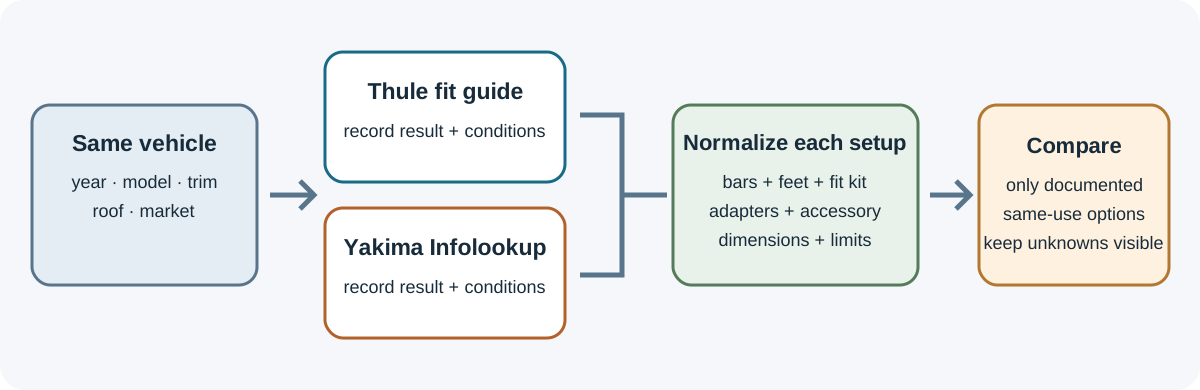
Enter the same vehicle details in Thule’s fit guide and Yakima’s Infolookup. Select the correct roof style and inspect the result, not just the first product card. Yakima distinguishes different fit states in its lookup; read the status and its explanation on the live result rather than treating a search match, a conditional result, and a confirmed fit as interchangeable. A listing in a catalog is not a vehicle-specific approval.
If one brand returns no supported setup, a custom-install path, or a result that needs more information, preserve that difference in your comparison. Do not fill a gap by borrowing another model year’s fit or by assuming that two vehicles with similar roofs use the same feet and kit. When the result is unclear, ask the manufacturer or an authorized fit specialist for the exact part numbers and supporting instructions.
2. Compare the whole parts path
Write down every component needed for each candidate: bar or platform, feet/towers, vehicle-specific clips or fit kit, locks, adapters, and the accessory itself. Confirm what is included in the package and what must be purchased separately. Two bars may look similar while attaching through different channels, clamps, or proprietary profiles. A compatible bar without the right towers or vehicle kit is not a complete system.
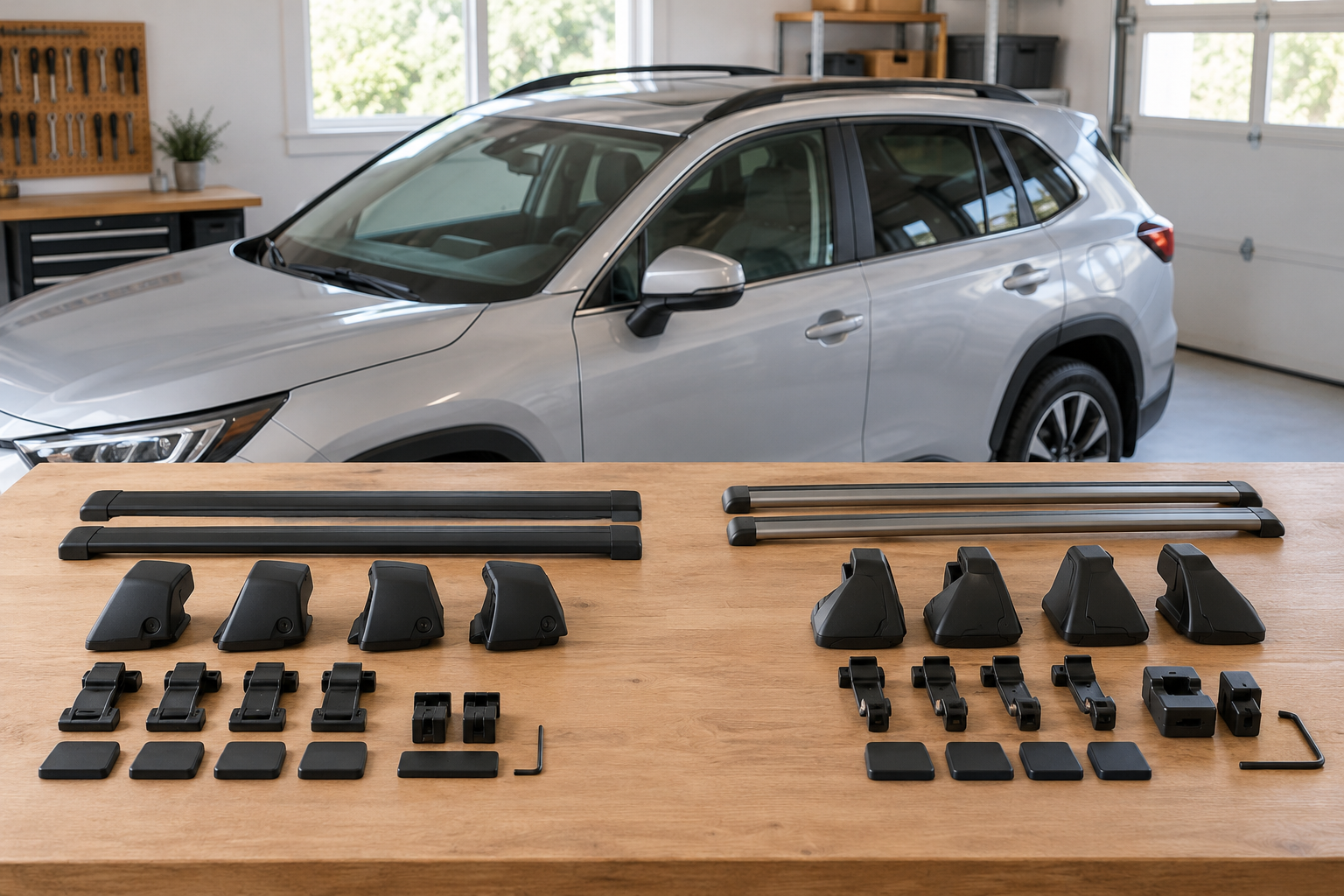
Use this short worksheet for each candidate:
| Check | Thule | Yakima |
|---|---|---|
| Exact vehicle and roof selected | Record the live result | Record the live result |
| Fit status and any conditions | Copy the manufacturer’s wording | Copy the manufacturer’s wording |
| Bar/platform, feet/towers, and fit kit | Record exact part numbers | Record exact part numbers |
| Accessory interface and adapters | Verify for each accessory | Verify for each accessory |
| Published dimensions and capacity | Match to the specific parts | Match to the specific parts |
| Instructions, support, and local seller | Confirm for your market | Confirm for your market |
This makes missing components and mismatched assumptions visible before you compare price. A listed bar length or accessory interface is a sizing detail; it does not establish that the bar, tower, load, or overhang is approved on your vehicle.
3. Compare for the job, not the logo
Consider the accessory you intend to use: box, bike carrier, kayak cradle, ski carrier, basket, or platform-mounted equipment. Verify that the accessory’s clamps or channel hardware fit the selected bar or platform and that the manufacturer allows that combination. Compare usable bar length, spacing, clearance over the roof, hatch opening, installation steps, lock coverage, and how easily the accessories can be removed. Noise and aerodynamic claims should be tied to a specific model and configuration; they are not safe assumptions across every bar in a brand’s range.
The 2025 Nissan Qashqai roof-bar test gives a useful example of why setup matters: Auto Express compared seven bar sets on one UK-market vehicle, but describes the test car’s rails as both fixed and flush in different parts of the report without resolving the terminology. Some fit, accessory, and installation observations were specific to that test. Its results do not identify a universal Thule or Yakima winner or establish compatibility with another Qashqai roof.
4. Check limits and ownership terms separately
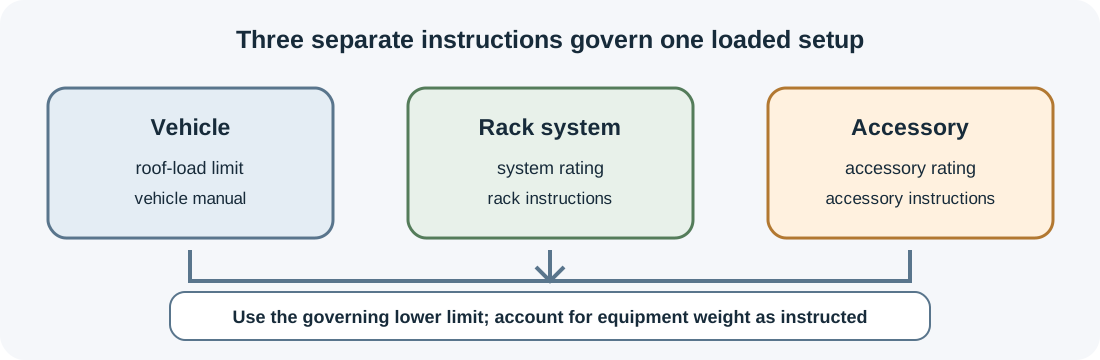
The vehicle’s roof limit, rack-system rating, and accessory rating all matter. Follow the exact vehicle manual and each selected product’s instructions; where limits differ, use the governing lower limit after accounting for the rack and accessory weight as the vehicle instructions require. Do not infer a dynamic or stationary limit from a different product or from a brand-wide marketing page.
Warranty coverage is a separate decision from fit. Terms can vary by product category, purchase country, original purchaser, seller, and transfer of ownership. Read the current warranty page for the exact market and product, and check who handles a claim. Neither a rack-brand warranty nor an OEM accessory label decides how a vehicle manufacturer’s warranty applies to a particular repair.
A practical buying sequence
- Confirm the vehicle identity, roof equipment, and market.
- Save each brand’s current fit result and read any conditions.
- Build a complete component list for the same intended cargo.
- Verify interfaces, measurements, instructions, and all applicable limits.
- Compare installation effort, replacement/support path, local terms, and dated price.
- Buy only when the complete combination is documented; keep the fit result and instructions with your records.
If you cannot make the two options comparable for the same vehicle, market, and use, report the unknown instead of awarding a brand winner. That is a useful buying answer: it tells you exactly what needs to be confirmed before spending money or loading the vehicle.
Sources and product references
Use these references to check the current instructions and fit information for your market and exact setup.
- Thule Find the Right Fitprimary
- Yakima Infolookupprimary
- Auto Express roof-bar testspecialist