Compare roof boxes and rear-mounted cargo carriers by fit, loading height, access, clearance, load, security, and the limits of fuel or EV range claims.
On this page
Roof Box or Rear Carrier: Which Cargo Solution Fits Your Vehicle?
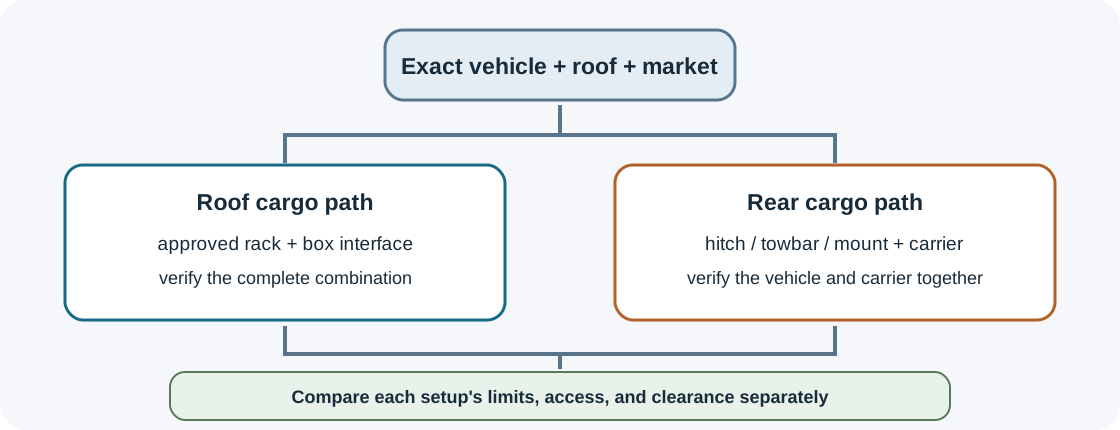
A roof box and a rear-mounted carrier put cargo in different places and use different mounting systems. The best choice depends on your vehicle’s documented fit, the shape and weight of the gear, how often you need access, and the trip you plan to take. A vehicle that supports one option does not automatically support the other: verify the roof-rack path and the rear carrier’s hitch, towbar, or other interface separately.
Start with the cargo and the vehicle
Measure the items you need to carry and note their weight, shape, and sensitivity to weather. Long skis, bulky soft bags, a stroller, camping equipment, and dirty or wet gear create different packing problems. Then check the exact vehicle year, trim, body style, and market. For roof cargo, identify the approved rack and box combination. For rear cargo, establish that the vehicle and carrier use a compatible hitch or other mounting point and confirm any vehicle-specific limits.
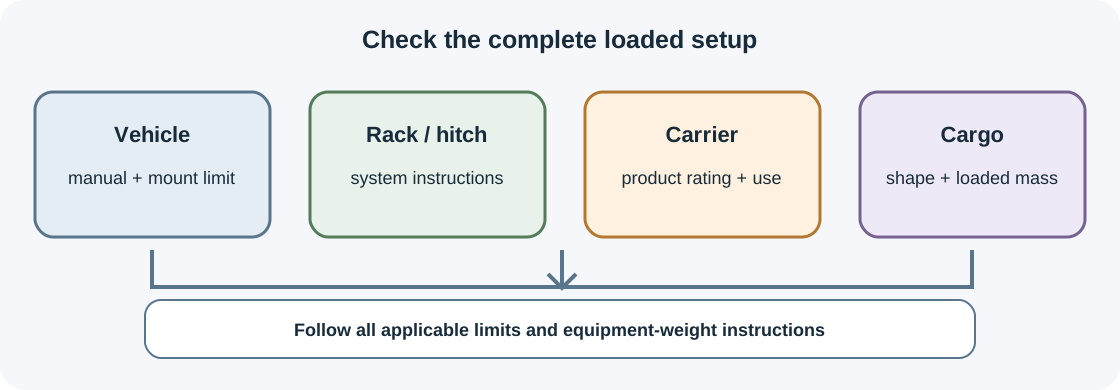
Compare the loaded system rather than the empty container alone. Include the carrier, box, rack or hitch hardware, adapters, and cargo when applying the instructions. A rear hitch’s vertical load limit may be affected by the combined mounted weight and by a different vehicle or hitch rating. The applicable vehicle and product documents determine what is permitted.
Compare how each location works day to day
| Decision factor | Roof box | Rear-mounted carrier |
|---|---|---|
| Loading | Often requires lifting items above shoulder height; check lid opening and safe access | Usually lower loading height; check platform or box access and loading position |
| Vehicle access | Box length and position can affect hatch or tailgate opening | Carrier may obstruct the hatch, door, lights, plate, sensors, or rear camera; check the exact setup and local rules |
| Clearance | Adds height; account for garages, branches, and route restrictions | Can reduce rear ground clearance or increase total vehicle length; consider ramps and departure angle |
| Cargo fit | Enclosed boxes suit many long or weather-sensitive items within their interior dimensions | Rear boxes or platforms can suit bulky loads; shape and restraint points vary by model |
| Mounting | Requires a compatible roof rack and box interface | Requires its own compatible receiver, towbar, or vehicle mounting system |
| Storage and handling | A large box may need lifting and off-season storage | A carrier may be heavy or awkward to attach; check folding, removal, and storage instructions |
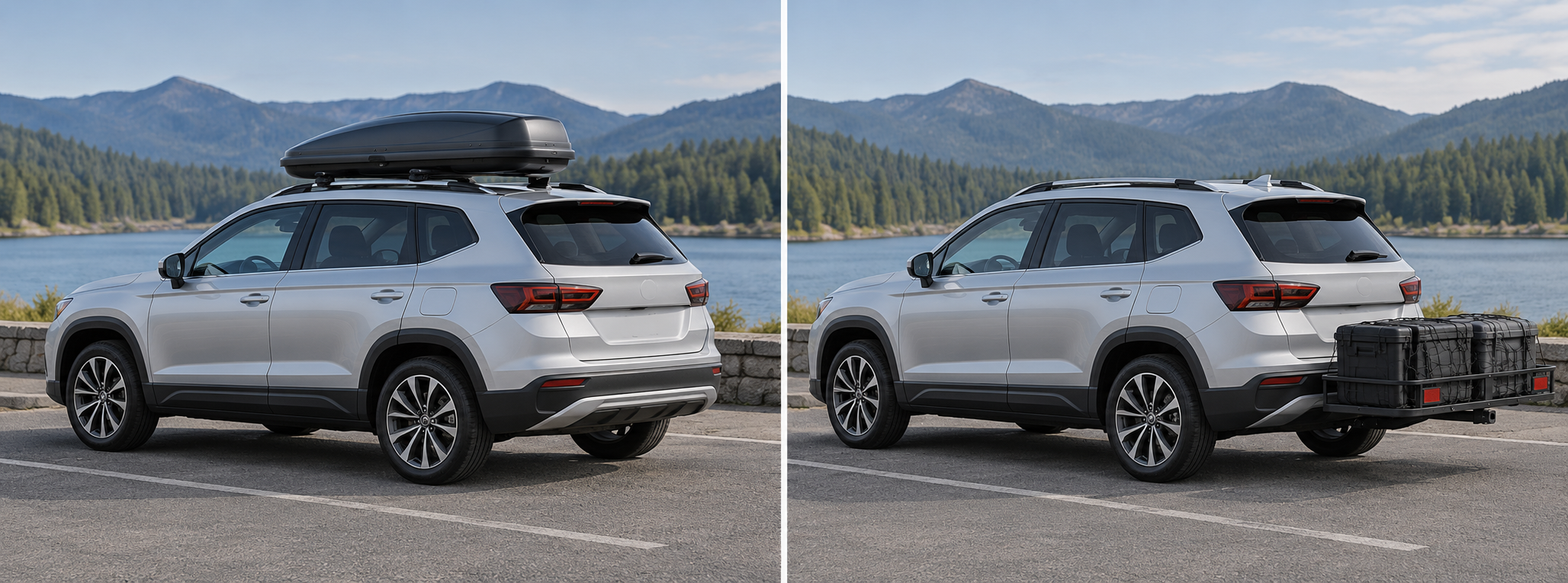
Thule’s comparison guidance also identifies vehicle height and length, gear shape and weight, and installation as useful decision points. A roof basket is another open-roof option for some irregular loads, but it has its own fit, tie-down, weather, and load requirements. Neither carrier format is a shortcut around those checks.
Estimate trip impact carefully
Extra equipment changes airflow, energy use, and sometimes access to the vehicle. The UK Vehicle Certification Agency gives illustrative figures of around 22% higher fuel consumption for a roof box at 62 mph, around 39% at 75 mph, and around 7% for empty roof bars at motorway speeds. These are public-guidance examples, not predictions for every vehicle, box, speed, load, or electric vehicle. Removing unused roof equipment can reduce drag, but the actual effect depends on the complete setup and conditions.
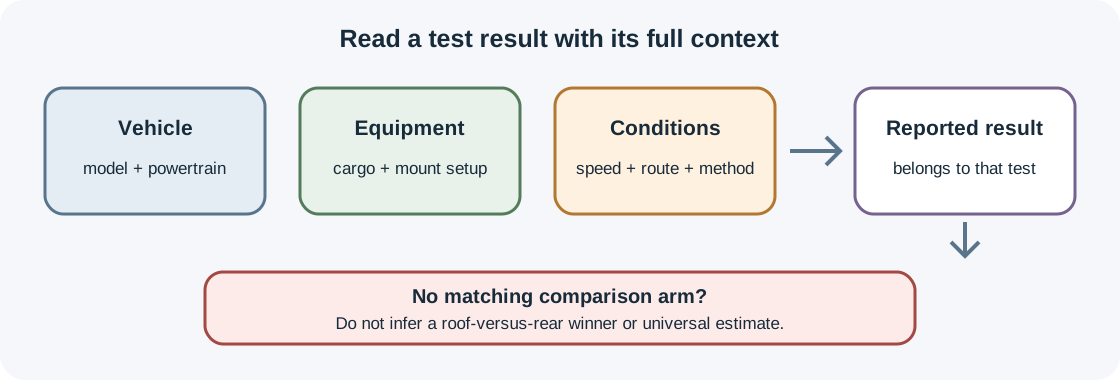
Controlled and editorial tests reinforce why one number cannot settle the choice. Oak Ridge National Laboratory’s older measurements cover particular vehicles and cargo fixtures; its reported results do not establish a universal roof-versus-rear factor. Car and Driver’s 2025 comparison used one Toyota Grand Highlander Hybrid with different roof and hitch-mounted setups, so it did not isolate mount location from the fixtures and configurations. ADAC’s 2024 roof-box test and AUTO ZEITUNG’s separate box comparison assess particular products and methods, not the performance of every box on your vehicle.
For EVs, use the same caution with range claims. Tests on different vehicles and cargo configurations have produced different relative energy results. In a 2026 fixed-speed test, Automobile Propre reported these 130 km/h readings for an empty Thule Arcos Box and platform versus no added box:
| Test vehicle | No added box | Empty Arcos Box and platform |
|---|---|---|
| Skoda Elroq 85 | 28.3 kWh/100 km | 26.3 kWh/100 km |
| Volkswagen ID.Buzz | 35.1 kWh/100 km | 32.9 kWh/100 km |
| Ford Kuga full hybrid (E85) | 10.1 L/100 km | 9.1 L/100 km |
The publication measured at fixed GPS speeds in both directions on a short motorway section, with dry pavement and air conditioning off. It did not report repeat counts, uncertainty bounds, cargo load, or detailed wind controls. The Kuga used E85, so its fuel-consumption figures are not comparable with the EV energy figures. The test had no roof-box comparison arm; these readings describe only the named vehicles and setup and cannot tell a reader which mounting location is more efficient or predict another vehicle’s trip impact. Look for a test that matches your vehicle, cargo, speed, and equipment before treating a figure as useful for trip planning.
Check access, visibility, security, and local requirements
Before purchase, confirm how the installed carrier affects the hatch, rear lights, number plate, camera, parking sensors, and visibility. Check any required lighting or plate arrangement for the country where you will drive. These requirements are jurisdiction-specific; the carrier maker’s fitting instructions and the local authority’s current rules should govern.
Check how cargo is restrained, how locks work, and whether the carrier can be opened or removed when loaded. A lock does not by itself establish theft protection, and enclosure does not make cargo weatherproof in every condition. Follow the selected product’s directions for loading and securing items.
Choose the option with a documented complete path
- Confirm the roof system or rear mounting point for your exact vehicle.
- Compare interior dimensions, cargo weight, loading height, and access.
- Check vehicle height, rear clearance, total length, and visibility effects.
- Apply all vehicle, rack/hitch, carrier, and accessory limits to the loaded setup.
- Compare the installation, storage, security, and removal work you will actually do.
- Treat efficiency figures as test-specific; remove equipment when it is not needed if the maker’s instructions allow.
Choose by your cargo and route, not by a universal roof-versus-rear ranking. If the exact fit, limit, or rear-access effect is unclear, pause the comparison until the vehicle and carrier makers confirm the complete combination.
Sources and product references
Use these references to check the current instructions and fit information for your market and exact setup.
- Comparing rear-mounted cargo carriers and roof boxesprimary
- Fuel efficient driving tipsprimary
- Fuel Economy and Emissions Effects of Low Tire Pressure, Open Windows, Roof Top and Hitch-Mounted Cargo, and Trailerprimary
- Dachboxen im ADAC Test: 13 Modelle fürs Auto im Vergleichauthoritative-secondary
- Rooftop Cargo Box Hurt Our Toyota Grand Highlander's Highway MPGspecialist
- Thule Arcos Box consumption testspecialist
- Schaffen E-Autos mit Dachbox Urlaubs-Reichweiten?specialist
- Neun Dachboxen im Test: Die Beste ist nicht die Teuerstespecialist