Learn which part connects a vehicle to its base rack, which part connects a carrier to the rack, and what to verify before buying.
On this page
When Does a Roof Rack or Carrier Need a Fit Kit or Adapter?
A fit kit and an adapter solve different gaps. A fit kit generally connects a base rack to the vehicle’s roof attachment points. An adapter connects an accessory to a bar, platform, or other part of the base system. Some setups need one; others need both, and some use a base system that does not require a separate fit kit. Check the exact vehicle and product instructions before deciding.
Find the missing connection
Think of the setup as three links:
- Vehicle to base rack. The vehicle’s year, model, trim, roof type, factory rails, fixed points, tracks, or other attachment features determine which base rack can be installed.
- Base rack to accessory. The bars or platform must accept the accessory’s mounting hardware, either directly or through a product-specific adapter.
- Accessory hardware to cargo. Some carriers need their own straps, locks, brackets, or other parts to hold or position the load.
Name the two parts at either end of the gap. “I have a roof rack” is not enough to identify a kit: the bar or platform family, the carrier model, and their generations can change the required hardware.
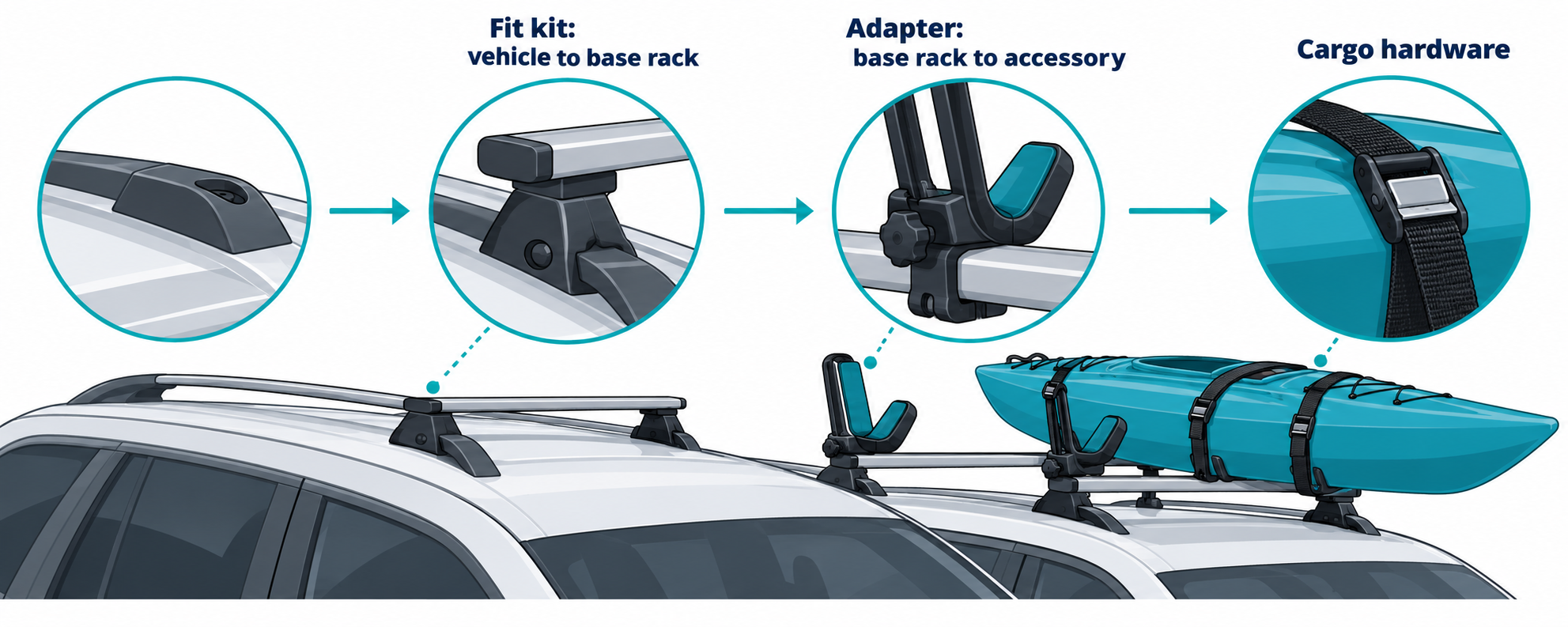
A fit kit connects the vehicle and base rack
Thule describes its roof-rack system as bars, feet, and a fit kit. The fit kit is the vehicle-specific part that lets the feet attach to the vehicle’s roof type. Its catalog is intended for vehicles without pre-installed attachment points. Other manufacturers may use different names or system designs, so use the selected vehicle’s current fit guide rather than assuming every rack follows the same parts list.
A fit-kit listing or a matching-looking attachment point is not a complete vehicle result. Select the exact market, year, model, body or trim, and roof configuration. Then confirm the base-rack family and read the vehicle-specific installation instructions. If the maker returns an uncertain or no-fit state, do not turn it into an approval by choosing a similar kit.
An adapter connects the base rack and accessory
An accessory can attach directly to a compatible track or wrap around a bar, yet still require a separate adapter for another bar family. For example, Thule’s Hull-a-Port Aero product page describes track mounting and around-bar mounting, while requiring a SquareBar adapter for that bar. That adapter relationship does not establish that the kayak carrier and bar are approved for a particular vehicle.
Adapters can also connect a platform channel to a carrier’s bolt pattern, or bridge two named product families. The product page and instructions must identify the exact accessory, base system, and adapter. A broad phrase such as “fits most T-slots” does not supply a complete compatibility list.
Check before buying
- Write down the vehicle’s market, year, make, model, trim or body, roof type, and factory attachment features.
- Identify the installed or planned feet/towers, bars or platform, carrier, and their product numbers or generations.
- Use the vehicle fit guide for the vehicle-to-base connection and the accessory page or manual for the base-to-accessory connection.
- Check whether the kit is included, sold separately, or depends on another bracket, foot pack, bolt, or lock.
- Compare the exact instructions for mounting position, bar profile or slot, clearance, and any stated load or installation limits.
- If the exact pair of products is not listed, pause and ask the manufacturer or an authorized fitter. Do not substitute a visually similar part.
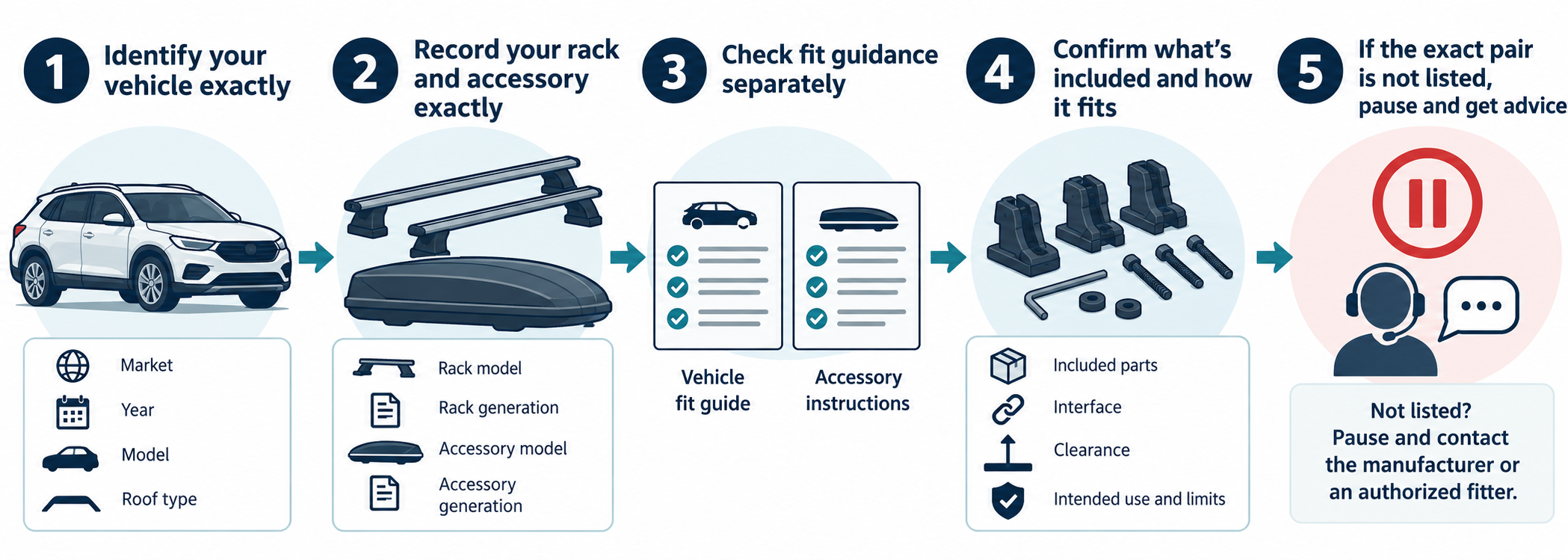
Keep fit and load checks separate
An adapter can solve a mechanical connection without approving the vehicle roof or the complete loaded system. Follow the vehicle, base-rack, accessory, and cargo instructions. The lowest applicable limit governs, and the rack and accessories may count toward the vehicle’s roof load. Recheck the installed hardware as the applicable instructions direct.
For the differences between track, clamp, and platform interfaces, see T-track, around-bar, clamp, and platform-channel adapters. For a part-number-by-part-number verification process, see how to identify the exact adapter.
Sources and product references
Use these references to check the current instructions and fit information for your market and exact setup.
- Everything you need to know about roof racksprimary
- Thule Fit Kitsprimary
- Fitting Applicationsprimary
- Thule Hull-a-Port Aeroprimary