Some rack components may transfer to a new vehicle, but the complete fit must be checked again. Compare the exact part numbers, roof configuration, accessories, and current instructions before reusing anything.
On this page
Can You Reuse a Roof Rack on a Different Car?
Sometimes. A roof rack that fitted your old car is not automatically compatible with the new one. Roof shape, attachment points, system generation, bar length, and the new vehicle’s load limits may differ. Reuse only the parts that the rack maker’s current guide identifies for the exact new vehicle.
Inventory the system you already own
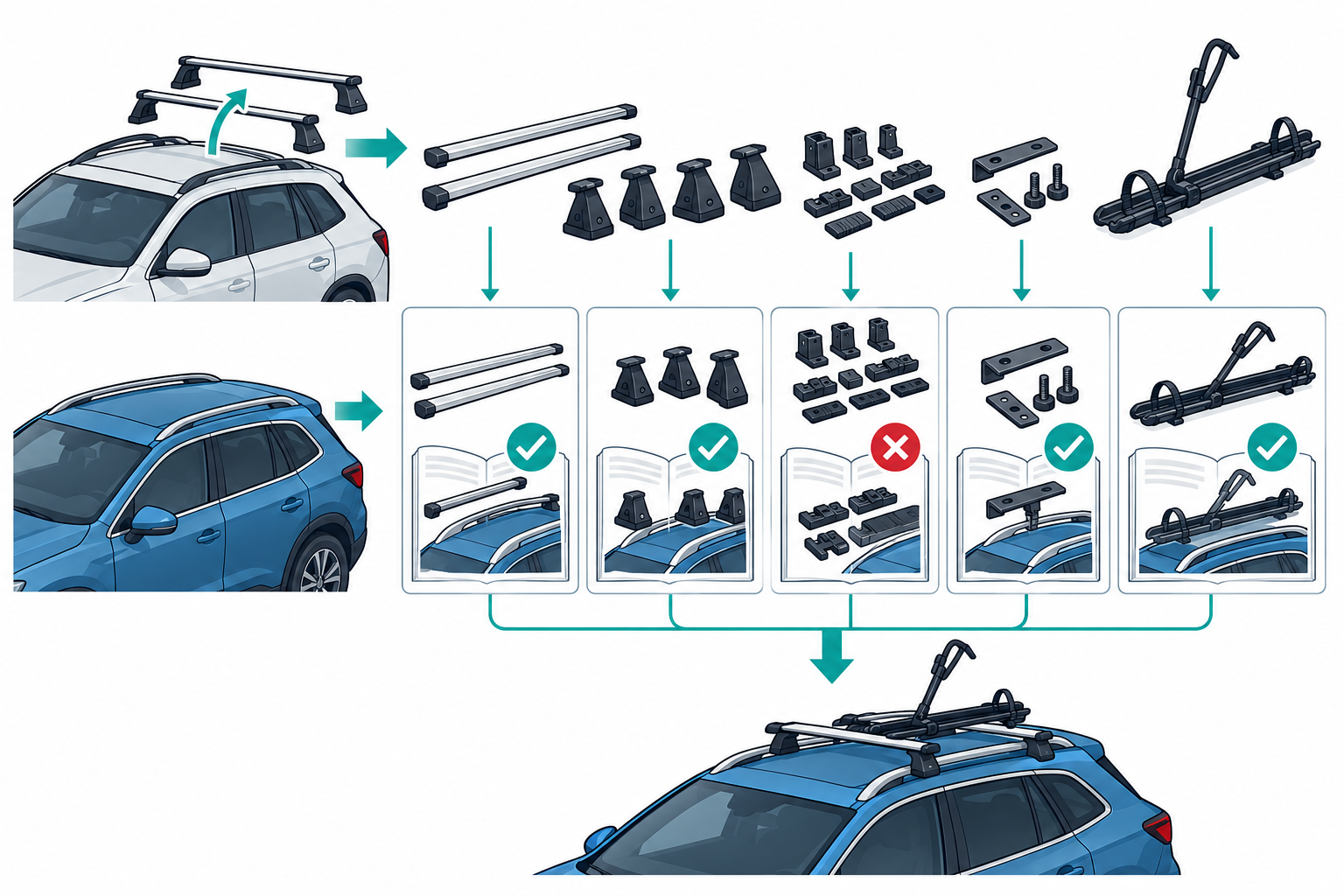
A complete setup may contain several separately identified pieces: crossbars, feet or towers, a vehicle-specific fit kit, locks, adapters, and the carrier or cargo product mounted on top. Find the brand, model, part numbers, and serial number for each piece. Look for the original installation documents or current product instructions, and note the previous car’s year, body, and roof hardware.
This matters because “I have a Thule rack” or “the bars look the same” does not identify which system generation or vehicle-specific parts are installed. If a label is worn or a part number is missing, ask the maker or an authorized dealer to identify it before trying to mount it.
Run the new vehicle through the maker’s guide
Use the same maker’s vehicle-fit tool for the new car, selecting its market, year, model, body or trim, and roof type. Compare the listed system with the parts you own one by one. A tool may show that bars can be reused but that the feet or fit kit must change; it may also require a complete replacement system.
Thule’s reuse guidance tells owners to compare the components shown for each car in its fit assistant. For the Thule Evo and Edge systems covered by that guide, the usual parts are a kit, foot, and roof bar, and raised rails are one case where a vehicle-specific kit is not needed. That example is limited to those systems; it is not a rule for every brand or roof.
Rhino-Rack’s FAQ warns owners not to assume an old rack will fit a new car. It asks them to cross-reference the current system’s product codes with the product breakdown for the new vehicle. If the result is custom or unclear, follow the maker’s dealer or specialist-fitting route instead of altering parts yourself.
Check accessories and limits again
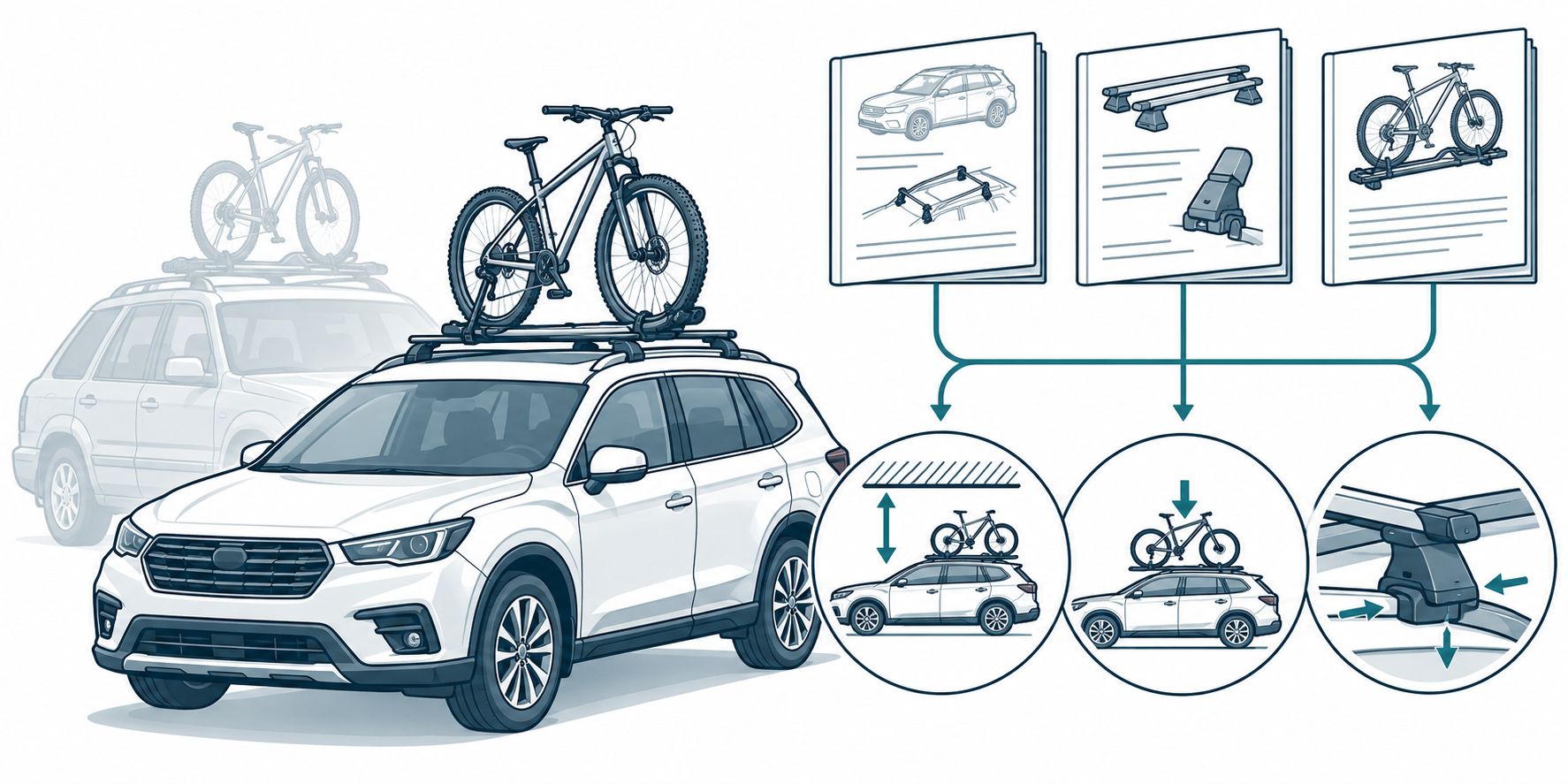
Even when the base bars transfer, recheck every box, bike rack, kayak carrier, ski carrier, or other accessory against the new bars and vehicle. Confirm the attachment interface, any adapter, bar width, spread, clearance, and the instructions for that exact combination. An accessory that fitted the old bars or sat correctly on the old roof is not automatically approved for the new setup.
Use the new vehicle’s manual to check roof-load limits and restrictions. Compare them with the current rack and accessory instructions, including how each maker counts the rack, attachments, and cargo. The old car’s limit does not carry over. Do not load the new vehicle until its base rack and accessory path are confirmed and installed as directed.
Read the outcome carefully
| Current result | Practical meaning |
|---|---|
| The maker lists the exact existing parts for the new car | Reuse only the components and combination named in the current instructions. |
| Some parts match and others differ | Replace only the components the maker identifies; do not improvise a mixed system. |
| No result, an evaluation state, or a reference-only listing | Compatibility remains unresolved or the listing may be obsolete. Ask the maker for a current answer. |
| Custom installation or a product-code mismatch | Stop and follow the manufacturer’s specialist or dealer route. |
After fitting the rack, follow its installation instructions and checks before carrying cargo. Rhino-Rack’s US FAQ, for example, calls for checking bolts and fixtures every 1,000 km and before each trip; use the inspection interval and procedure specified for your own system.
If you are shopping for a complete setup rather than transferring parts, use the exact-vehicle fitment workflow. For a label whose meaning is unclear, see how to read a fit-guide result.
Sources and product references
Use these references to check the current instructions and fit information for your market and exact setup.