Use your vehicle's market, model year, body, trim, and roof hardware to find a complete rack-and-accessory setup. Learn what to verify when a fit guide returns a conditional, unmeasured, or custom result.
On this page
How to Check Roof-Rack Fitment for Your Exact Vehicle
A roof-rack fit belongs to a particular vehicle configuration and a particular set of rack parts. Start with your country or market, then match the model year, body, trim, roof hardware, base rack, and accessory. A fit shown for another year or a similar-looking roof does not confirm yours.
Collect the vehicle and roof details
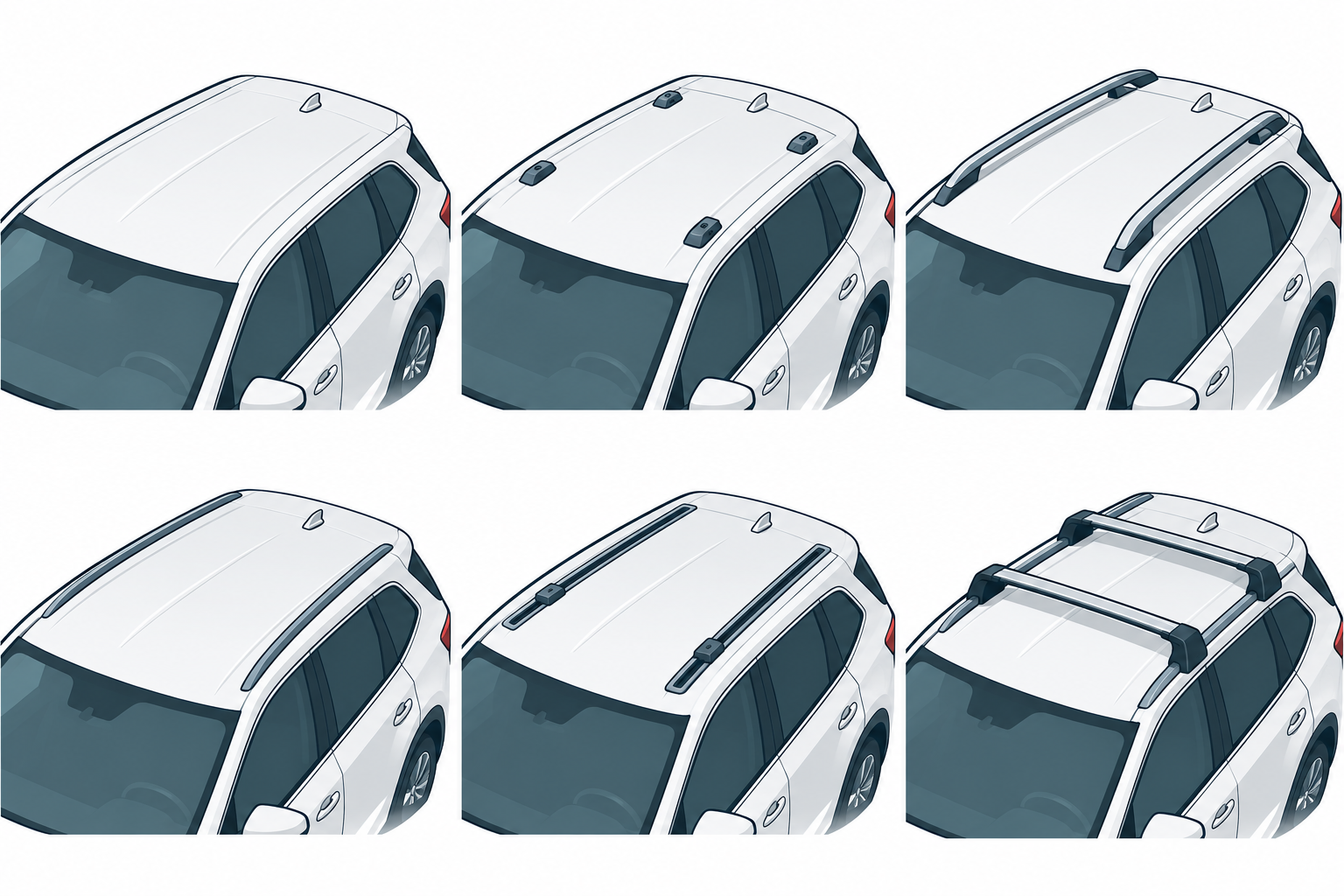
Write down the market where the vehicle and rack will be used, model year, make, model, generation or body style, and trim. Then identify what is actually fitted to the roof: bare roof, fixed mounting points, tracks, raised rails, flush rails, or factory crossbars. Note a sunroof or panoramic roof when the instructions ask about it.
Specialist roof-type guides from Rack Attack and Rack Warehouse show common visual clues. Use them to describe your roof, not to approve a rack: the vehicle maker’s manual and the selected fit guide determine which parts apply.
| What you see | Common roof type | What to verify in the selected guide |
|---|---|---|
| No factory rail or crossbar | Bare or naked roof | Some systems use vehicle-specific clips or a fit kit and feet; follow the maker’s exact attachment instructions. A decorative roof molding is not automatically a rack mounting point. |
| Small covers or strips at set locations | Fixed mounting points | Check the vehicle manual and fit guide for the correct points and vehicle-specific kit. Similar-looking covers do not establish that the same hardware fits. |
| A front-to-back rail with a visible gap underneath | Raised rail | Confirm feet designed for that rail and the matching bars. A rail running front-to-back is not itself a crossbar. |
| A front-to-back rail that meets the roof with no gap | Flush or integrated rail | Check the exact rail shape and vehicle-specific foot or kit path; these rails are not interchangeable with raised rails by appearance alone. |
| A groove or channel running front-to-back | Track | Confirm the track-specific hardware and vehicle kit. Some systems allow adjustable bar spread; use only the positions permitted by that system. |
| Bars already span from one side of the roof to the other | Factory crossbars | Check the bars’ interface, usable width, spread, accessory requirements, and the vehicle manual’s rack limit. An adapter may be needed. |
| A rain gutter or a nonstandard/permanent attachment | Gutter or custom mount | Use the vehicle and rack maker’s documented instructions or a qualified fitter; do not improvise a mounting point. |
If you already own a rack, record the brand, product or part numbers, bar type, feet, fit kit, adapters, and any serial number. Do not identify a system from its logo or bar shape alone.
Start with the matching manufacturer’s guide
Choose the correct country or market in the current fit guide. Thule’s guide lets you choose a product category and enter vehicle details or an existing rack. Yakima’s Infolookup separates Year, Make, Model, and Fit. Some makers also ask for details such as roof type or number of doors, so use the fields shown by the guide you selected.

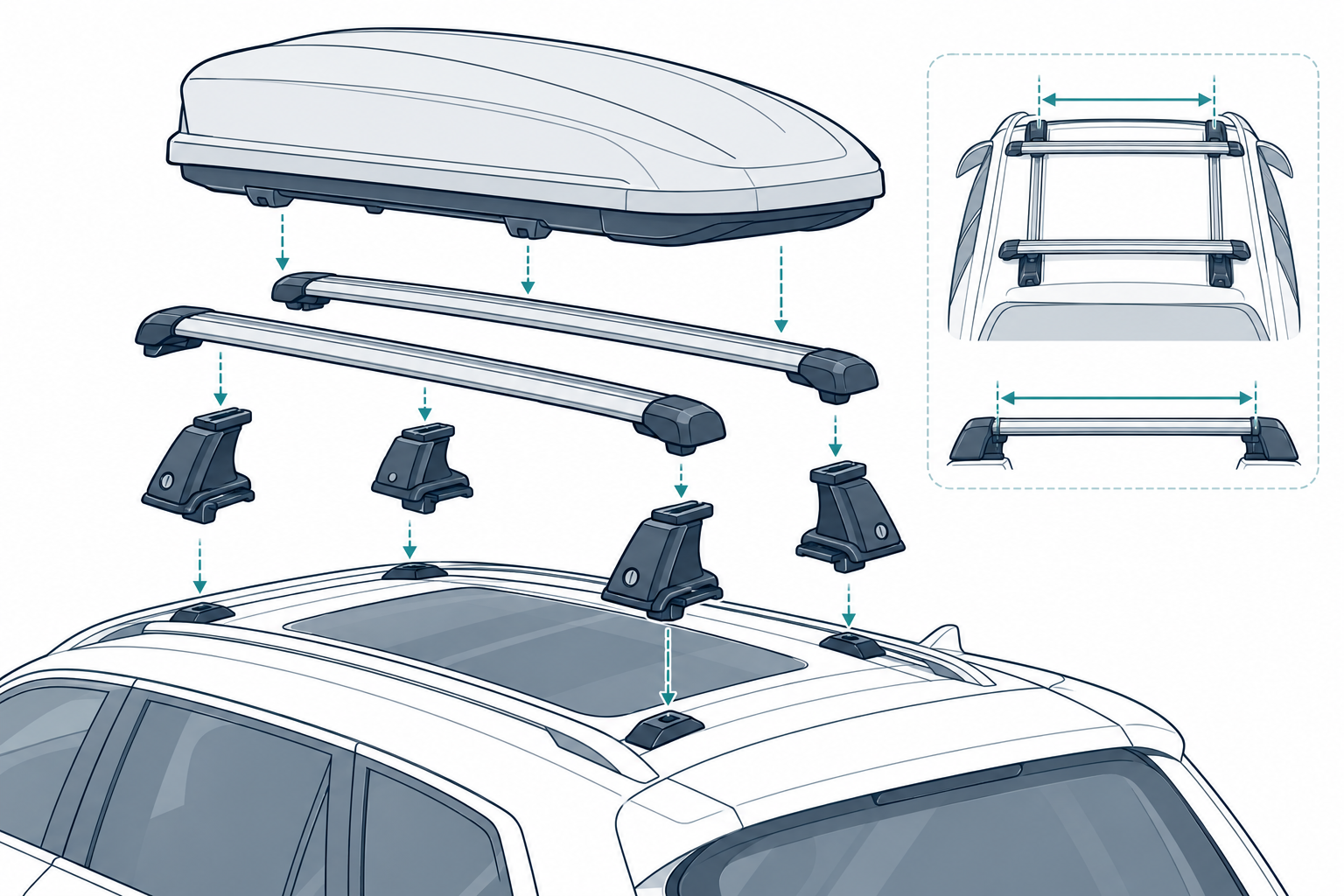
Follow the result far enough to identify the complete setup. A usual bar system may contain crossbars, feet or towers, and a vehicle-specific fit kit; some roof interfaces use a different combination. A product listing for one part, such as a fit kit or crossbar, does not by itself verify the whole system. Check the maker’s vehicle-specific installation instructions and required hardware.
Verify the accessory separately
After the base system is identified, check the carrier or cargo product against that exact system. A bike rack, kayak carrier, roof box, or other accessory may have its own bar-profile, track, clamp, adapter, spread, width, or clearance requirements. The fact that an accessory is described as broadly compatible does not establish that it fits your vehicle or its roof rack.
Record product names or part numbers rather than relying on a category label. Check front-to-back bar spread, usable bar width, hatch or door clearance, and any sunroof note when those details appear in the product instructions. The permitted interface and measurements are product-specific; do not substitute a value from a similar vehicle or another manufacturer’s system.
Read the status and check the limits
Fit tools may distinguish a confirmed fit from a configuration that is still being evaluated, in development, not yet available, custom-install-only, or listed for reference. Labels are brand-specific. See how to read a fit-guide result before interpreting a no-result or status message.
Read load information in the vehicle manual and the instructions for the rack and accessory. A rack or carrier rating is not permission to load that amount on every vehicle. Check what each applicable rating includes, account for the mounted parts and cargo as its instructions direct, and stay within the lowest applicable limit. Thule’s roof-rack guide explicitly says the vehicle’s own maximum can be lower than the rack system’s design value.
If the guide does not give a clear match
Do not treat “not measured,” “still being evaluated,” or “no confirmed fits” as a confirmed fit. They also do not automatically prove that every possible rack is incompatible. Check the selected maker’s definition, ask the vehicle or rack manufacturer about the exact configuration, or use a qualified fitter when the maker directs you to a custom installation. Do not modify a rack or improvise an attachment to turn an uncertain result into a fit.
Before buying or loading, confirm:
- the correct country or market, model year, body, trim, and roof hardware;
- the complete base rack and each required foot, fit kit, adapter, or fastener;
- the accessory model and its compatibility with those exact bars or platform;
- the measurements, clearances, installation instructions, and applicable load limits;
- what to do if the manufacturer result is conditional, unmeasured, obsolete, or custom.
If you are moving an existing system to another vehicle, use the separate rack-transfer checklist. A sound setup on one car is not automatically a match for the next.
Sources and product references
Use these references to check the current instructions and fit information for your market and exact setup.
- Find the right gear for your vehicleprimary
- Yakima Infolookupprimary
- Everything you need to know about roof racksprimary
- FAQs & Fitting Timesprimary
- Base Roof Rack Guidespecialist
- Vehicle Roof Types & How to Identify Which Roof Type You Havespecialist
- Find your vehicleprimary