Match an awning to the installed rack or tent interface, select the documented adapter path, and verify vehicle clearance and operating limits.
On this page
How to Fit an Awning to a Roof Rack, Platform, or Rooftop Tent
An awning fit has several separate links: the vehicle supports the base rack or platform; the bracket attaches to a particular bar, track, or platform; and the awning attaches to that bracket. A shared brand name, a similar-looking channel, or a broad “compatible” label does not prove that all three links fit your vehicle.
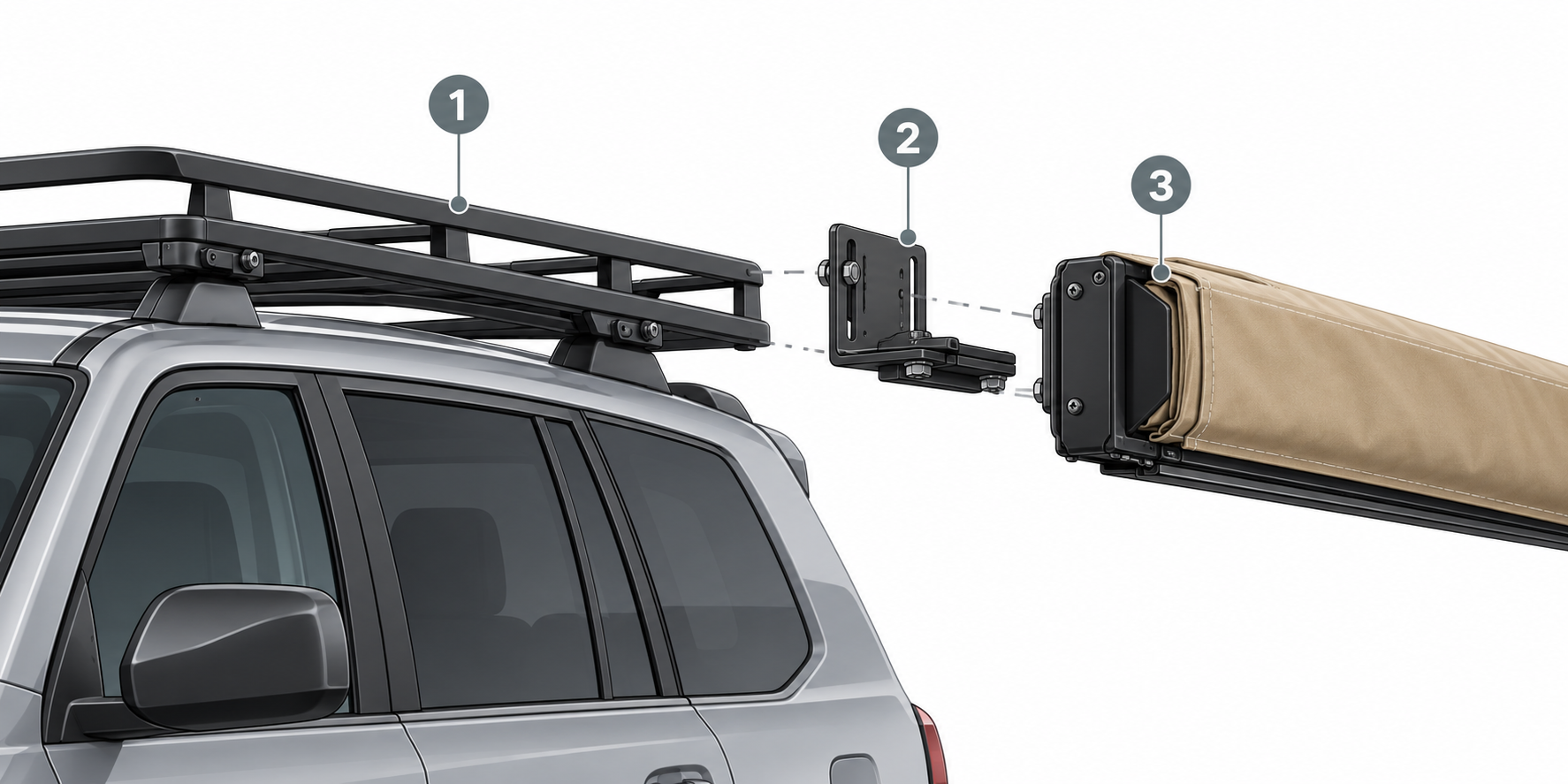
Identify the complete setup
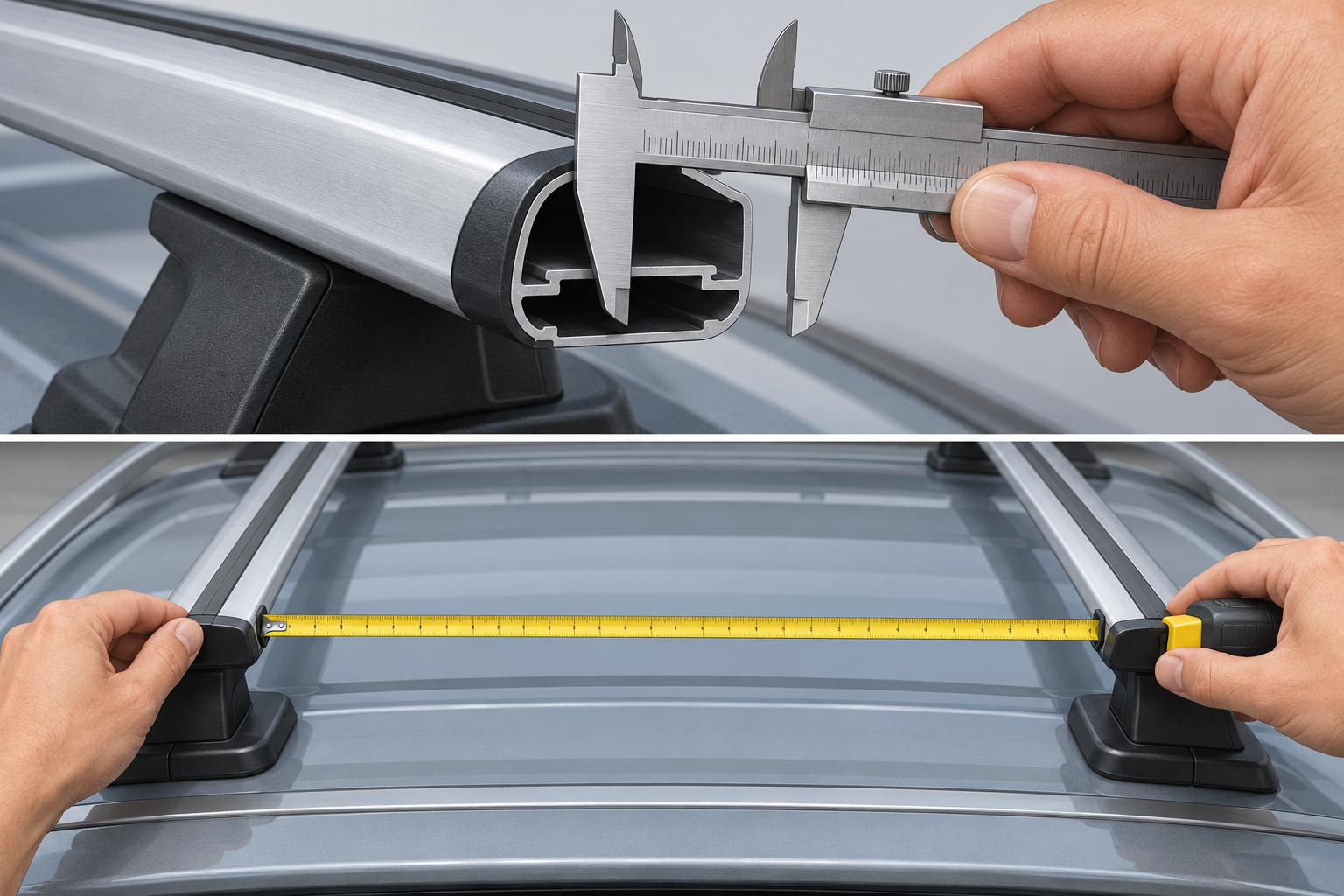
Before buying an awning or adapter, record the market, vehicle year and model, roof configuration, installed rack or platform model, awning model, and every proposed bracket or adapter part number. Check the rack maker’s fit guide for the vehicle, then confirm the accessory maker’s current instructions for the exact rack interface. “T-track,” “square bar,” and “flush bar” are not precise enough descriptions on their own; dimensions and product generations can differ.
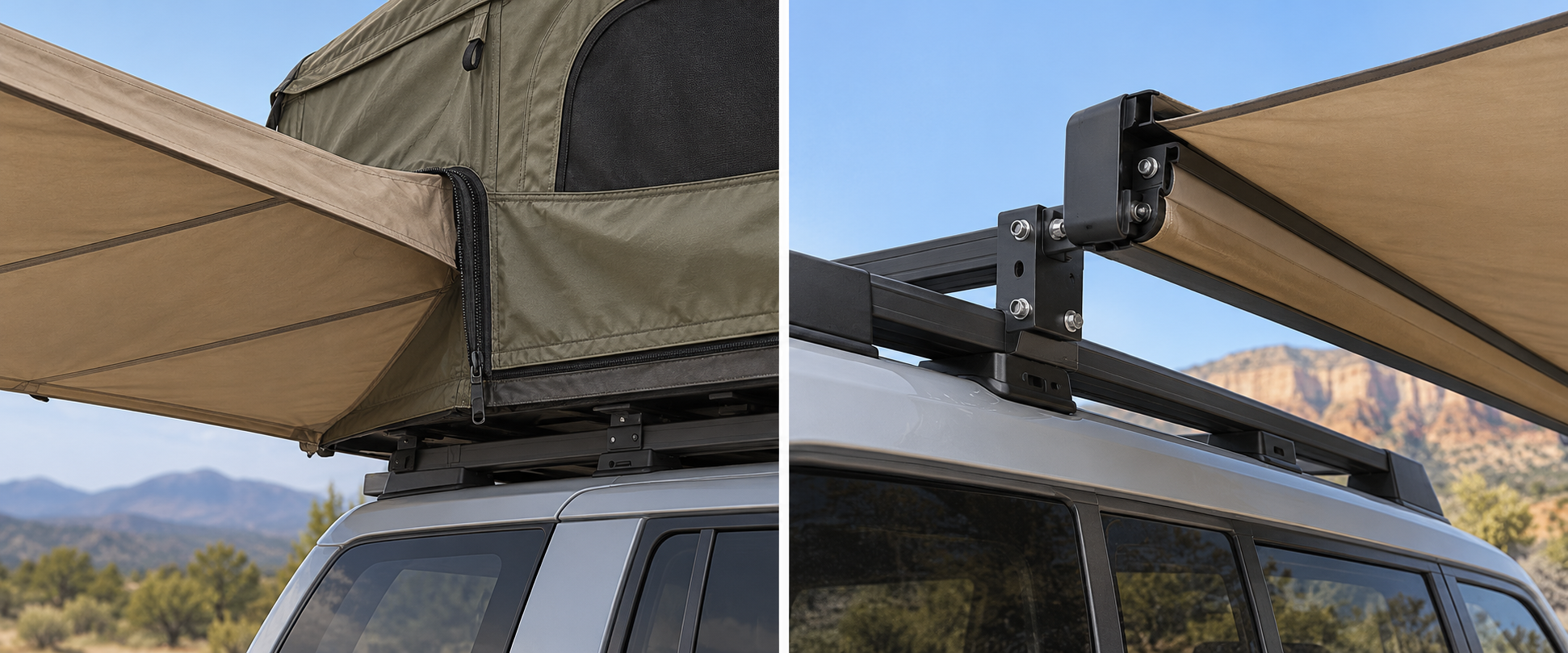
An awning made for a rooftop tent may use the tent itself as its interface. For example, Thule lists the Approach awning 2 S/M as compatible with the Approach 2 S, Approach 2 M, Approach S, and Approach M tents. It attaches by a zip connection; that relationship does not make it a rack-mounted awning or establish a vehicle fit. Thule’s product page lists an open size of 152 × 110 × 96.5 inches, a weight of 10.8 lb, and a maximum leg height of 8 ft. Use the current instructions for the named tent and check deployed clearance on the vehicle.
Match the bracket to the interface
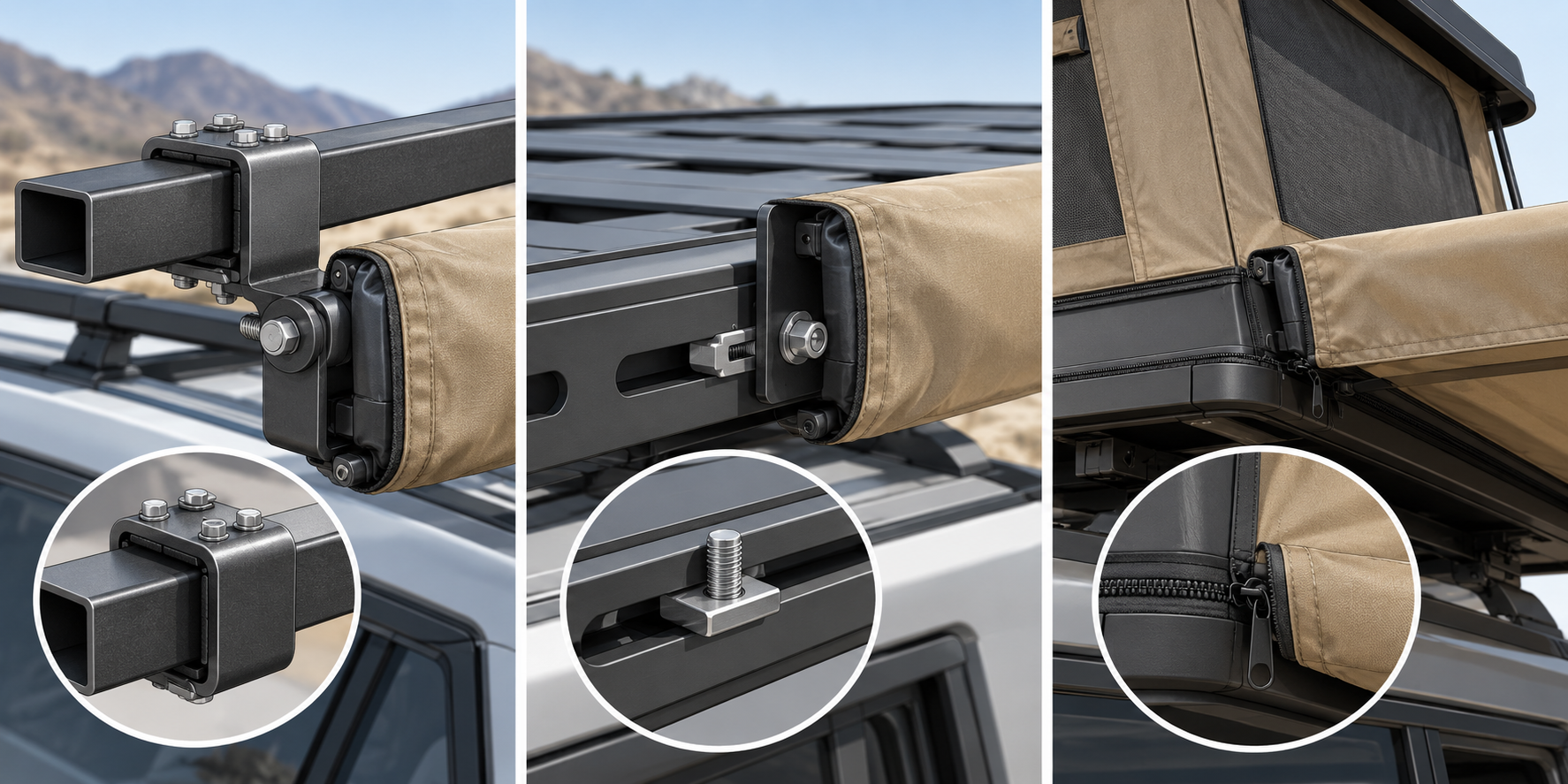
These examples show why the part number matters. They are product-specific paths, not a complete awning-to-vehicle compatibility table.
| Documented path | What the source establishes | What still needs checking |
|---|---|---|
| Thule adapter 490001 | Attaches a Thule HideAway awning around load bars up to 90 mm wide or into T-tracks; the adapter weighs 5 lb. | The vehicle-selected instructions, exact bar profile, rack approval, and the vehicle’s load allowance. Thule adapter details |
| Thule adapter 301925 | Its fit guide specifies 20–90 mm bar width, 18–35 mm bar height, and at least 610 mm bar spread, with named Thule rack families. | These measurements apply to this adapter. They do not establish vehicle fit or transfer to another Thule awning adapter. Thule’s 301925 instructions |
| Rhino-Rack bracket 43259 | Attaches named Batwing or Sunseeker awnings directly to Pioneer Trays or Platforms. | The listed Pioneer relationship is not approval for a vehicle, combined load, or other awning model. Rhino-Rack’s 43259 listing |
| Rhino-Rack bracket kit 31105 | Provides a documented Batwing path for Thule square bars and Yakima round bars; its product information names a 32 × 22 mm square-bar interface and calls for the Batwing’s separate bracket kit. | Confirm the installed bar profile and the current instructions; do not infer that every square or round bar fits. Rhino-Rack’s 31105 listing |
| Thule adapter 490002 | Connects a HideAway awning to the T-track of Thule TracRac load bars identified as pre-2018. | Do not carry this path over to newer TracRac generations or other bars. Thule’s 490002 listing |
| Rhino-Rack tall freestanding bracket 32150 | Raises the awning mount 50 mm above the standard freestanding bracket to improve access around rear doors, canopies, or other accessories. | The height difference is not a clearance measurement for a particular vehicle. Measure the installed setup and confirm the exact system. Rhino-Rack’s 32150 listing |
Rhino-Rack’s Sunseeker bar kits show why an exact compatibility table is more useful than a generic brand match. Kit 32102 is listed for Euro square bars and specified third-party bars, while the same product page lists Yakima round bars and marks Vortex and Heavy Duty as not compatible. Follow the current page and instructions for the exact bar; do not generalize its round-bar listing to other profiles. Rhino-Rack also lists separate angled-up and angled-down Sunseeker brackets for named flush-bar families. Their orientation is a product-specific mounting feature, not a guarantee of door or hatch clearance. See the 32102 listing, 32123 listing, and 32127 listing.
Thule’s adapter 301649 is another select-vehicle path: its product page directs the buyer to select a vehicle for the installation instructions but does not itself expose a complete application list. Use the current selector for the exact vehicle, trim, rack, and awning combination; the adapter number alone is not a fit result. Thule Adapter 301649 should be treated as a verification route, not a universal recommendation.
Check the installed and deployed clearances
Compare the mounted awning and brackets with side doors, rear doors, a tailgate, roof features, and nearby accessories. Check both stowed and deployed positions; a manufacturer’s product dimensions or bracket-height difference is not a measured clearance result for your vehicle.
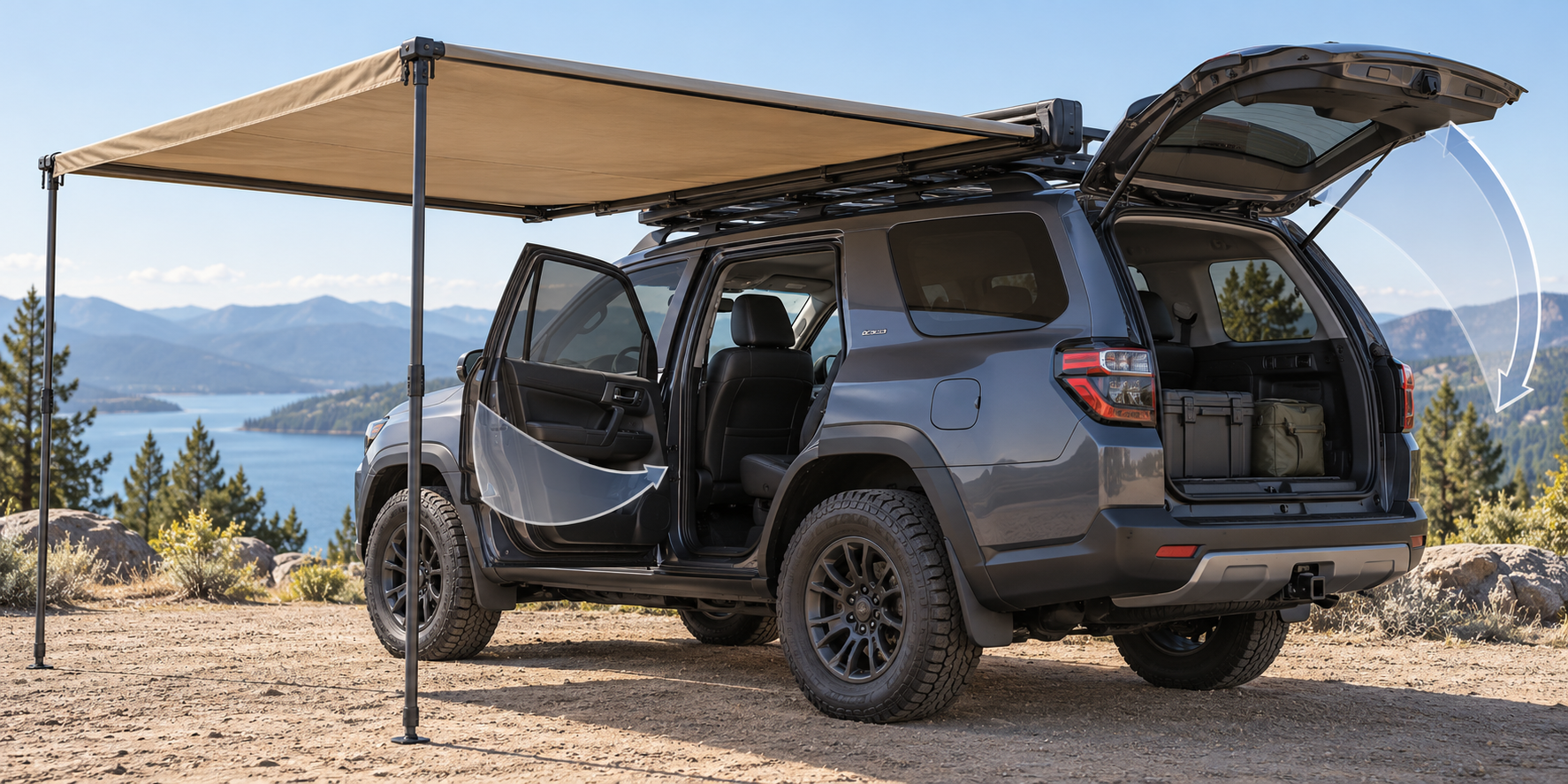
A 2 m Sunseeker example extends 2 m from the vehicle edge, so the space required beside the vehicle can be substantial. Rhino-Rack’s product information lists its 4 m² coverage, 20.9 lb product weight, included STOW iT bracket, and named rack families. Those entries still do not establish a vehicle’s roof capacity or clearance.
Never treat installation instructions for one bracket as permission to drill or modify another rack. Thule’s Tepui awning installation manual warns that not all factory or aftermarket racks can accommodate drilled awning brackets and that drilling a rack without mounting tracks may compromise rack integrity. Its drilling steps describe the manual’s no-track setup; they are not permission to modify a different rack. Rhino-Rack’s 2025 instructions for bracket 31128 give separate installation paths for Pioneer Platforms and named crossbars; use the path matching the installed system. The older 31111 instructions also require vertical legs to support the awning’s weight when that kit is used. Read the current 31128 instructions and the 31111 fitting document rather than adapting a step from another product.
Check load, weather, and market
Add the rack, platform, bracket, awning, and any carried accessories when checking the vehicle and rack instructions. Product weight and accessory compatibility do not establish a safe combined setup. Rhino-Rack’s 31129 freestanding bracket page recommends it for awnings over 20 kg and says two or three brackets are needed depending on awning weight, but does not state the selection threshold. Do not guess the bracket count; confirm the exact awning and current fitting instructions. The related load, wind, and clearance guide covers those checks in more detail.
Finally, select the product catalog and manual for the country where the rack will be used. US and Canadian listings, UK or European product variants, unit conventions, and availability may differ. A selector result or an adapter for a particular bar still needs to be checked against the exact vehicle configuration and current manufacturer instructions.
For a model-year example of how to read an accessory listing without treating it as a complete fit result, see the 2024 Subaru Crosstrek SOA567C200 guide.
Sources and product references
Use these references to check the current instructions and fit information for your market and exact setup.
- Thule Approach awning 2 S/Mprimary
- Thule Awning Adapter 490001primary
- Thule Awning Adapter 301925 instructionsprimary
- Thule Awning Adapter for TracRac (pre-2018)primary
- Thule Adapter 301649primary
- Thule Tepui awning installation instructionsprimary
- Rhino-Rack 31128 Universal Awning Bracket instructionsprimary
- Rhino-Rack 31111 Universal Awning Kit instructionsprimary
- Rhino-Rack Batwing Awning Bracket 43259primary
- Rhino-Rack Batwing Thule and Yakima Bracket Kit 31105primary
- Rhino-Rack Sunseeker Euro Bar Bracket Kit 32102primary
- Rhino-Rack Sunseeker angled-up bracket for flush bars 32123primary
- Rhino-Rack Sunseeker angled-down bracket for flush bars 32127primary
- Rhino-Rack Universal Freestanding Awning Bracket Pair 31129primary
- Rhino-Rack Tall Freestanding Awning Brackets 32150primary
- Rhino-Rack Sunseeker 2.0m Awning with STOW iT 32139primary