Check an e-bike’s actual transport weight, battery instructions, carrier rating, roof-system fit, and overhead loading before choosing a rack.
On this page
Can an E-Bike Go on a Roof Rack? Weight and Fit Checks
Sometimes, but the answer depends on the exact e-bike, battery instructions, carrier, bars, and vehicle. A rack advertised for a heavy bike is only one part of that check. No single weight threshold makes every e-bike safe to lift onto or carry on a roof.
Start with the e-bike’s own manual
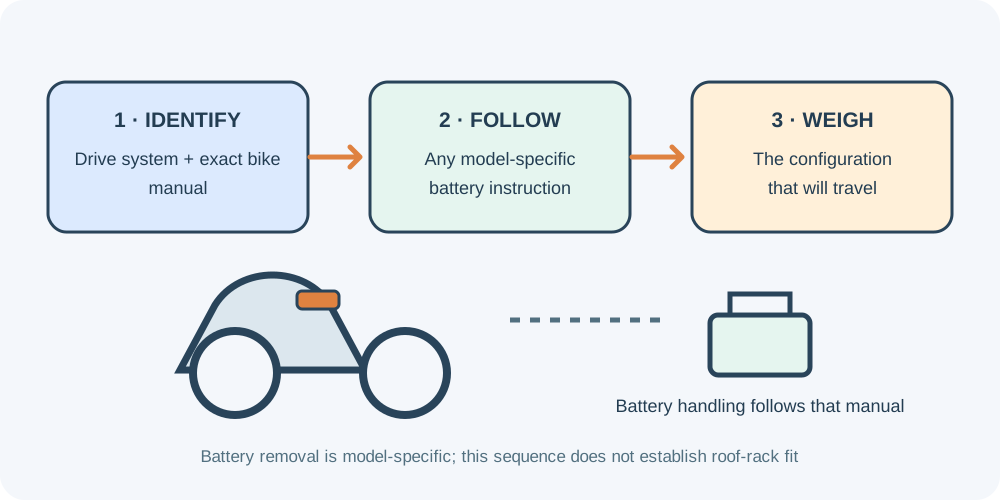
Identify the drive system and the exact bicycle model before removing a battery or choosing a carrier. Manuals can give model-specific external-transport instructions. For example, the North American English manual for the Bosch Performance Line Gen.2 28 mph system says to remove the battery before carrying the bicycle on a vehicle bike rack. It warns that an attached battery may detach in transit and cause a serious accident, and also says to use an approved, compatible rack because the drive system adds weight to the bicycle.
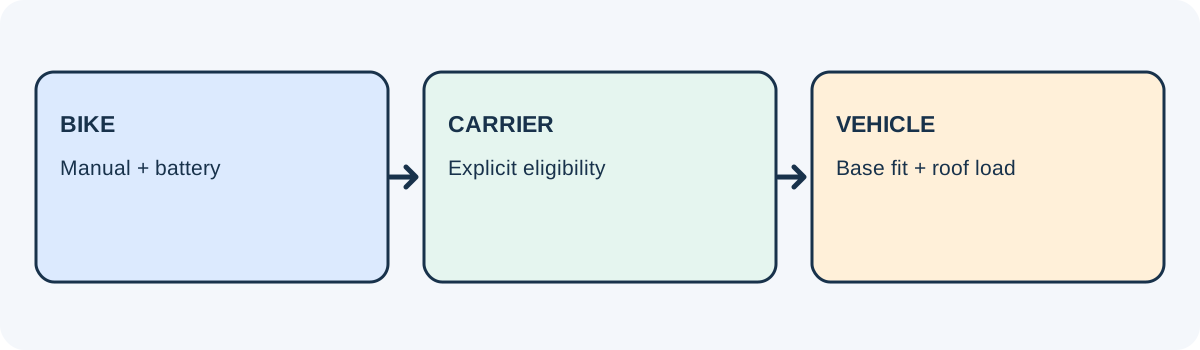
That warning belongs to the identified Bosch manual; it is not a rule for every e-bike or Bosch generation. Check the manual for the actual bicycle and battery, follow its removal and storage steps, and weigh the bike in the configuration that will travel. Taking off a battery does not establish that the remaining bike and carrier fit the roof system.
Compare exact product limits, not category labels
Current product pages show how much model-specific limits can differ:
| Example | What the manufacturer lists | Important boundary |
|---|---|---|
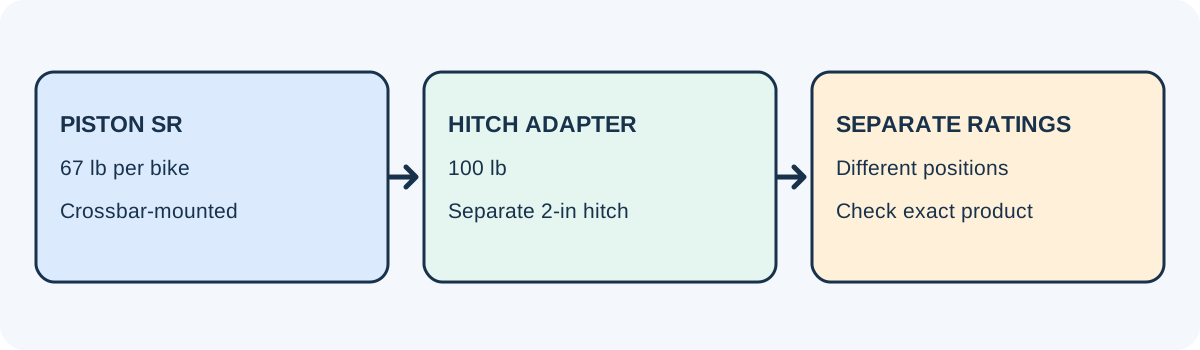
| Küat Piston SR, crossbar-mounted | 67 lb per bike; Küat describes this roof model as e-bike compatible. | The 100 lb figure belongs to a separate 2-inch hitch adapter. It is not the roof rating. The product also has wheel, tire, crossbar, and horizontal-mounting conditions. |
| 1UP USA Super Duty Roof Rack | Up to 100 lb per tray, with the listed wheel and tire ranges; the manufacturer presents it for heavier bikes including e-bikes. | This is a carrier rating and product claim, not proof that a specific e-bike, bar system, or vehicle is compatible. |
| Yakima HighSpeed 8002140 | 40 lb per bike for road use and 24 lb per bike off-road; the listing describes a range of axle types and tires up to 5 inches. | These are HighSpeed’s named limits. The page does not establish a fit for a selected e-bike or vehicle. |
| Rhino-Rack Hybrid RBC050 | The available issue 08 instructions list a 21 kg / 45 lb carrier maximum. | The same instructions explicitly say the carrier is not suitable for e-bikes. Check Rhino-Rack for the latest issue before relying on this manual. |
The examples come from named manufacturer listings and instructions, many on US pages. They are not a cross-brand ranking or a promise of availability in the United States, Canada, or the United Kingdom. Check the product and market that actually apply to your vehicle.
Calculate the roof load
Add the base rack, each carrier, every bike in its transport configuration, and any other equipment on the roof. Compare the result with the vehicle roof limit and the limits for the base system and each carrier. Follow the vehicle and rack makers’ definitions; a carrier’s per-bike limit does not raise the roof allowance.
For multiple bikes, also check each tray limit, total rack capacity, bar spacing, usable bar length, bike-to-bike clearance, and whether the chosen base system permits that number of carriers. Confirm the e-bike’s tire width, wheel size, wheelbase, axle or fork, frame, and fender fit against the exact carrier manual.
Decide whether the overhead lift is workable
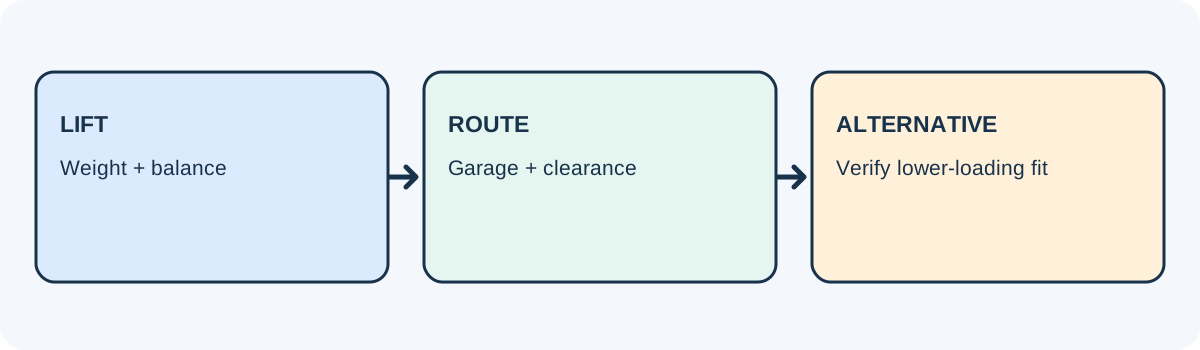
A bike can pass every numeric fit check and still be impractical to lift. Consider the vehicle’s roof height, the e-bike’s weight and balance, how you will control it while aligning the wheels or fork, and whether the intended parking route includes low clearances. Ask whether a lower-loading alternative is more workable, then verify that the exact hitch or trunk product fits the vehicle and bike. The roof-versus-hitch/trunk comparison explains those separate checks.
Use a go/no-go checklist
- Identify the exact e-bike, drive-system generation, battery, and transport manual.
- Follow any model-specific battery or accessory removal instructions.
- Weigh the complete bike and carrier in the transport configuration.
- Confirm explicit e-bike eligibility and the carrier’s per-bike, total, tire, wheel, axle, and frame limits.
- Verify vehicle-to-base-rack and carrier-to-bar fit for the exact market and roof.
- Check total roof load, bar spacing, lift height, hatch clearance, and overhead clearance.
- Install and recheck the system using the current vehicle, base-rack, carrier, and bicycle instructions.
If a manual excludes e-bikes or the exact fit is unconfirmed, do not treat a high published weight rating as an override. Use the bike constraint checklist and vehicle fit steps to resolve the remaining measurements.
Sources and product references
Use these references to check the current instructions and fit information for your market and exact setup.
- Roof bike racks for cars, SUVs & trucksprimary
- HighSpeed Rooftop Fork Mount Bike Rackprimary
- Bike Roof Racks | Bike Carrier for Roof of Carsprimary
- Piston SRprimary
- Performance Line Gen.2 (28 mph) — Owner’s Manual: The Bosch Drive Systemprimary
- Hybrid Bike Carrier — Fitting Instructions, RBC050 issue 08primary