Use the vehicle's exact configuration and current manufacturer instructions to check rack approval, mounting hardware, load, roof operation, and clearance.
On this page
How to Verify Roof-Rack Approval for an EV or Glass Roof
A glass or panoramic roof is a vehicle feature, not a rack-fit result. A reliable answer connects the exact vehicle and roof option to an approved carrier, its mounting hardware, and the instructions for the intended load. Treat a store filter or a general “glass-roof compatible” description as a lead until the vehicle maker’s instructions confirm that complete path.
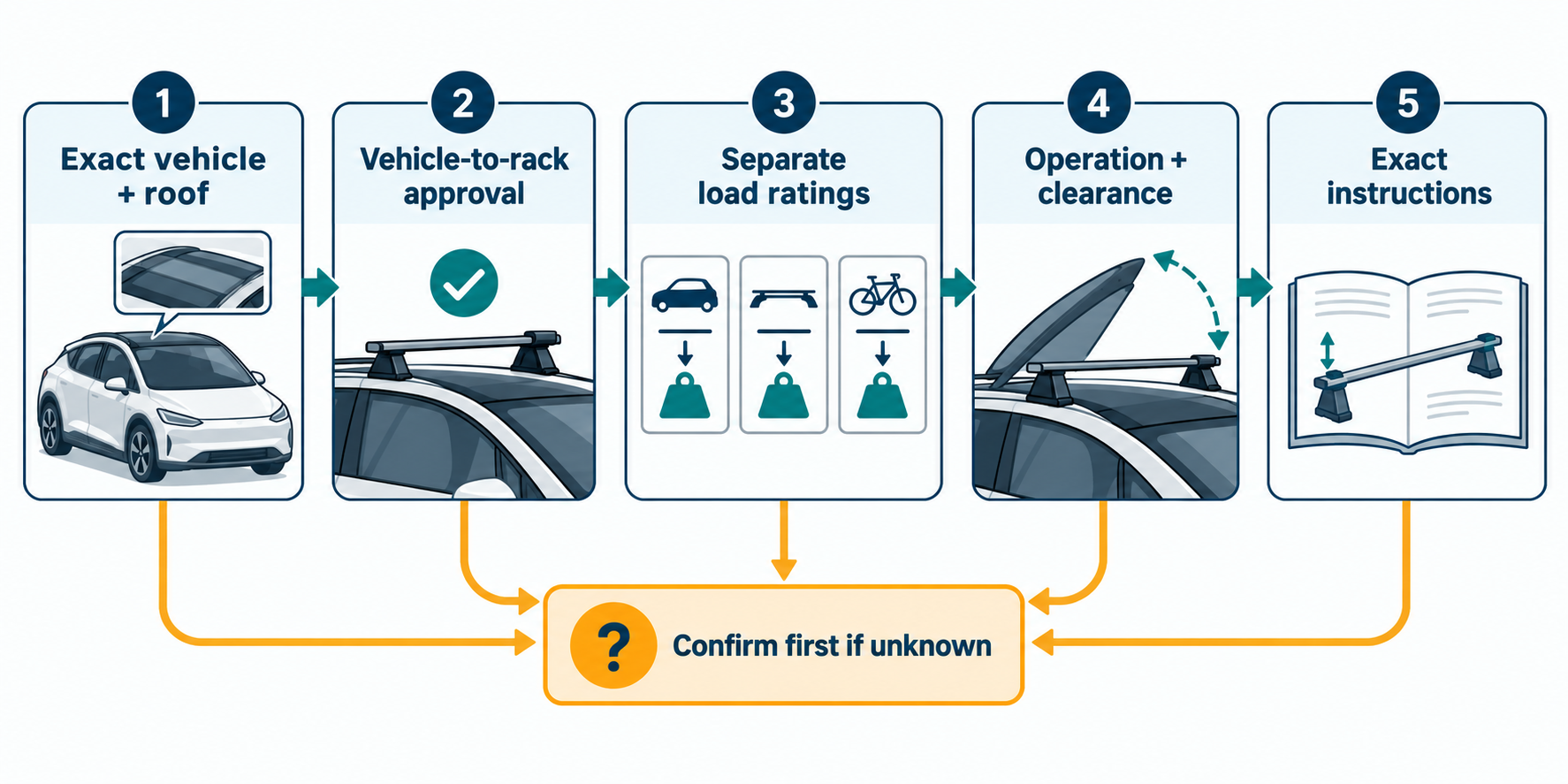
1. Identify the vehicle as it is equipped
Record the market, model year, model, trim, roof option, factory rails or mounting points, and any relevant production change. “Panoramic roof” can describe different fixed and opening designs. The same model name can also cover different roof hardware or approved accessories in different markets. Use the vehicle’s labels, build information, and current local owner’s manual to confirm the configuration.
2. Find an explicit vehicle-to-rack path
Start with the vehicle owner’s manual, then follow its link or direction to the maker’s approved rack and mounting accessory. Check the rack maker’s fitment guide and the instructions for the exact kit and any carrier mounted on it. Confirm that the part numbers and vehicle application match. Approval of a base rack does not automatically approve every box, bike carrier, tent, adapter, or third-party attachment that can physically connect to it.
For example, Tesla’s current Model Y manual requires a Tesla-approved rack and Tesla mounting accessory. Its warning about damage from a non-approved system makes approval part of the fit check. See the Model Y approval and placement guide.
3. Keep every load rating in its own scope
Check the vehicle’s roof limit, rack-system limit, accessory limit, and vehicle payload or axle limits. The instructions must explain what each number covers: rack hardware, attachments, cargo, occupants, or a particular driving or parked condition. Use the lowest applicable limit only after confirming how the figures combine. A rack’s load rating is not automatically the vehicle’s roof allowance or the amount of cargo it can carry.
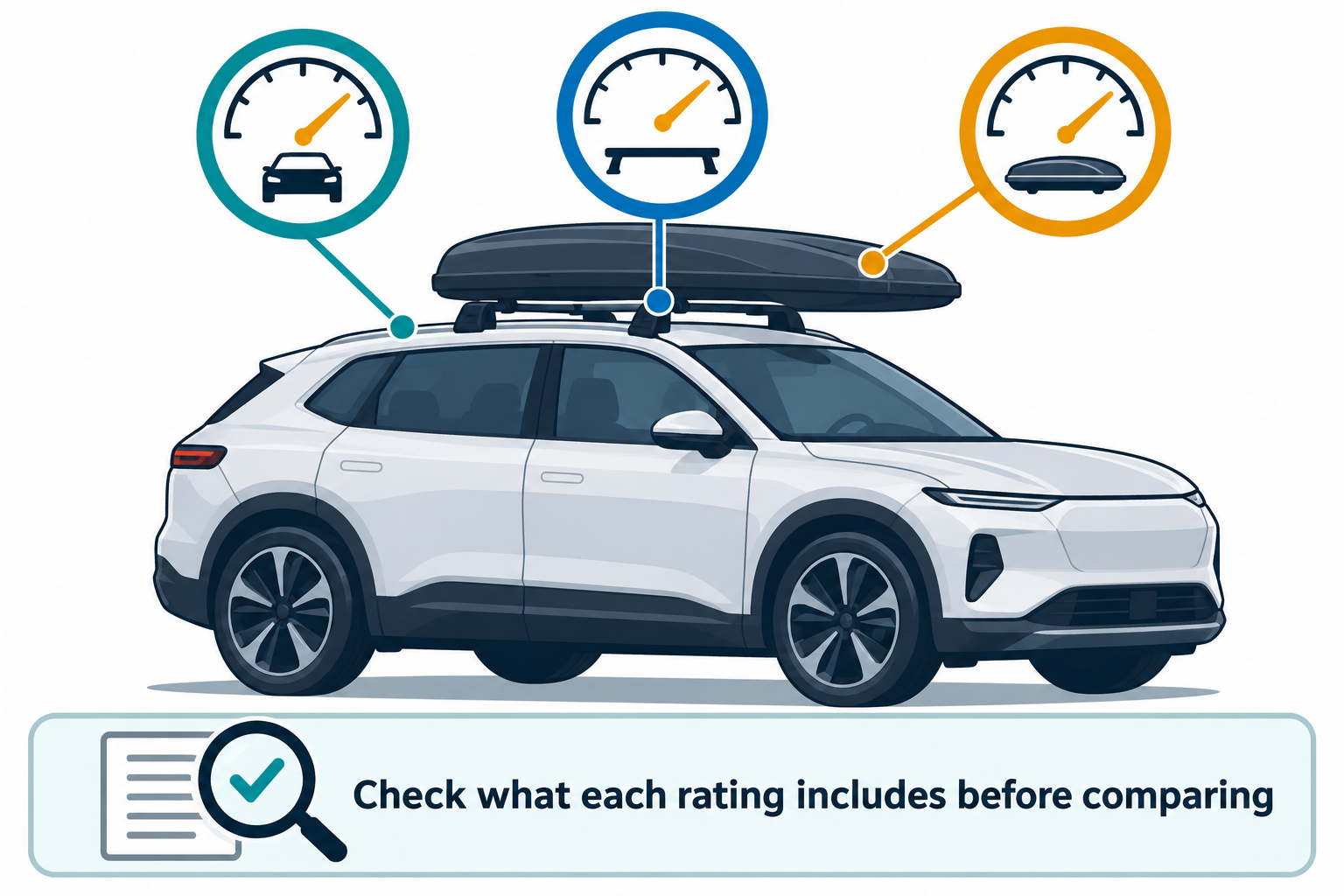
One bounded example is the 2026 Ford Bronco Sport manual: it lists a maximum recommended load of 100 lb (45 kg) for vehicles with a glass roof and 150 lb (68 kg) for vehicles without one. Ford says the load is evenly distributed on the crossbars and that rack-system weight must be subtracted to determine actual cargo load. These figures apply to that manual and vehicle family; they are not a glass-roof rule for other EVs.
4. Check roof movement, contact, and clearance
Confirm whether the roof may be opened with the rack or load installed. Check where the feet, clips, pads, or rails sit, whether protective material is required, and whether the installation must avoid contact with a glass panel. Also check hatch, door, antenna, camera, sensor, and overhead-clearance conditions where the vehicle instructions identify them.
Thule’s general guidance says a glass roof may be permitted unless the relevant mounting instructions say otherwise, and that an installation must not interfere with an openable or panoramic roof. That is conditional Thule guidance, not permission for a named vehicle or another rack brand. A vehicle-specific manual can impose a stricter operating rule. Kia’s 2025 UK EV9 manual, for example, says not to operate an equipped sunroof while roof cargo or accessories are fitted and says never to load the roof panels directly.
5. Use the exact installation and loading instructions
Follow the current instructions for the vehicle and complete rack system. Use the specified mounting points, contact protection, bar positions, fasteners, torque, locks, and final security checks. Check the load again after installation and as directed during travel. An installation procedure for another model year, market, or rack kit is not a substitute.
When the answer is still unknown
Keep a combination unconfirmed if the exact roof option, approval, load accounting, or mounting instructions are missing. Ask the vehicle maker or qualified fitter to resolve that exact question before purchasing or installing the system. Do not infer “yes” from a product photo or “no” from the absence of a search result; record what is known and what remains to be checked.
Sources and product references
Use these references to check the current instructions and fit information for your market and exact setup.