Compare roof boxes, soft bags, open baskets and rear carriers by cargo, weather protection, loading height, vehicle access and mounting requirements. Fit and load limits come before convenience.
On this page
Roof Box, Cargo Bag, Basket, or Rear Carrier: Which Fits Your Trip?
Choose a cargo system by working backward from the gear and vehicle. First confirm which products are approved for the exact vehicle and mounting interface. Then compare weather protection, loading height, access, roof space, total height and weight. A convenient storage form is not useful if it does not fit or its complete load exceeds the vehicle’s limits.
| Storage form | Often useful for | Trade-offs and fit checks |
|---|---|---|
| Roof box | Enclosed luggage, clothing and long or bulky lighter gear | Adds height; needs a compatible rack; check bar spread, hatch clearance, vehicle height and total roof load. |
| Soft cargo bag | Flexible luggage that can be compressed or removed for storage | Attachment points vary by model. Check the exact vehicle and product manual; weather-resistant material may not be waterproof. |
| Roof basket | Tall, irregular or dirty equipment that does not need an enclosure | Cargo is exposed to weather. The rack and basket limits still apply, and every item needs a suitable restraint. |
| Rear carrier | Bulky items that are easier to lift at waist height, or a setup that leaves roof space free | Needs a compatible hitch or platform. Check vehicle and hitch limits, platform and carrier ratings, hatch access, width, exhaust and ground clearance. |
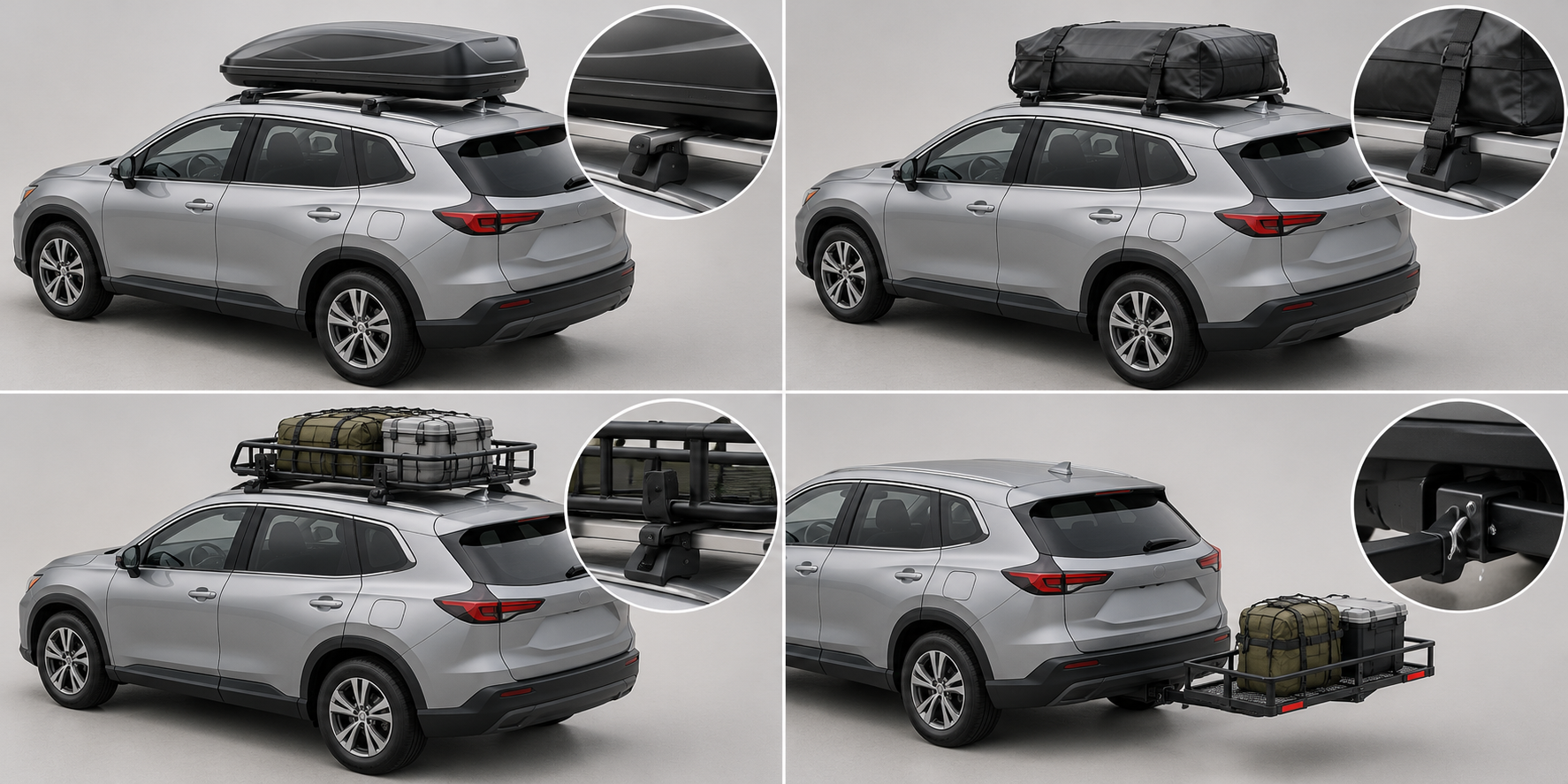
When a roof box makes sense
A roof box encloses cargo and keeps it out of the passenger area. It can suit long gear such as skis, bags or camping equipment, but the installed box adds height. Check whether the hatch opens fully and whether the roof, rack, box and cargo remain within their separate limits. A box does not attach to the vehicle by itself; it needs the mounting system listed in its instructions.
When a bag or basket makes sense
A soft bag may take less storage space when it is not on the vehicle, but its mounting method is product-specific. Do not assume that one bag’s straps can be used on another bag, or that a no-rack claim is appropriate for every roof, door or airbag arrangement. Check whether the product is still available and use only the exact current manual. See the no-crossbar roof-bag guide for the difference between side rails and a bare roof.
A basket is open, so it can hold tall or irregular shapes that may not fit inside a box. That also leaves cargo exposed to rain and road spray. Use the basket’s tie-down points and the restraint method required by its instructions. The basket’s product rating does not raise the vehicle or rack limit.
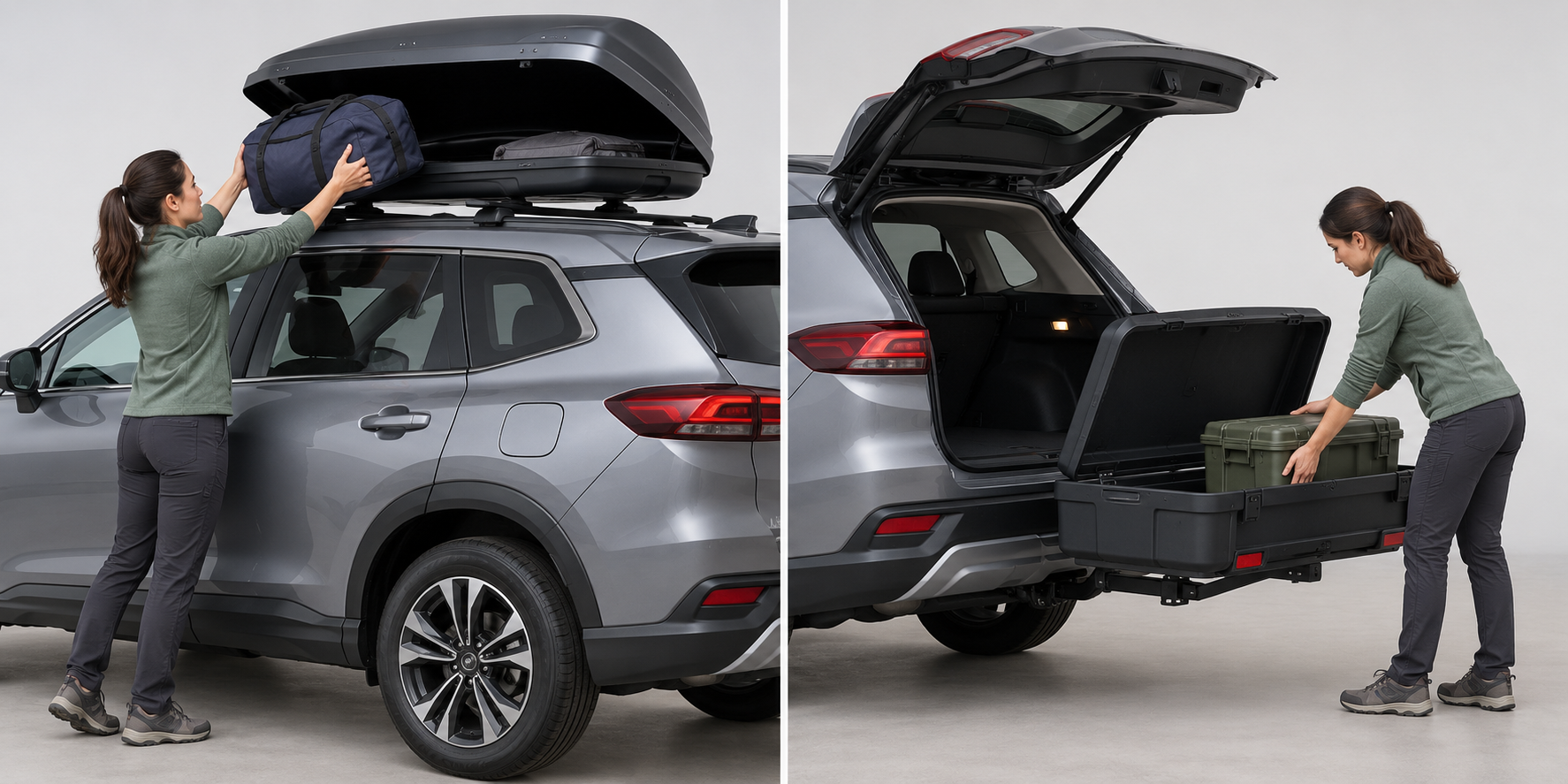
When a rear carrier makes sense
A rear carrier loads lower and leaves the roof available for other equipment. It also adds length and may affect hatch access, vehicle width, exhaust clearance or departure angle. Roof-rack checks do not transfer to a rear setup: verify the exact receiver, hitch, platform, carrier and vehicle instructions. A rear box’s product capacity is only one of the limits; the installed platform and vehicle support must also be adequate.
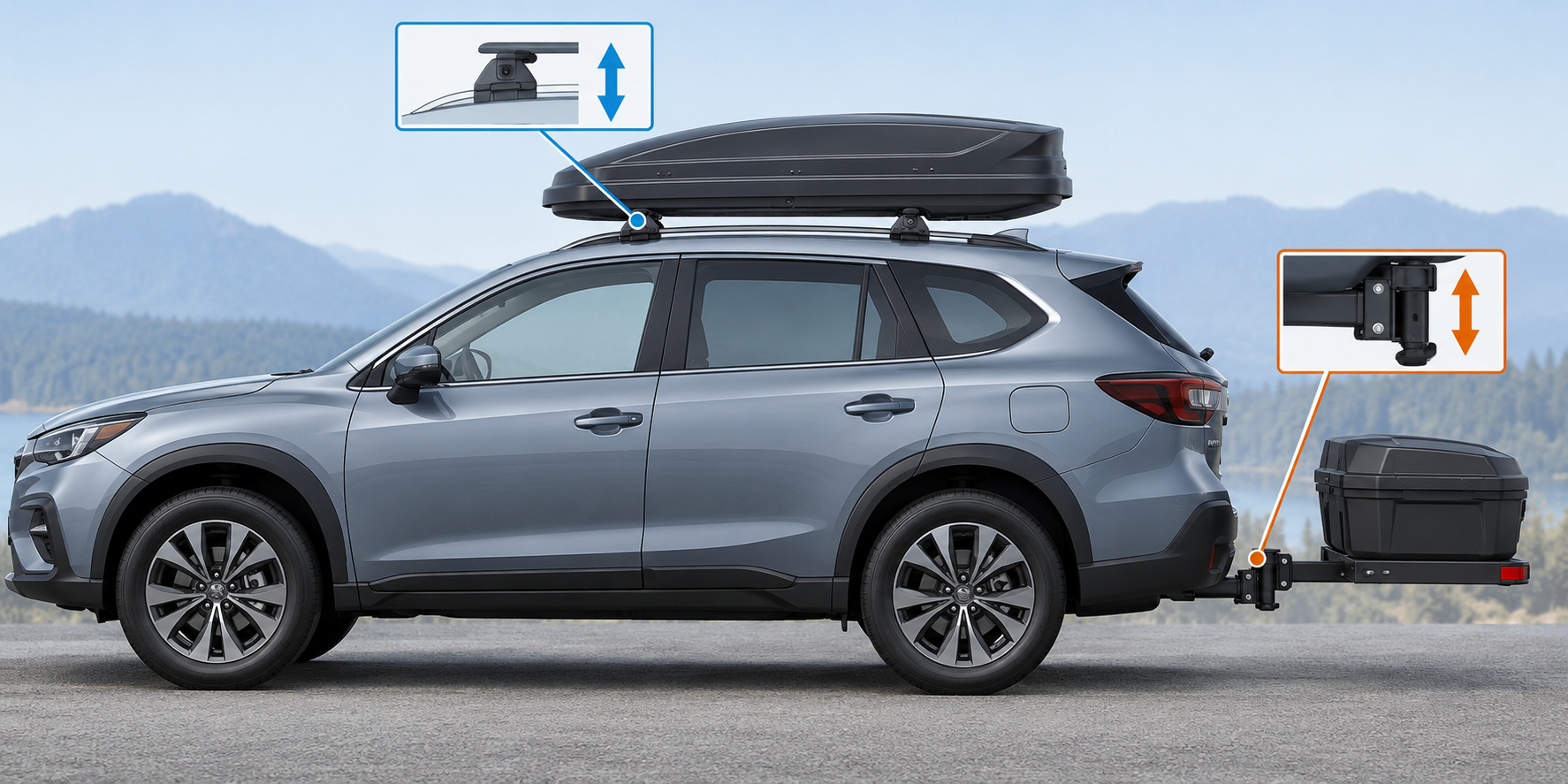
One documented example is Thule’s Santu cargo box with selected hitch-mounted bike carriers. Thule’s Santu page lists the Epos and EasyFold XT path and says EasyFold XT needs a separate adapter kit. Its page’s compatibility panel also names EasyFold 3, while the main product description and the linked measurement sheet give the detailed path and dimensions for Epos and EasyFold XT. Confirm current EasyFold 3 instructions with Thule before relying on that listing. The product page gives Santu a 99 lb cargo limit; that is a product rating, not approval from your vehicle, receiver or hitch. Confirm the exact rack, kit and vehicle limits and whether bikes and cargo may be carried together for your model.
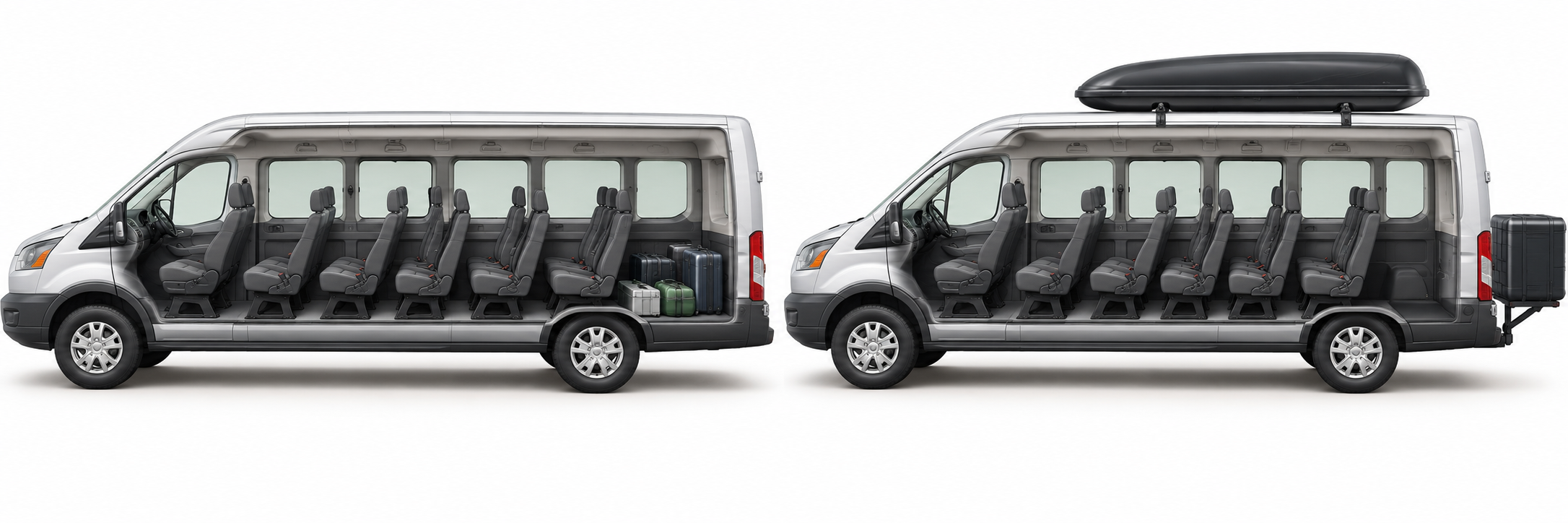
For 12- and 15-passenger large vans, cargo placement has a separate stability concern. Transport Canada’s 2013 guidance for this van class advises stowing cargo inside to the greatest extent possible and warns that roof cargo can lower stability and increase rollover risk. It also cautions that heavy rear-mounted boxes or racks may affect handling, so a rear setup is not an automatic answer. This is class-specific Canadian guidance, not a fit or load table for other vans or cars; check the exact vehicle instructions and local guidance.
What can cargo do to energy use?
External cargo can affect consumption, especially at speed, but one test does not predict another vehicle or trip. The UK Vehicle Certification Agency advises removing roof boxes and bars when they are not in use. It also publishes typical fuel-consumption examples without naming the tested vehicle or equipment, so those percentages should not be used as a forecast for your journey.
Oak Ridge National Laboratory’s 2014 abstract reports that a roof box on its tested compact sedan produced a fuel-economy penalty as high as 25–27% at higher speeds. In the same study, a hitch-mounted tray carrying a similar load produced “very small” penalties on the tested sedan and SUV; the abstract does not give a numeric tray result. This is a limited historical test, not a universal roof-versus-rear comparison.
A 2023 report by the Polish automotive publication Magazyn Auto described a 111 km test with a Volvo C40 Recharge. With 50 kg of cargo, it reported 24.1 kWh/100 km in a roof box, 19.9 kWh/100 km in a hitch box and 20.2 kWh/100 km with the same cargo in the trunk. Those figures describe that test’s vehicle and setup. The roof and hitch accessories had different empty weights, and the report does not provide repeated trials or a detailed speed-and-weather log. Do not use the result as an EV range estimate for another car.
Make the decision in this order
- Identify the vehicle market, year, trim and roof or hitch equipment.
- Confirm a manufacturer-approved mounting path for the exact product.
- Measure the hatch, crossbar or receiver clearances required by its manual.
- Calculate the remaining load allowance for the complete installed system.
- Compare loading height, weather protection, access and storage when not in use.
If no verified fit path exists, choose another option or ask a qualified installer to check the vehicle. For box measurements, see the roof-box sizing guide. For the roof-load and restraint checks, see how to load and secure roof cargo.
Sources and product references
Use these references to check the current instructions and fit information for your market and exact setup.
- Comparing Rear-Mounted Cargo Carriers and Roof Boxesauthoritative-secondary
- Thule Santuprimary
- Technical Information — Thule Santu with Hitch Bike Rack Measurementsprimary
- Loading a Large Passenger Vanprimary
- Fuel Economy and Emissions Effects of Low Tire Pressure, Open Windows, Roof Top and Hitch-Mounted Cargo, and Trailerprimary
- Fuel-Efficient Driving Tipsprimary
- Box Dachowy i na Hak – Zużycie Energii w Aucie Elektrycznym | Testspecialist