Compare roof carrier shapes and loading methods, then check how hull geometry, bar interfaces, and vehicle limits affect the choice.
On this page
Kayak and Canoe Carrier Types: J-Style, Saddles, Stackers, and Load Aids
Choose a carrier by the craft it must support and the way you can load it, then verify the complete vehicle and crossbar path. A J-cradle, horizontal saddle, roller, or lift-assist feature describes a carrying or loading method. None of those labels alone confirms that the carrier fits a particular vehicle, crossbar, kayak, or canoe.
Start with the watercraft and roof system
Before comparing carrier shapes, record each craft’s length, widest point, weight, hull shape, and the areas where it can be supported. Note accessories that travel with it, such as a paddle or seat, and whether a rudder or other projection changes where the craft can sit. Then identify the vehicle’s market, year, trim, roof type, and installed base rack. The crossbar profile, width, usable length, and front-to-rear spread can rule out a carrier even when its product page uses broad language such as “fits most factory racks.”
Measure against the selected product’s limits rather than a general carrier category. A manufacturer’s width or weight maximum applies only to that product and configuration. It does not establish vehicle fit, clearance, or the maximum load the complete roof system can carry.
Compare the main carrying methods
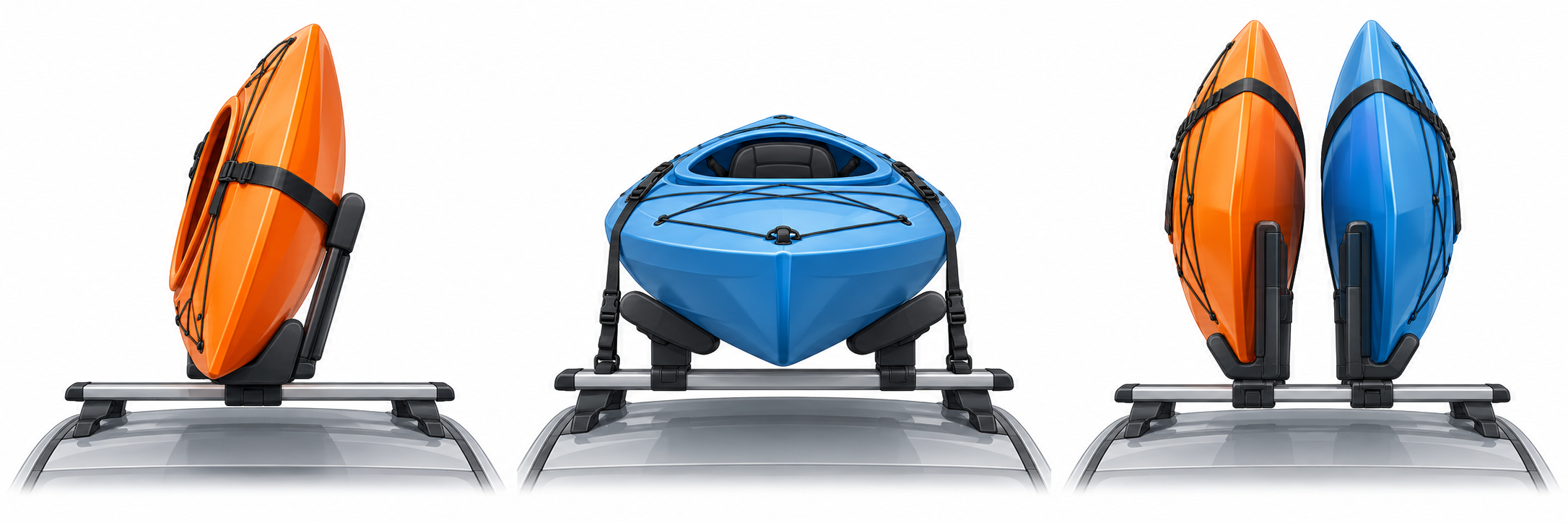
| Carrier form | What it is useful for | What still needs checking |
|---|---|---|
| J-style or vertical cradle | Holds a kayak on its side and can leave roof area for other gear. Thule Hull-a-Port XTR is one named example with a J-cradle mode for one kayak and a vertical mode for two. | Kayak width and contact points, total height, side-loading reach, bar spread, and whether the exact model’s instructions allow one or two craft. |
| Horizontal saddles or cradles | Supports a kayak or SUP across its bottom. Thule DockGlide, for example, uses two independently pivoting saddles to adapt to hull angles. | The actual hull shape and width, pad placement, fore-and-aft support, carrier capacity, and the vehicle’s bar and roof limits. |
| Stacker | Carries craft vertically to make more of the bar length available. A Thule Stacker listing describes up to four kayaks, but its instructions, straps, craft dimensions, and the vehicle must all support the proposed arrangement. | Total count and combined load, usable bar length, side clearance, the straps required for every craft, and a practical team-loading method. |
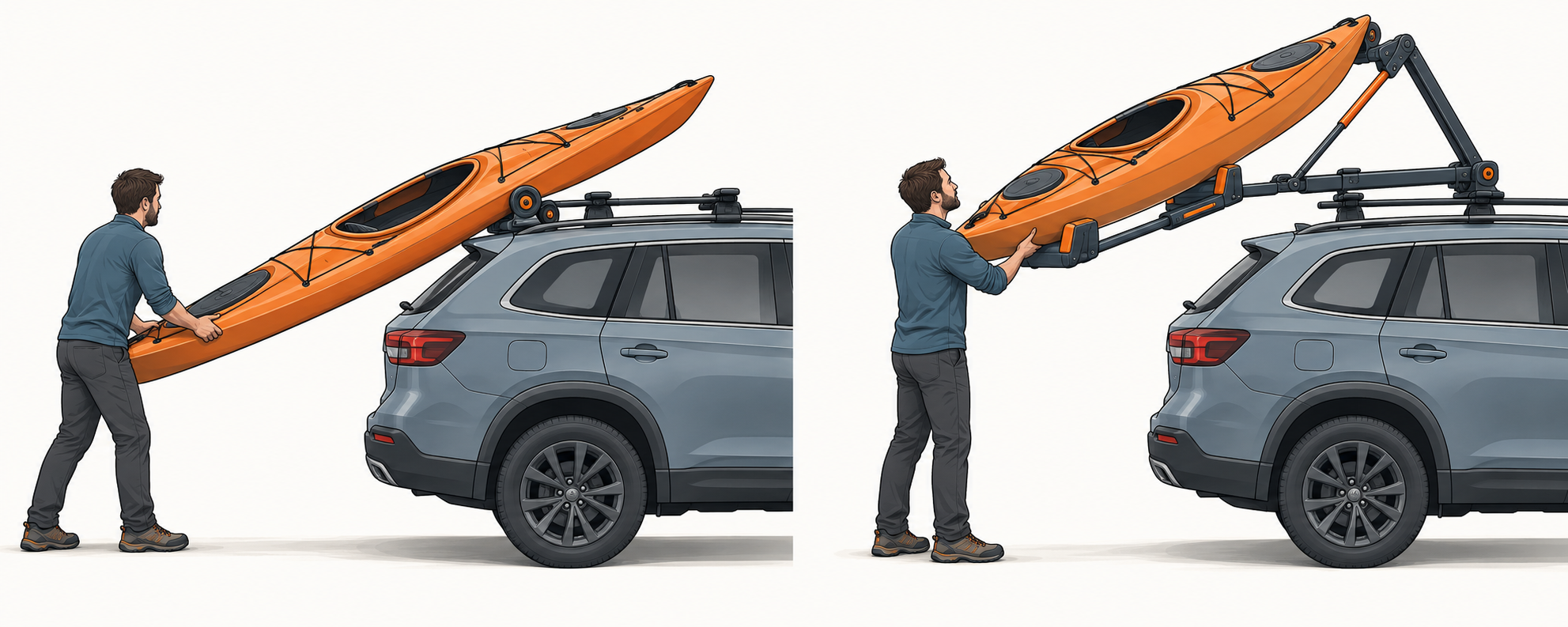
| Roller or rear-loading carrier | Uses rollers or low-friction supports to help guide a kayak onto the roof. A roller reduces sliding effort; it does not reduce the kayak’s carried weight. | The exact crossbar spacing and mounting path, the rear loading route, support position along the hull, and whether the user can control the craft throughout the lift. |
| Tilt or lift-assist carrier | Lowers part of the loading path to reduce the height of an overhead lift. The Thule Hullavator Pro listing distinguishes a 75 lb carrier capacity from assistance lifting up to 40 lb of kayak weight. Yakima’s ShowDown listing gives an 80 lb capacity and 30–45% assistance depending on boat width. | The load-assist amount is not extra capacity. Count the carrier’s own weight where the vehicle or rack instructions require it, and verify the exact vehicle and bar instructions before purchase. |
| Canoe-specific supports | Uses supports shaped for a canoe’s gunwales. Thule Portage is one product-specific example; its design should not be assumed to suit any kayak or other hull. | Canoe width and contact points, support placement, straps, adapters, the bar system, and the selected model’s load limit. |
The figures and examples above describe the named US product pages where they are given. Product names, specifications, and available fit guides can differ by market and change over time. Use the current page and instructions for the market and exact model being considered.
Market-specific example: Thule’s UK page for K-Guard 840003 describes a tilting carrier with a 45 kg product limit and a SquareBar Evo adapter path. Those UK details do not establish US or Canadian availability or fit.
Match the carrier to the paddler as well as the craft
Consider how the craft will be lifted, turned, and secured at home and at the destination. A tall vehicle can make an otherwise suitable carrier difficult to use. A side-loading method may reduce the reach over the center of the roof, while a rear roller can help with one part of a loading movement. Neither feature guarantees that one person can safely control a heavy or awkward craft. Check the product’s stated loading steps and arrange help or another documented loading method when needed.
Use a dedicated board carrier when its shape and restraint system fit the SUP or surfboard. A kayak cradle’s ability to carry a SUP in one advertised configuration does not establish that it will fit every board or allow a mixed kayak-and-board load. For a board-centered comparison of listed width, count, and carrier modes, see the SUP and surfboard carrier guide.
Check the whole installation path
Confirm that the vehicle has the correct base rack, not just roof rails or a mounting surface. Read the carrier instructions for the required bar interface, adapter, spacing, and position. Compare the carrier’s loaded craft and the weights of the rack and accessories with the vehicle and crossbar limits as those limits are defined in their manuals. The lowest applicable limit governs; where an instruction tells you to include rack and accessory weight, include it in the calculation.
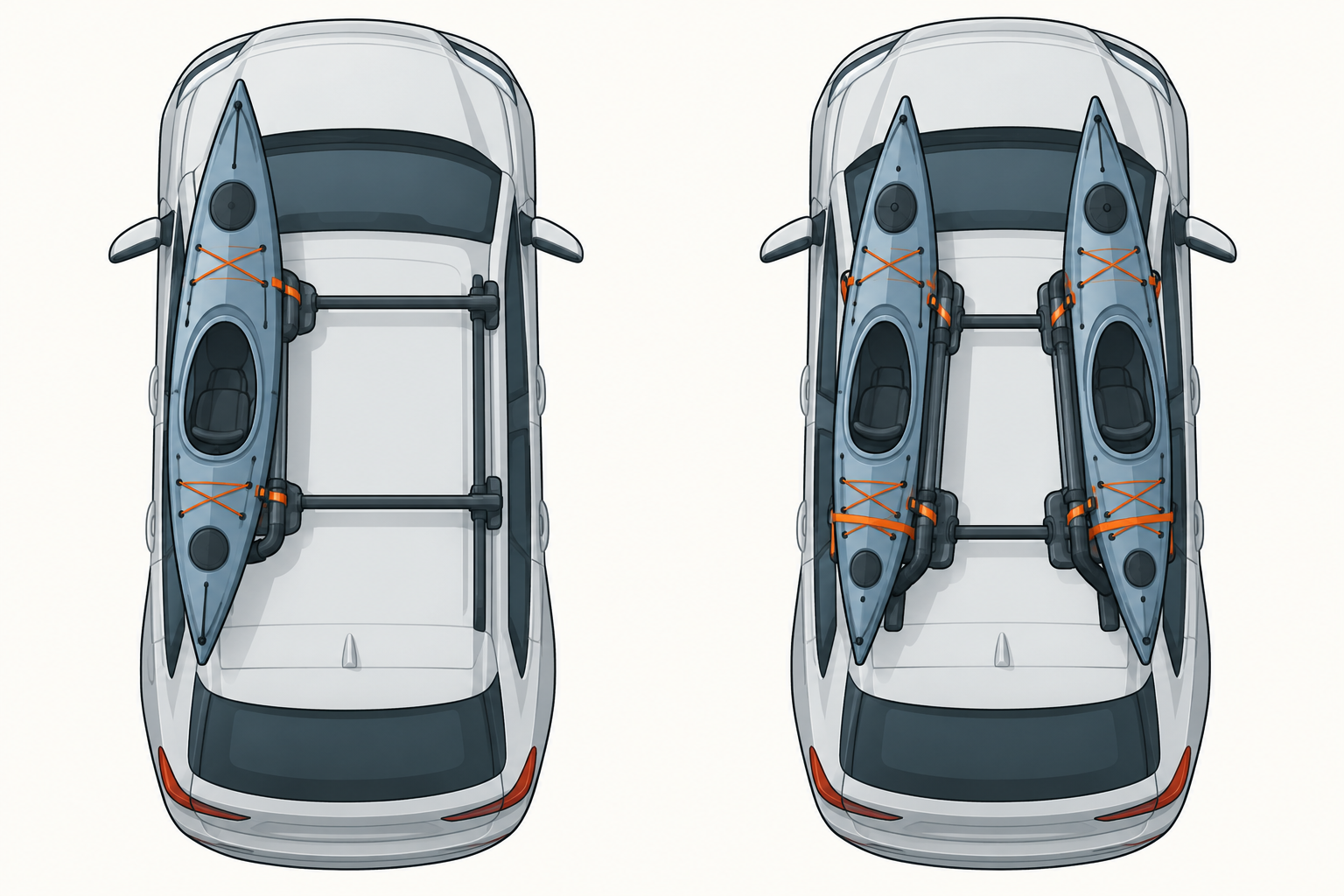
Before choosing, also check that the craft will clear the hatch, doors, roof features, and adjacent gear. A carrier that fits the bars may still leave too little usable roof width or an unsuitable tie-down route. Use the multi-watercraft layout guide for count and space planning, and the loading and tie-down guide for model-specific securement examples.
Make the decision
Choose the simplest carrier form whose documented fit, geometry, and loading method meet the real need. If a product page gives no weight or craft-width limit, treat that value as unknown rather than unlimited. If a vehicle selector returns no confirmed result, keep the combination unverified until the exact vehicle, base rack, carrier, and current instructions have been checked together.
Sources and product references
Use these references to check the current instructions and fit information for your market and exact setup.
- Kayak and canoe racksprimary
- Thule Hull-a-Port XTRprimary
- Thule DockGlideprimary
- Thule Hullavator Proprimary
- ShowDown load-assist kayak and SUP mountprimary
- Kayak carrier buying guideprimary
- Thule Portageprimary
- Thule Stackerprimary
- Thule K-Guardprimary