Plan craft count, carrier configuration, crossbar space, and total load without assuming that an advertised carrier capacity fits every roof.
On this page
Planning Roof Space for One or More Kayaks, Canoes, SUPs, or Surfboards
The number of boats a carrier advertises is a product capability, not a promise that the same number fits your vehicle. A real multi-craft layout must fit the craft, their carrier positions, the usable crossbar length and spread, approved tie-downs, and every applicable load limit at the same time.
Inventory the whole load
List each kayak, canoe, SUP, or surfboard separately. Record its length, widest point, weight, hull or board shape, and the points where the carrier may support it. Include paddles or other equipment only when they will travel on the roof. Then note the vehicle, market, roof configuration, base-rack model, and any existing cargo or accessories.
Measure the actual usable crossbar span after accounting for the feet, mounts, and carrier clamps. The published bar length is not necessarily all available for cargo. Also record the front-to-rear bar spread; a carrier may specify a minimum distance that the vehicle’s approved rack cannot provide. Leave enough space for the carrier supports, adjacent gear, and each craft’s overhang as limited by the product and vehicle instructions.
Treat configurations as product-specific
Manufacturer examples show why a stated count cannot be generalized:
| Example | Listed arrangement | What the listing does not establish |
|---|---|---|
| Thule Compass | One kayak in J-style or saddle mode; two kayaks in stacker mode; up to two SUPs in saddle mode. The US page lists kayaks up to 36 inches wide and a 130 lb capacity. | A mixed kayak-and-SUP arrangement, fit on a specific vehicle, or sufficient room for the proposed craft. |
| Yakima JayLow | One boat in J-cradle position or two boats in vertical position. The current page gives date-specific ratings and spread requirements. | The applicable rating for an unidentified unit or the fit of a particular vehicle. See the JayLow rating guide. |
| Thule Stacker | The US page describes carrying up to four kayaks, lists a 75 lb load capacity and kayaks up to 36 inches wide, and says straps for one kayak are included. | How those product limits apply to a chosen multi-craft arrangement, whether four kayaks fit a particular roof, or whether another accessory can share the remaining space. |
| Rhino-Rack Nautic Stack S520 | Rhino-Rack’s 2024 Australia/New Zealand catalogue lists up to four kayaks. | Current availability outside that catalogue’s region and date, vehicle fit, or a complete four-craft installation. |
| Thule SUP Taxi XT | The US listing gives a 28–34 inch loading width and 55 lb capacity. | A board count, vehicle fit, or permission to mix boards with another carrier. |
The product-specific figures above come from US listings except the Rhino-Rack catalogue, which is for Australia and New Zealand. Recheck the product page and instructions for the market and exact model being considered.
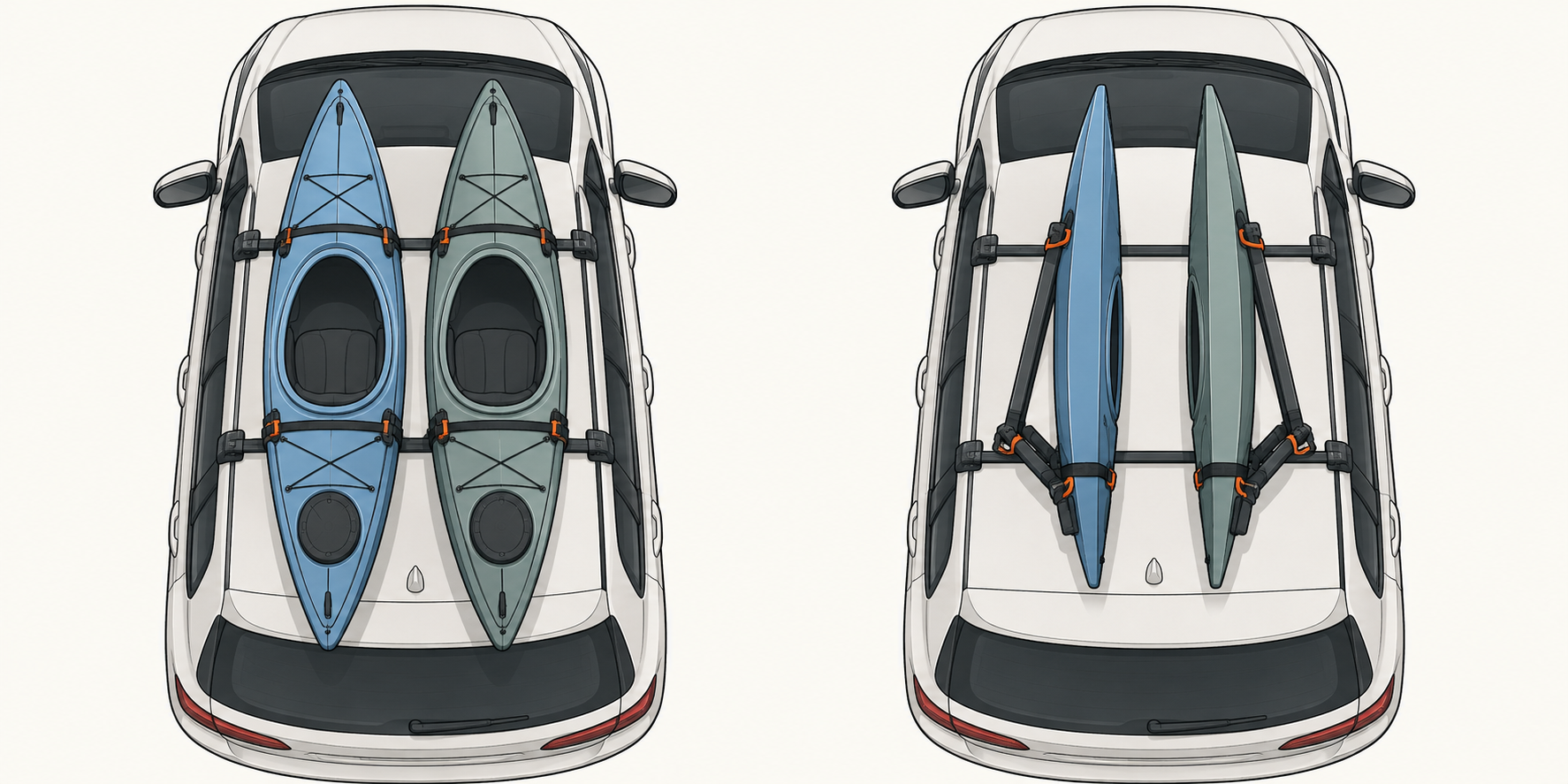
Check space, not just capacity
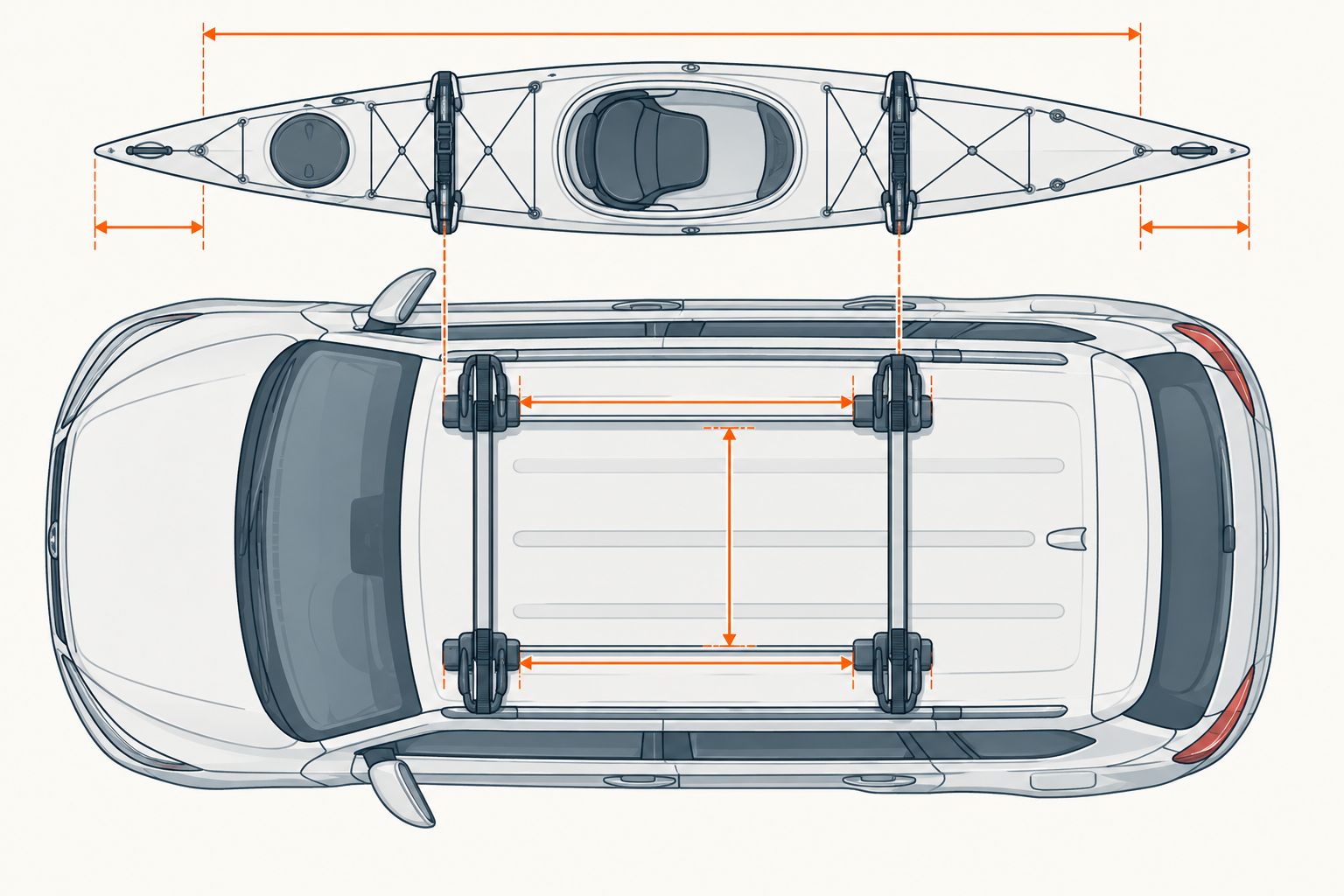
Sketch the vehicle roof from above and mark the bar locations, feet, carrier contact points, craft outlines, and neighboring equipment. A side-by-side kayak layout may need more bar width than a vertical stacker arrangement. A vertical arrangement can save bar length but takes space above the roof and may affect side clearance. Canoes and long boards can extend beyond the vehicle’s rack area; follow the applicable limits rather than assuming a longer craft is acceptable because the carrier itself is wide enough.
Confirm that each craft has separate, stable support and that the exact product instructions allow the proposed layout. Do not infer that two products advertised for kayaks can be combined, or that one carrier’s two-boat mode permits a canoe, SUP, or surfboard in the same setup. Mixed loads need documented support and restraint paths for every item.
Add up the load using the right rule
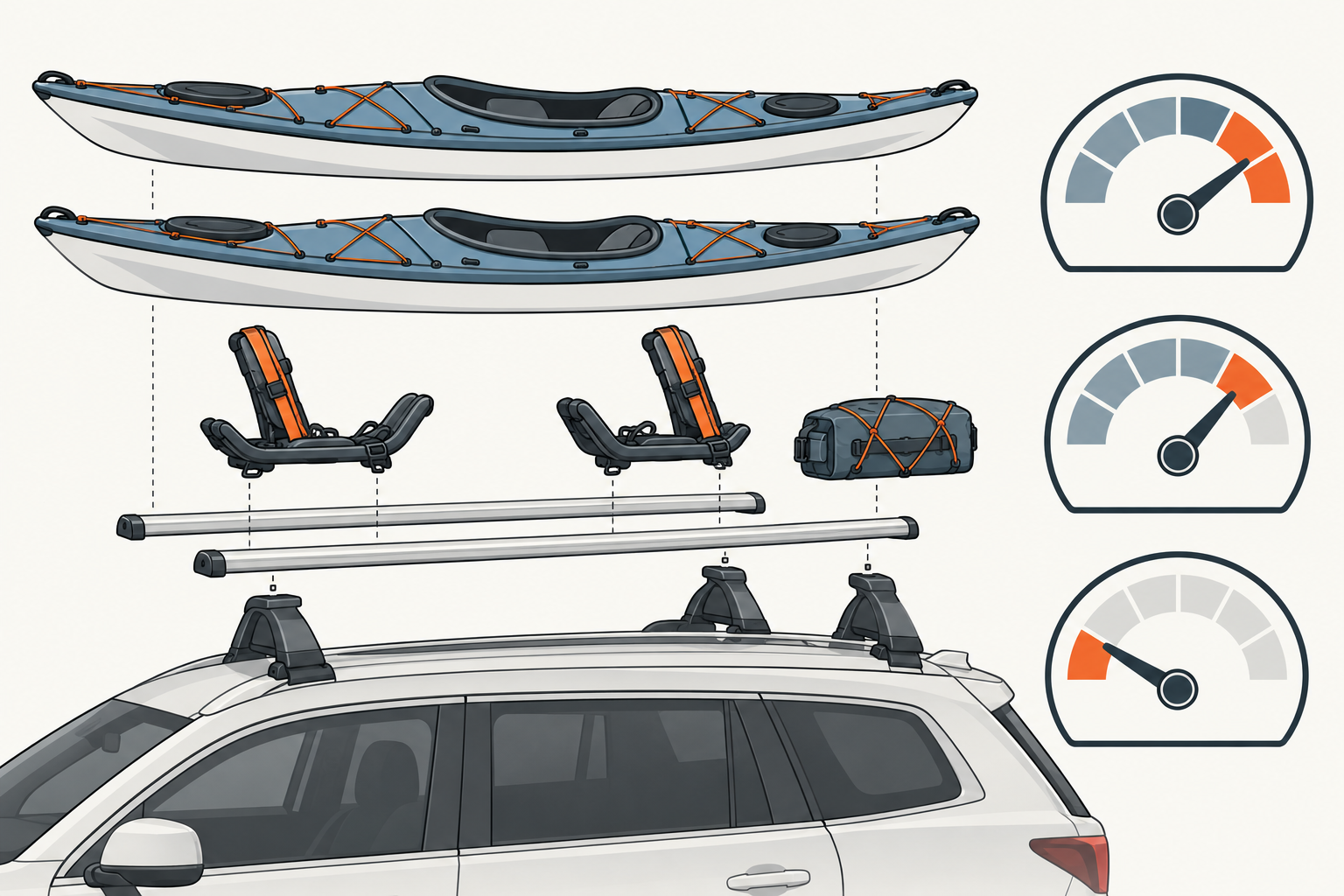
Do not compare only the craft weight with the carrier’s largest number. Follow the vehicle and base-rack manuals to determine what their roof limits include. Where instructions require it, account for the crossbars, feet, carriers, adapters, and every craft. Check the carrier’s single- or multi-craft rating for the chosen mode; one-boat and two-boat limits can differ. The lowest applicable limit governs, and a product rating never raises a lower vehicle or rack limit.
Plan loading and tie-downs
Work out how each craft will be placed without first committing to a layout that blocks another item’s support or tie-down point. Check the carrier’s prescribed straps and whether the vehicle has approved bow and stern attachment points. If the required route, anchor, or loading help is missing, pause and confirm a suitable method with the vehicle or carrier maker.
Before purchase, verify the exact vehicle and crossbars in the manufacturer’s current selector and confirm the part numbers and craft dimensions. If the combination is not documented, keep it unverified rather than extrapolating from a similar vehicle, another bar shape, or a carrier’s advertised maximum count. Finish with the pre-trip checklist and the watercraft loading guide. For a board-first choice between dedicated SUP/surfboard carriers and named multi-purpose modes, see the SUP and surfboard carrier guide.
Sources and product references
Use these references to check the current instructions and fit information for your market and exact setup.
- Thule Compassprimary
- Yakima JayLow J-Cradle Rooftop Kayak Mountprimary
- Thule Stackerprimary
- Rhino-Rack Catalogue 2024 ANZprimary
- Thule SUP Taxi XTprimary
- Surfboard and SUP racksprimary