Verify a pickup-bed rack against the exact cab and bed, mounting rails or tracks, tonneau cover, accessory, clearance, and vehicle limits.
On this page
Pickup-Bed Rack Fitment: Bed Length, Rails, Tonneau Covers, and Loads
A pickup-bed rack is a system for a particular truck and attachment surface. Cab style, bed length, factory tracks, bed rails, cover model, and rack generation can change the parts path. Before choosing a rack for a kayak, bike, tent, ladder, or cargo, confirm how it attaches and whether the complete system fits your truck and cover together.
Identify the truck and mounting surface
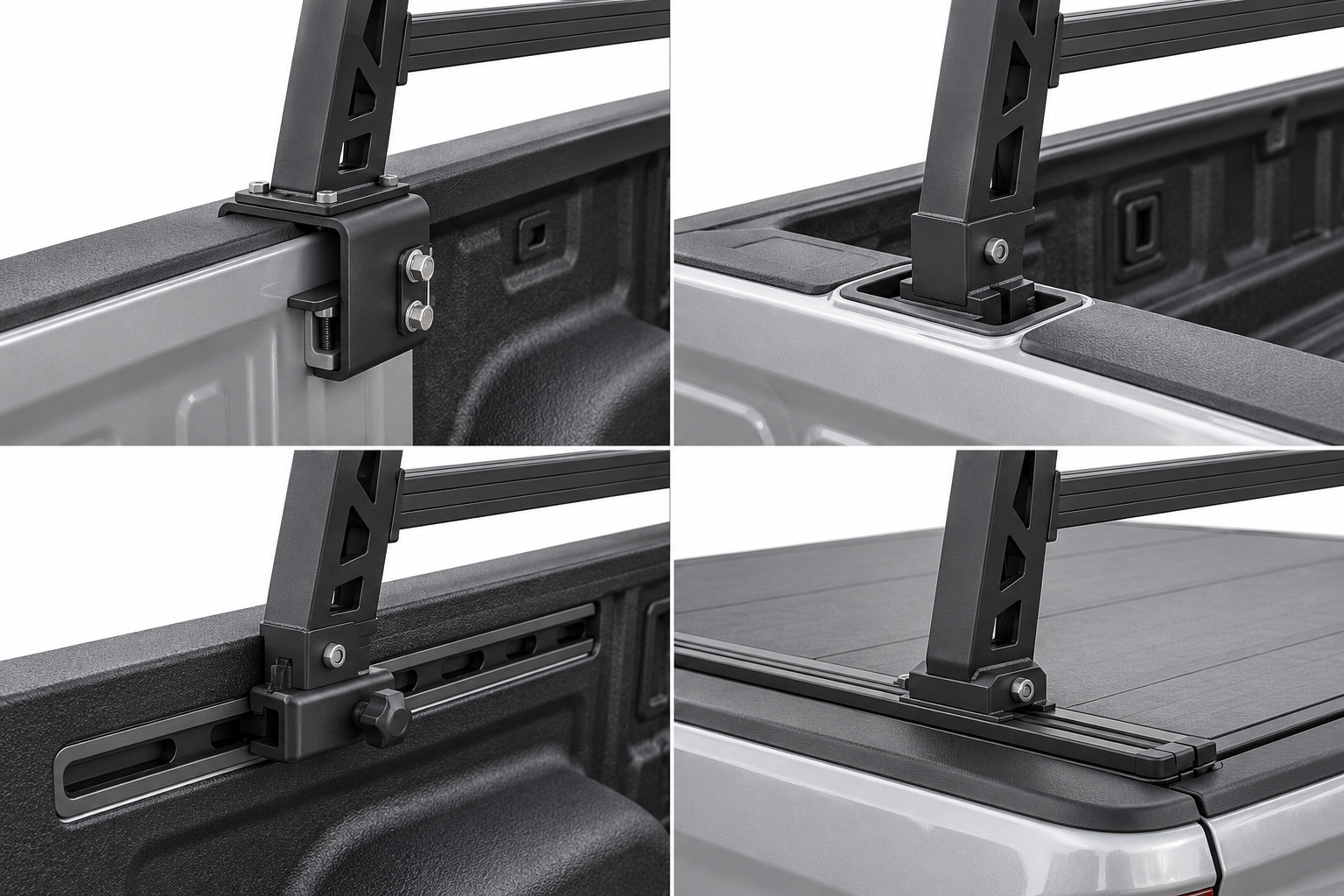
Record the market, model year, make, model, cab, bed length, trim or package, and installed bed accessories. Identify whether the rack clamps to an approved bed structure, mounts to factory utility tracks, uses stake pockets, or attaches to tracks built into a tonneau cover. A bed rack that fits without a cover may not leave enough room for a cover, and a cover-mounted rack must be approved for the exact cover interface.
| Attachment path | Fitment questions |
|---|---|
| Bed rail or stake pocket | Does the current rack guide list the exact bed and rail or pocket design? Is the attachment clear of the cover and bed accessories? |
| Factory bed track | Which track kit and fasteners match this vehicle generation? Are track spacing and allowable load documented? |
| Tonneau-cover track | Is the exact cover model named by the rack maker? Does the guide specify the fit kit, T-bolt or insert, uprights, and bar size? |
| Cap or topper roof | Is the rack supported by the cap rather than the bed or cab? Use the separate cap and topper fitting guide. |
Do not transfer a product fit from one bed length, cab, rail, or cover generation to another. A broad selector result or a product advertised for “most trucks” does not settle the exact installation.
Verify a tonneau and rack as one system
Check the cover manufacturer’s model and generation, not just the cover brand. Then use the rack maker’s current fit guide to match the cover and truck size to the required rack components. For example, Thule’s Xscape is designed for selected retractable covers with an aluminum frame and T-track. Thule’s current fit guide lists these cover models:
| Cover maker | Models named in the Xscape guide |
|---|---|
| Embark | Embark LS |
| LEER / Pace Edwards | UltraGroove, UltraGroove Metal, UltraGroove Electric |
| Retrax | RetraxONE XR, Retrax PRO XR, PowerTraxPRO XR, PowerTraxOne XR, Retrax EQ |
| Roll-N-Lock | A-Series XT, E-Series XT, M-Series XT |
The guide maps these covers to Xscape uprights 500051 and fit kit 500107. It changes the listed T-bolt by cover and groups load bars by truck size: 60 inches for mid-size trucks and 70 inches for full-size and heavy-duty trucks. Confirm the exact cover model, truck, bed, and current instructions before ordering. This list is specific to Xscape; it does not establish fit for another cover or for every truck using one of the named cover models.
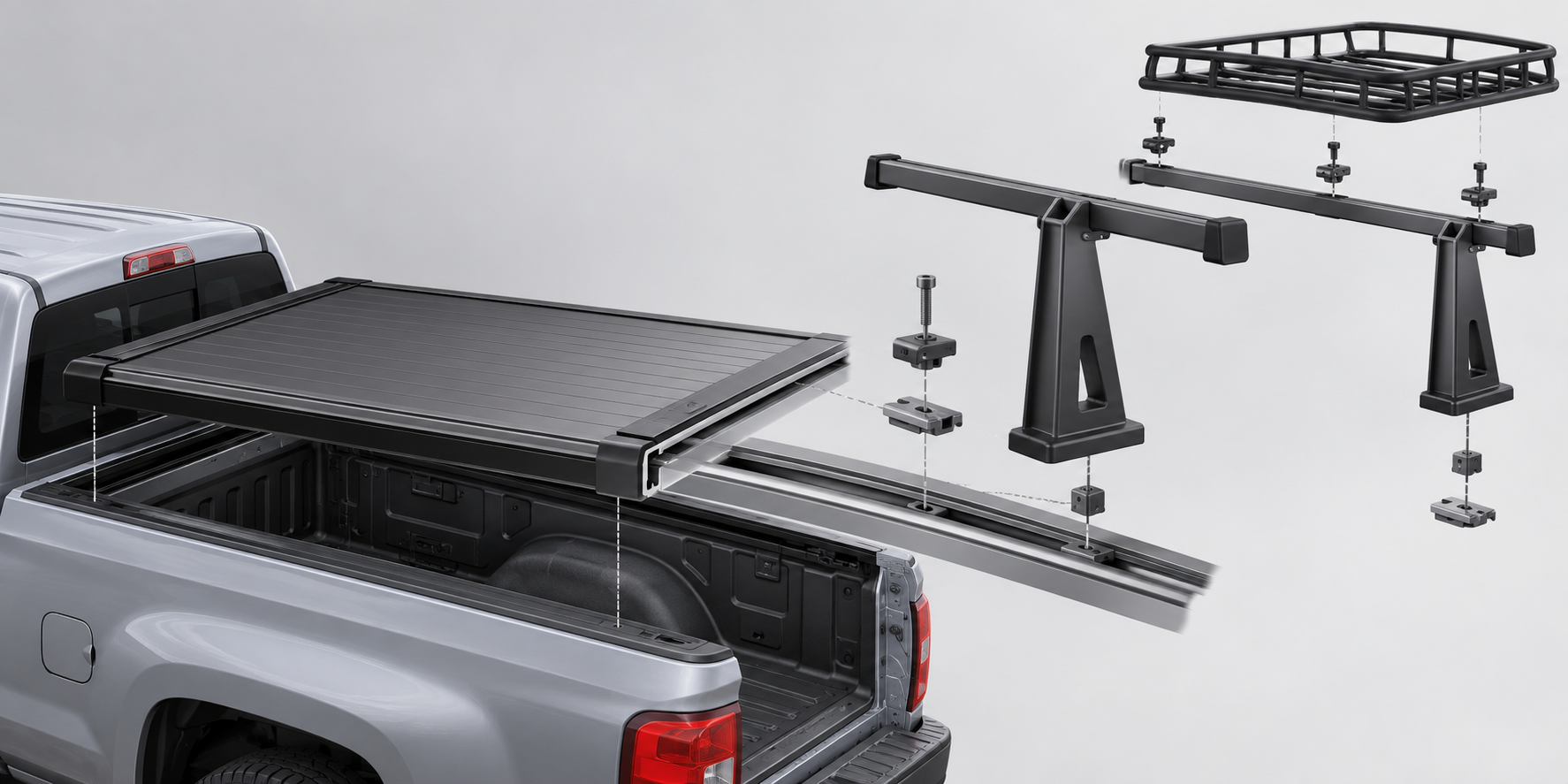
Another distinct path is Rhino-Rack’s Reconn-Deck system, which requires rails on the tub and starts with four towers before choosing bars or a platform. Its page instructs customers to subtract system weight from the selected system rating and to apply vehicle-manufacturer limits. The component and rating statements vary by configuration, so they must not be transferred to another truck or Reconn-Deck setup.
Other rack families have different branches. Yakima’s OverHaul HD page specifies a separate HD crossbar choice and directs tracked-bed and selected tonneau installations to dedicated kits. Yakima lists 500 lb on-road and 300 lb off-road product ratings for the system. Those are product ratings, not the truck’s bed, cover, or effective cargo limit. Check the exact installation instructions, bar spread, kit, and lower vehicle or cover limits before loading.
DiamondBack HD and SE covers have dedicated rack-system paths of their own. See Rack Systems for DiamondBack HD and SE Covers for the listed interfaces, installation boundary, and unresolved load labels. A named cover-and-rack combination still needs confirmation for the exact truck and cover generation.
Ford currently lists VentureTec rack SKU VML3Z9955100A for 2021–2027 F-150s with a 5.5-foot bed. The listing says it mounts at the stake pockets without drilling, approves it for the F-150 Lightning, and excludes the Raptor. Its 500 lb figure is tie-down strength, not the permitted cargo load or an effective vehicle/rack rating. Confirm the exact truck, bed, installed cover, current instructions, and the lower applicable system limits before treating the listing as a fit for your setup.
Rhino-Rack’s R5120 chart names a Ford Ranger Double Cab P703 with Ford internal side rails and excludes roller shutters. The PDF filename says RDB150, while its parts panel lists two RDB165 crossbars; printed metric and imperial load and installation-dimension pairs also conflict. Treat this chart as unresolved, not as a verified part or load result. Confirm the exact current SKU, dimensions, and instructions with Rhino-Rack for the truck and installed equipment before ordering or using that setup.
Check the load path and useful capacity
Compare the truck or bed limit with limits for the bed rail or track, cover, mounting kit, rack, accessory, and cargo. Use the lowest applicable figure. Read whether each source describes cargo weight, total system weight, a static figure, or a driving figure. Some instructions include the rack in the stated amount; others do not clearly say. Do not assume a product maximum is all available for cargo or subtract rack mass twice. If the documents leave the calculation unclear, ask the vehicle or product maker.
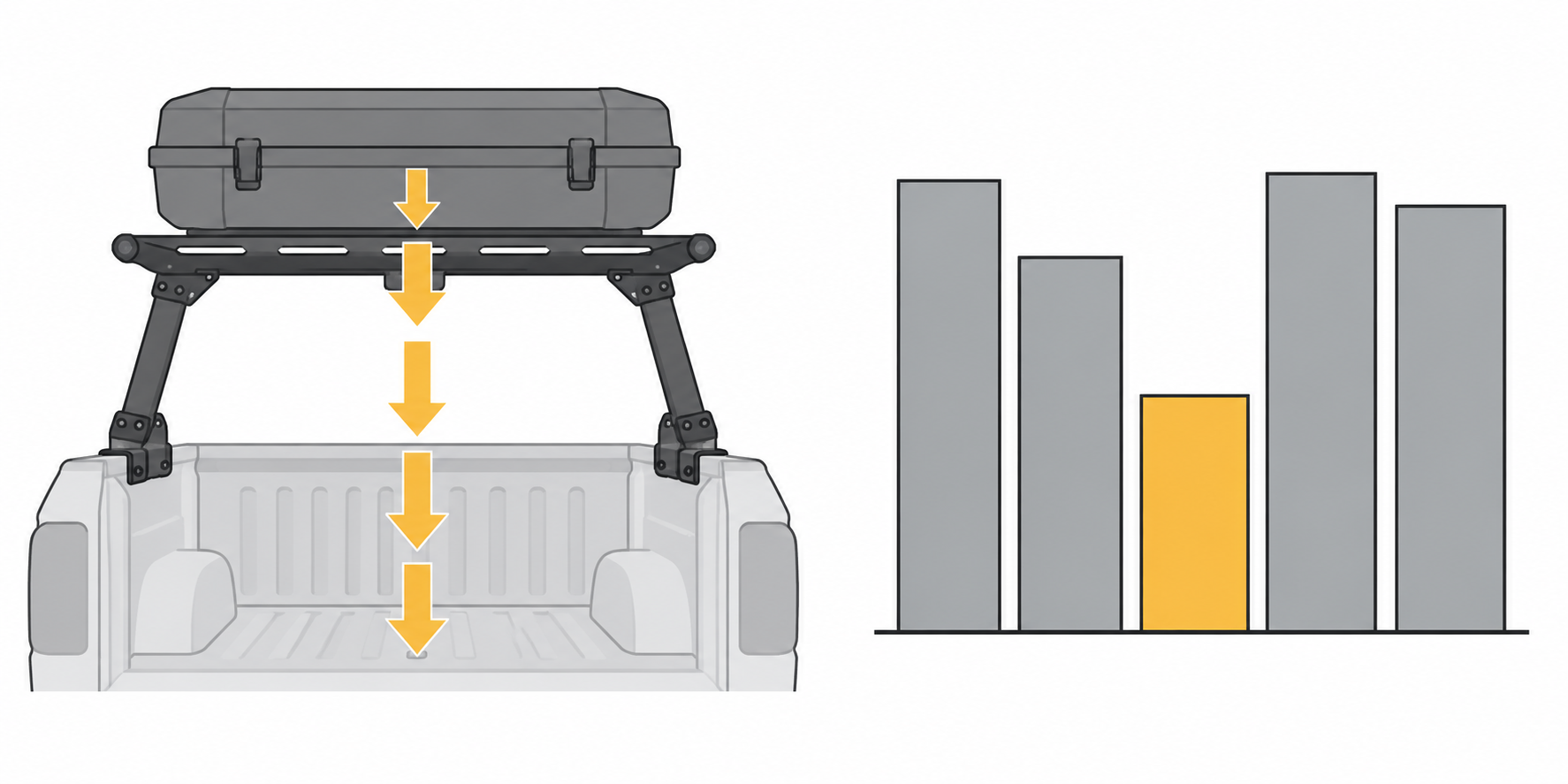
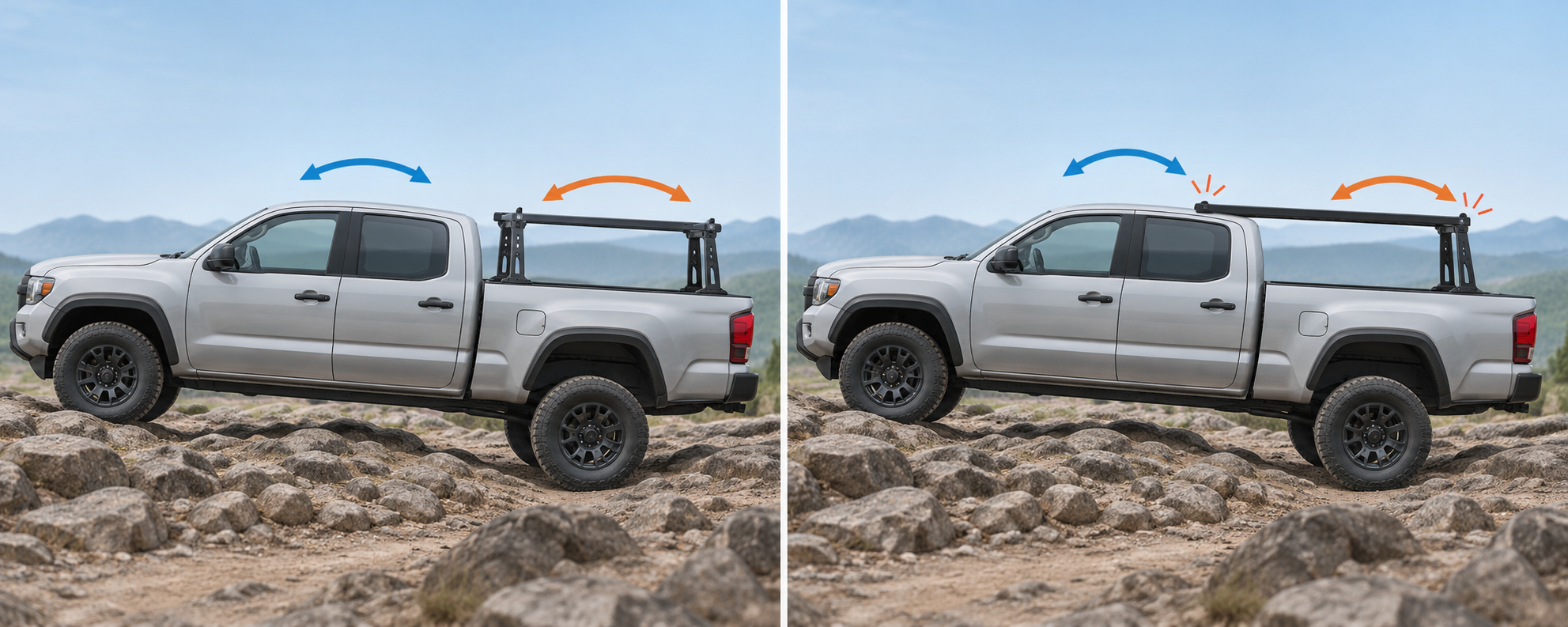
Check crossbar spread, rack height, cab clearance, tailgate or cover movement, and the load’s length and centre of mass. Follow any model-specific changes to a rating when the bar spread or operating surface changes. Keep on-road, off-road, and stationary ratings separate. A tie-down strength, fit-kit capacity, or track rating is not automatically a permitted cargo load for the complete vehicle.
Pickup bodies can also move at their joints. Rhino-Rack’s RTHB1 instructions for its named HiLux bed-rack system warn that the cabin and bed move independently and that a rigid load attached to both can damage the rack or vehicle. Treat that as a system-specific warning and follow the selected rack’s own instructions; do not improvise a rigid bridge between body sections.
Install and secure the documented setup
Use current instructions for the exact truck, bed, cover, and rack combination. Confirm whether installation uses clamps, bolts, track nuts, a cover-specific kit, drilling, or a professional fitter. Do not drill a bed, alter a cover, or substitute a similar-looking part without explicit manufacturer approval. Check the bed and cover for interference throughout their normal movement before carrying cargo.
Install and secure the accessory according to its own guide. Load stops and tie-down points help restrain cargo but do not increase the rack or vehicle limit. For a cap-supported setup, see How to Fit a Roof Rack to a Pickup Cap or Topper; to choose between pickup and other mount locations, see Start With the Mount.
Sources and product references
Use these references to check the current instructions and fit information for your market and exact setup.
- Rhino-Rack Truck Bed Solutionsprimary
- Rhino-Rack Reconn-Deck Truck-Bed Systemprimary
- Yakima OverHaul HDprimary
- Yakima OverHaul HD Installation Instructionsprimary
- Rhino-Rack RTHB1 Instructions for Toyota HiLux Gen 7/Gen 8 Dual Cabprimary
- Thule Xscape Tonneau-Cover Truck Rackprimary
- Thule Xscape Tonneau Fitment Guideprimary
- Ford F-150 VentureTec Rack for 5.5 ft Bedprimary
- Rhino-Rack R5120 Ford Ranger Double Cab P703 Fitting Chartprimary
- Front Runner × DiamondBack Rack Systemprimary